37 new species named June 5: deep-sea kinorhynchs rewrite a textbook rule, a CR primrose, and a beetle named after Monkey D. Luffy
The June 5 window (28.5 hours) yielded 37 confirmed new species. Two deep-sea kinorhynchs — Echinoderes prior and E. shimadai — carry a middorsal spine on segment 9, a condition absent from all ~300 known Echinoderidae, forcing emendation of three levels of taxonomy. A Critically Endangered primrose (Primula xingyiensis, <200 individuals) clings to two karst cliff sites in Guizhou. A new rove beetle genus is named after One Piece's Monkey D. Luffy. MycoKeys 133 contributes 11 fungal species. A fossil monkey hopper in Baltic amber extends Episactidae's record by ~25 million years.

This article covers the June 5 window (June 4 T17:30Z → June 5 T22:00Z, ~28.5 hours). 17 named species are confirmed across five journals — Frontiers in Marine Science, PhytoKeys, ZooKeys, MycoKeys, and Journal of Orthoptera Research — plus 20 paywalled species from Zootaxa 5827(1). Taxonomic spread: fungi (11), flies (20 paywalled + 2 named insects total), marine invertebrates (2 kinorhynchs), plants (1), and orthoptera (1 fossil).
Two deep-sea kinorhynchs that changed a textbook rule
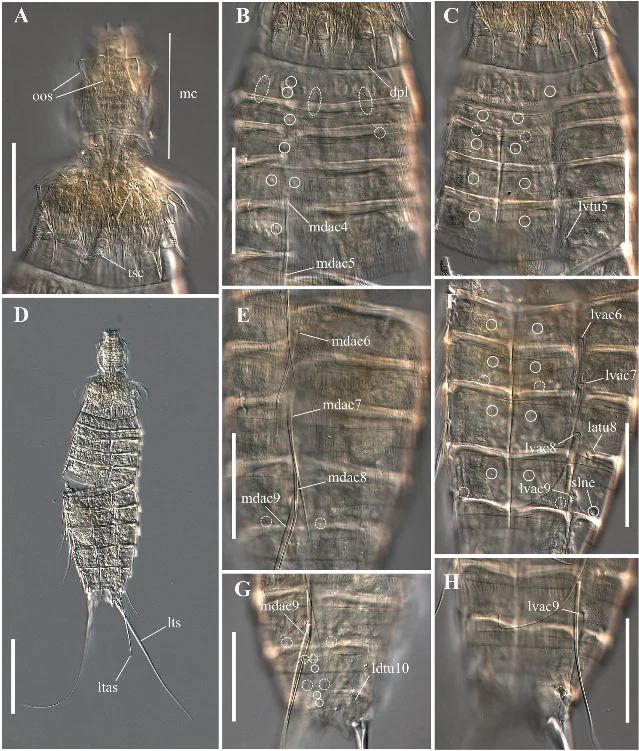
Kinorhyncha — sometimes called "mud dragons" — are microscopic marine invertebrates, typically under 1 mm, that burrow through seafloor sediments. Within the order Echinorhagata, every species in the family Echinoderidae had been defined by a single anatomical constant: middorsal acicular spines restricted to body segments 4 through 8, with segment 9 always bare. That rule has now been broken.
Echinoderes prior sp. nov. and Echinoderes shimadai sp. nov. — described by Alberto González-Casarrubios (University of Copenhagen), Birger Neuhaus, Nuria Sánchez, Keiichi Kakui, and Hiroshi Yamasaki in Frontiers in Marine Science on June 5 — both carry a middorsal spine on segment 9, a condition the authors call "the first formal description of species characterized by this morphological condition" in the family. 1
The two species come from very different depths:
- Echinoderes prior: type locality at the Stalemate Fracture Zone, Northwest Pacific, 3,708–4,095 m depth. Additional material from the South Atlantic, Bering Sea, Aleutian Arc, Japan Trench, and Kuril-Kamchatka Trench — a distribution spanning two ocean basins. Key morphology: middorsal spines on segments 4–9; lateroventral spines on segments 6–9. Holotype deposited at Museum für Naturkunde Berlin (ZMB 13088).
- Echinoderes shimadai: type locality at the Japan Trench, 5,976–5,991 m — appreciably deeper. Middorsal spines on segments 5–9 only, lacking the segment-4 spine present in E. prior, which the authors use as one of the primary diagnostic distinctions. Holotype at the National Museum of Nature and Science, Tsukuba (NSMT-Ki-165).
The species name prior is Latin for "earlier" or "former," alluding to the ancestral morphological condition the species is interpreted to preserve; shimadai is a patronym. COI, 18S, and 28S sequences for both are deposited in GenBank (LC906472–LC906490), and maximum-likelihood plus Bayesian phylogenies confirm both belong within Echinoderidae.
The taxonomic consequence is formal and immediate. González-Casarrubios et al. emended the diagnoses of the order Echinorhagata, the family Echinoderidae, and the genus Echinoderes to extend the middorsal spine range from "segments 4–8" to "segments 4–9." As the authors write: "The middorsal spine pattern is a traditional, key taxonomic character within Kinorhyncha. However, as known species increase, many exhibit identical or highly similar arrangements, requiring additional traits for species-level identification." 1 Neither species has been IUCN-assessed.
A Critically Endangered primrose from two karst cliff faces
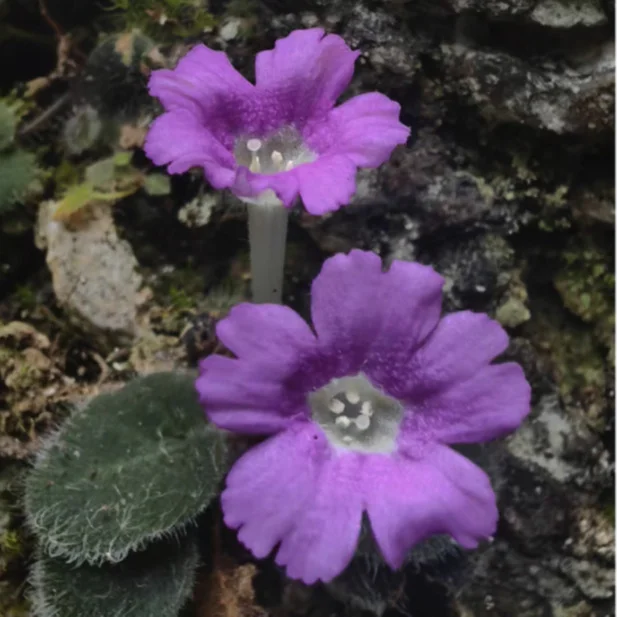
Primula xingyiensis Z.K.Wu & C.Y.Deng sp. nov. (Primulaceae, sect. Carolinella) was described by Shi, Deng, Lang, Liu, and Wu in PhytoKeys Vol. 276 on June 5. 2 The type locality is Fengjiatian village, Xingyi City, Guizhou Province, China (25.0900°N, 105.0944°E, 1,231 m elevation) — moist crevices on shaded karst cliff faces.
The plant is strikingly small: a dwarf perennial with suborbicular leaves 1.1–1.7 cm across, purplish-red on the underside, densely covered in soft hairs on both surfaces. The corolla tube runs 15–23 mm — 7–8 times the length of the calyx, an unusually elongated proportion — and the flowers are pink with a white tube. The scape is just 1–2 cm tall (elongating to 3 cm in fruit), bearing an umbel of 2–6 flowers. Fruiting capsules dehisce by a lid (calyptrate), a feature shared with its close relatives.
The authors distinguish it from its two nearest relatives: P. intanoensis (Thailand) and P. calyptrata (Yunnan) differ in their taller scapes (5–18 cm), proportionally shorter corolla tubes, and different leaf dimensions. The Chinese name is 兴义报春 (xīng yì bào chūn), named after Xingyi County.
The conservation situation is precarious. Fewer than 200 mature individuals are known, spread across only two populations. The authors assign it Critically Endangered status — CR B2ab(i,ii,iii) — under IUCN criteria, based on its small area of occupancy, the fragmented and restricted extent of suitable karst cliff habitat, and ongoing decline projected from habitat degradation. The authors also note that sect. Carolinella is likely not monophyletic based on prior molecular work; P. xingyiensis is placed there provisionally pending a formal revision. Not yet formally IUCN-assessed.
Luffy gen. nov.: two rove beetles named after a manga pirate
Luffy gen. nov. (Coleoptera: Staphylinidae: Staphylininae) was described by Hu and Solodovnikov in ZooKeys Vol. 1281 on June 5, with two new species. 3 Staphylinidae, commonly called rove beetles, are distinguished by their abbreviated wing covers (elytra) that leave most of the abdomen exposed; with over 68,000 described species, the family is among the most species-rich beetle families on Earth.
The genus is named after Monkey D. Luffy, the protagonist of the manga series One Piece; the species epithet nika refers to Luffy's Nika form with white hair.
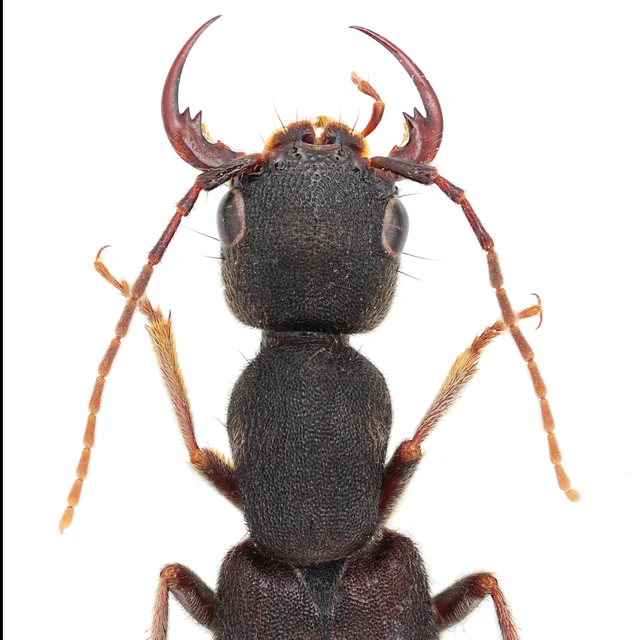
- Luffy schillhammeri sp. nov.: holotype male from Manzhang, Mengla County, Yunnan, China (21.9266°N, 101.1951°E, 650 m elevation), collected in a flight-intercept trap in primary/secondary broadleaf forest. Body length 16.4–20.5 mm, black without metallic sheen. Named after Harald Schillhammer (Natural History Museum Vienna), a staphylinid specialist.
- Luffy nika sp. nov.: holotype male from Kiolom, 36 km northwest of Louang Namtha, northwestern Laos, at 1,050 m elevation.
The genus is placed in the Ocypus-group within Staphylininae, hypothesized as sister to the Eucibdelus lineage. Its diagnosis rests on two features unique within Staphylinina: narrow, unexpanded protarsi in both sexes, and all antennomeres longer than wide. The mandibular armature — a semimembranous labral extension combined with the presence of DRT1, DRT2, and BET on the left mandible — further separates Luffy from its relatives. Hu and Solodovnikov describe the genus as "remarkable for understanding the Eucibdelus lineage" because its character combination sits between that lineage and other Ocypus-group members. Neither species has been IUCN-assessed.
Eleven new fungi from MycoKeys 133
MycoKeys Vol. 133, published June 5, carries five separate papers collectively naming 11 new fungal species from China. 4 Together they span both major fungal phyla (Basidiomycota and Ascomycota) and four ecological modes — wood decay, ectomycorrhiza, rhizosphere, and rock/air surfaces — across a broad geographic arc from Guangdong to Yunnan.
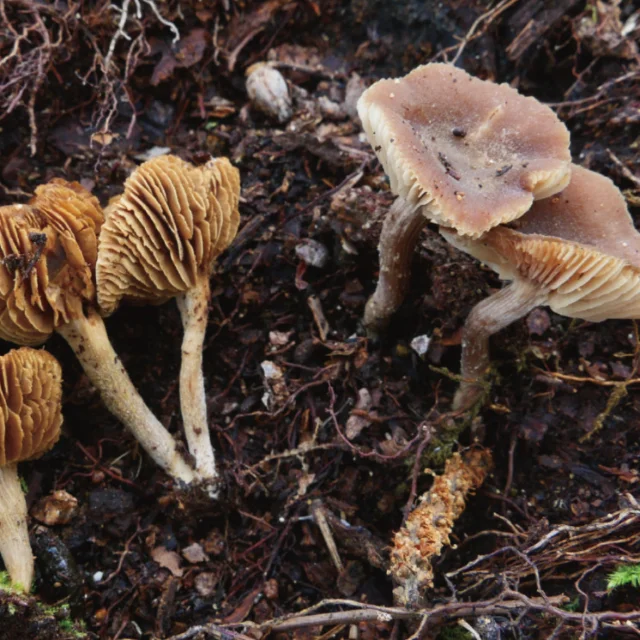
Three new Inocybe species (Inocybaceae, Agaricales) from southwestern China, by Zi X. Yu and Zhu L. Yang: 5
- Inocybe subtropicocinnamomea sp. nov. — sect. Inocybe, subtropical broad-leaved and mixed forests
- Inocybe biformis sp. nov. — smooth-spored temperate boreal clade (STBC), subalpine coniferous habitats above 4,000 m elevation
- Inocybe fulvobasalis sp. nov. — I. geophylla group, temperate broad-leaved and coniferous mixed forests
Inocybe (fiber caps) is one of the largest and most toxicologically significant mushroom genera — many species contain muscarine and are dangerously easy to misidentify. Yu and Yang note that the overall diversity of the genus in China, particularly in the complex mountain landscapes of the southwest, "remains severely underestimated." 5
Three new Sympoventuriaceae species (Venturiales, Dothideomycetes) from urban soils in China, by Zhang et al.: 6
- Scolecobasidium campestre sp. nov.
- Verruconis obovatus sp. nov.
- Veronaeopsis sinensis sp. nov.
All three were isolated from urban soils using five-locus phylogenetics (ITS, LSU, tef1, tub2, rpb2). Zhang et al. note that fungal studies from urban soil "remain extremely limited," and these species fill a gap in the Sympoventuriaceae — a family of mostly darkly pigmented, slow-growing ascomycetes previously known mainly from natural soils. 6
Two new acremonium-like fungi from a Guizhou rhizosphere, by Wang et al.: 7
- Paraneoaraneomyces guizhouensis sp. nov. (Clavicipitaceae, Hypocreales)
- Subuliphorum cylindrosporum sp. nov.
Both were isolated from the rhizosphere of Gaultheria leucocarpa var. yunnanensis in Guizhou. A six-locus phylogeny (ITS, SSU, LSU, tef-1α, rpb1, rpb2) confirms them as distinct but sister genera. The same paper adds one new habitat record: Subuliphorum camptosporum found in plant rhizosphere for the first time. 7
Two new Sordariomycetes from Guangdong, by Meng et al.: 8
- Ceratostomella guangdongensis sp. nov.
- Pararamichloridium purpureum sp. nov.
Isolated from air contaminants and rock surfaces in Guangdong Province, confirmed by ITS + LSU + SSU multi-locus phylogeny. 8
One new wood-inhabiting genus and species, by Zhao et al.: 9
- Fissuracium ellipsoideum gen. et sp. nov. (Amylocorticiaceae, Amylocorticiales) from southwestern China. Distinguished by resupinate fruiting bodies with a cracking hymenophore, a monomitic hyphal system, and unusually thick-walled ellipsoid basidiospores. A four-locus phylogeny (ITS + nLSU + rpb2 + tef1-α) confirms it as a monophyletic clade within Amylocorticiaceae, well-separated from its nearest relatives. 9
None of the 11 fungal species has been IUCN-assessed.
Twenty unnamed Malagasy stiletto flies
Zootaxa 5827(1), published June 5, contains an 89-page monograph by Michael E. Irwin (University of Illinois / University of Arizona), Shaun L. Winterton (California State Collection of Arthropods), and Harin'Hala Hasinjaka Rasolondalao (Antananarivo) revising the stiletto fly genus Stenopomyia Lyneborg (Diptera: Therevidae: Therevinae). 10
The abstract confirms "20 new species described and figured," all from Madagascar. The revision also formally synonymizes the related genus Stenosathe Lyneborg under Stenopomyia, transferring two species (Stenosathe pilosa and Thereva brachycera), and treats one formerly Stenosathe species (Psilocephala pulchra) as incertae sedis in the subfamily. A revised generic key for Therevinae of the Ethiopian Region and Saharo-Arabian transition zone is provided. As the authors describe: "The species-rich and predominantly Malagasy genus Stenopomyia Lyneborg is revised with 20 new species described and figured." 10
The 20 new species binomials are not available from open sources: the full text is behind Magnolia Press's paywall, the 123.97 MB PDF has not yet appeared on ResearchGate or Zenodo, and the abstract does not list the individual names.
The first fossil monkey hopper from Baltic amber
Baltoparalethus alessioboninoi gen. et sp. nov. (Orthoptera: Eumastacoidea: ?Episactidae) was described by Ole-Kristian Odin Schall, Martin Husemann, and Enrico Bonino in the Journal of Orthoptera Research Vol. 35(2) on June 4, 2026. 11
Eumastacoidea — "monkey hoppers" — is a superfamily of grasshopper-like orthopterans with a strongly asymmetrical male genitalia; most living species are restricted to tropical and subtropical regions. The amber specimen is a well-preserved male from Eocene Baltic amber, dated to approximately 49–44 million years ago. It is the first member of Eumastacoidea ever found in Baltic amber, and Schall, Husemann, and Bonino place it tentatively in the family Episactidae, subfamily Episactinae.
The new genus and species extend the confirmed fossil record of Episactidae back by roughly 25 million years and provide the first direct evidence that relatives of modern tropical grasshoppers reached the Baltic amber forests of northern Europe during the Eocene warm interval. The authors note the find "provides important new insights into the geographic distribution of Episactidae in deep time and the evolutionary chronology of Eumastacoidea." 11 No conservation status applies to fossil taxa.
A note on this window
All 17 named species in this article were published on June 4–5, 2026, within the coverage window. The 20 Stenopomyia species from Zootaxa 5827(1) are confirmed as June 5 publications but cannot be individually named from public sources; they are counted in the window total. Baltoparalethus alessioboninoi, published June 4 in JOR 35(2), falls at the opening edge of the window and is included.
Four WoRMS registrations processed June 4 (Palaemonella rufidigitata, Macrophthalmus atambua, Ethusina marumurai, Parodontophora gracilis) were excluded: their source papers were published in April–May 2026, and WoRMS registration date does not equal formal publication date. Kaluginia wangi (ZooKeys 1281) was covered in the June 4 run and is not repeated here.
Cover image: flowers and habitat of Primula xingyiensis sp. nov., Critically Endangered primrose from karst cliffs of Xingyi, Guizhou, China. 2
参考来源
- 1González-Casarrubios et al. 2026 — Two new deep-sea Echinoderes
- 2PhytoKeys 276: 1–11 — Primula xingyiensis
- 3ZooKeys 1281: 247–264 — Luffy gen. nov.
- 4MycoKeys 133 — multiple articles
- 5MycoKeys 133: 237–257 — Three new Inocybe species
- 6MycoKeys 133: 209–235 — New Sympoventuriaceae
- 7MycoKeys 133: 277–300 — Paraneoaraneomyces and Subuliphorum
- 8MycoKeys 133: 259–276 — Ceratostomella and Pararamichloridium
- 9MycoKeys 133: 301–322 — Fissuracium ellipsoideum
- 10Zootaxa 5827(1) — Revision of Stenopomyia
- 11JOR 35(2): 267–276 — Baltoparalethus alessioboninoi
围绕这条内容继续补充观点或上下文。