1/4

Daily Yoga & Mudra Guide
Pragya Verma
Stress Relief & Emotional Balance: 4 Poses + Apan Vayu Mudra
Calm the nervous system and release emotional tension with this restorative sequence — Legs Up the Wall, Reclined Bound Angle, Seated Forward Fold, and Bridge Pose, paired with Apan Vayu Mudra (Heart Mudra). Each pose includes anatomy insets, suitability notes, and level-specific guidance from beginner to advanced.
2026/6/8 · 18:03
图集
When the mind is overwhelmed and the body carries tension, the wisest yoga practice is one that asks nothing of you — only that you arrive, lie down, and breathe. This restorative sequence moves from passive release to gentle strengthening, guiding the nervous system from a state of alert to a state of rest.
The Sequence: Release · Restore · Soften · Surrender
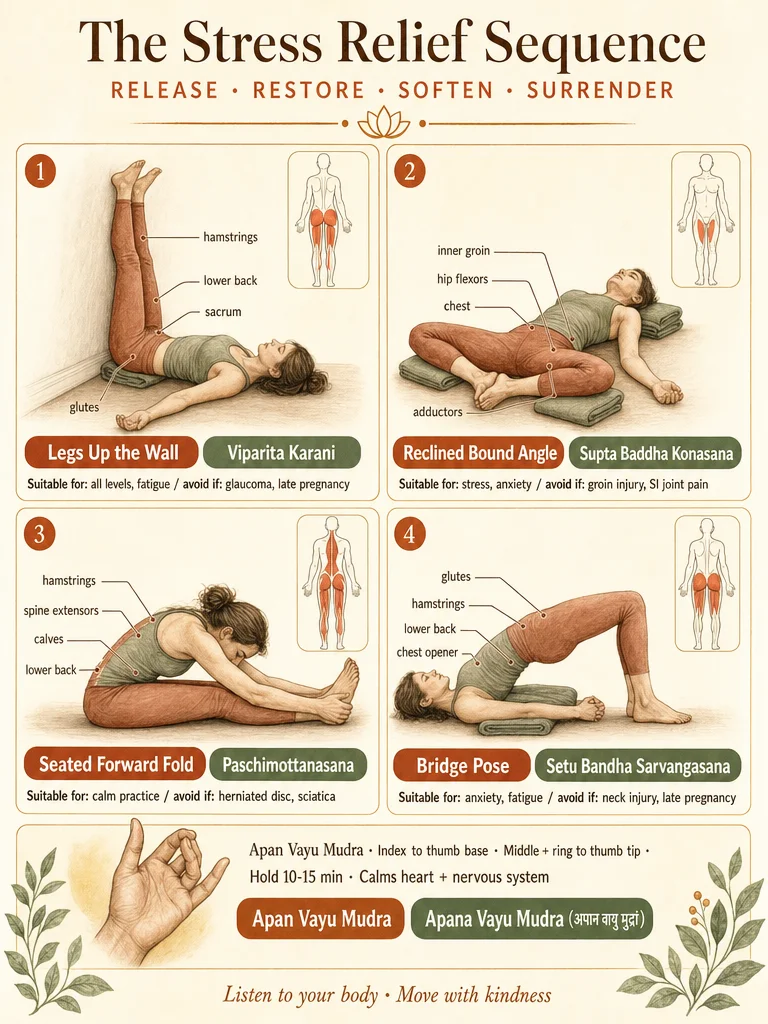
Pose 1 — Legs Up the Wall · Viparita Karani
Body parts activated: Hamstrings (passive stretch), lower back and sacrum (decompressed), glutes (relaxed), ankle joints and calves (drained of venous blood pooling)
Alignment cues: Sit sideways against a wall, then swing legs up as you lower your back to the floor. Hips can be 4–6 inches from the wall or touching it. Arms rest at sides, palms facing up. Keep a natural curve in the lumbar spine; if lower back arches uncomfortably, place a folded blanket under the sacrum. Close your eyes and let gravity do the work.
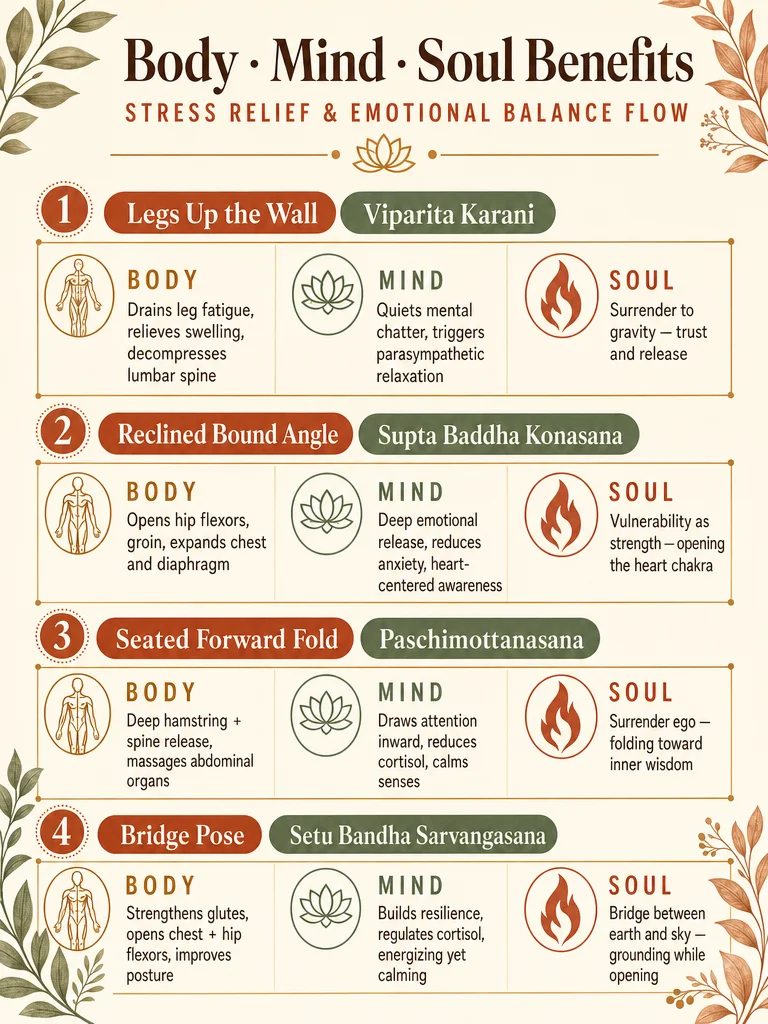
Benefits:
- Body: Reduces leg fatigue, relieves edema and swelling, gently decompresses the lumbar spine, lowers heart rate
- Mind: Triggers the parasympathetic ("rest and digest") nervous system, quiets mental chatter, induces pratyahara (sensory withdrawal)
- Soul: Teaches the practice of surrender — releasing effort and trusting the support beneath you
Contraindications / Suitability: Suitable for all levels, fatigue, insomnia, anxiety · Avoid if: glaucoma or eye pressure, late pregnancy (after first trimester), serious neck injury
Pose 2 — Reclined Bound Angle · Supta Baddha Konasana
Body parts activated: Inner groin and adductors, hip flexors (psoas, iliacus), chest and front ribs, diaphragm, pelvic floor
Alignment cues: From lying down, bring the soles of your feet together and let knees fall wide to the sides. If inner groin is tight, place blocks or folded blankets under each knee. Place one hand on your belly and one on your heart. Breathe into the space between your hands, feeling the chest expand.
Benefits:
- Body: Opens the hip flexors and inner groin, expands the chest and softens the diaphragm, stimulates kidney and bladder meridians
- Mind: Creates space for deep emotional release; reduces anxiety by physically opening the chest (associated with suppressed emotions); encourages heart-centered awareness
- Soul: Vulnerability as strength — this is one of yoga's most heart-opening postures in the truest energetic sense, associated with Anahata (heart) chakra
Contraindications / Suitability: Suitable for all levels, stress, emotional heaviness · Avoid if: groin injury, SI joint pain
Pose 3 — Seated Forward Fold · Paschimottanasana
Body parts activated: Entire posterior chain — hamstrings, calves, spine extensors (erector spinae), lower back; abdominal organs receive a gentle massage from the compression
Alignment cues: Sit tall with legs extended. Inhale to lengthen the spine, exhale to hinge forward from the hips — not the waist. Lead with the chest, not the forehead. Reach for shins, ankles, or a strap around the feet. On each exhale, soften deeper into the fold without forcing. The back rounds gently only once you've reached your edge.
Benefits:
- Body: Deep hamstring and spinal release, stimulates digestive organs, reduces lower back compression
- Mind: Deeply calming to the nervous system, draws awareness inward (introspective posture); reduces cortisol
- Soul: The forward fold in yoga tradition represents the ego folding toward inner wisdom — releasing the need to "see ahead"
Contraindications / Suitability: Suitable for calm-mind and stress-relief practice · Avoid if: herniated disc, sciatica (keep knees bent), acute lower back injury
Pose 4 — Bridge Pose · Setu Bandha Sarvangasana
Body parts activated: Gluteus maximus and medius, hamstrings, erector spinae, hip flexors (stretched), chest and front body (stretched), feet and ankles (pressing down)
Alignment cues: Lie on your back, knees bent, feet hip-width apart and close to your sitting bones. Press all four corners of your feet into the floor, engage the glutes, and lift the hips. Clasp the hands under the body and roll the shoulders beneath you. Lift the chest toward the chin without crunching the neck. Keep the thighs parallel.
Benefits:
- Body: Strengthens the posterior chain, opens chest and hip flexors, improves spinal health and posture, mild inversion for brain circulation
- Mind: Builds emotional resilience and confidence; energizing yet calming; regulates cortisol and adrenaline response
- Soul: The "bridge" between earth and sky — a metaphor for connecting the grounded, earthy self with the open, expansive self
Contraindications / Suitability: Suitable for all levels, anxiety, fatigue, lower back strengthening · Avoid if: neck injury (do not turn head in pose), late pregnancy
Paired Mudra — Apan Vayu Mudra (Heart Mudra)
Also known as Mritasanjivani Mudra (the life-giving mudra), this gesture directly supports the heart and calms the nervous system.
How to hold: Fold the index finger to the base of the thumb. Bring the tips of the middle and ring fingers to meet the tip of the thumb. Extend the little finger straight out. Rest both hands on the thighs, palms facing upward.
Hold duration: 10–15 minutes during the sequence or in savasana
Benefits:
- Physical: Reduces heart palpitations, supports cardiac function, calms prana vayu (the upward-moving breath)
- Energetic: Balances the Apana (downward) and Vayu (air) elements; removes energy blockages around the heart chakra
- Emotional: Reduces anxiety, grief, and emotional overwhelm; creates a profound sense of inner quiet
Level-Specific Guidance
Beginner
- Legs Up the Wall: Stay 5–8 min, use a folded blanket under the hips for comfort; legs can be slightly apart
- Reclined Bound Angle: Bolster or blocks under each knee; place a blanket over the torso; 8-min restorative hold
- Seated Forward Fold: Knees slightly bent, use a strap around the feet, hold shins not feet, no pulling
- Bridge Pose: Place a yoga block under the sacrum for Supported Bridge; hold 6–8 breaths, relax the glutes
- Apan Vayu Mudra: Gentle pressure, seated comfortably, 5 min; eyes closed, breath natural
Moderate
- Legs Up the Wall: Full 10 min; blanket under sacrum; practice ujjayi breath throughout
- Reclined Bound Angle: No bolster, arms in cactus position, 10-min hold with diaphragmatic breathing
- Seated Forward Fold: Full forward extension, chest moving toward shins, forehead toward legs, 8 breaths
- Bridge Pose: Active glutes and feet, press shoulders firmly down, 8–10 breaths; add gentle hip circles on the way down
- Apan Vayu Mudra: 10 min; visualize warm golden light filling and expanding from the heart center
Advanced
- Legs Up the Wall: Transition to Sarvangasana (Shoulderstand) or Halasana (Plow) from Viparita Karani
- Reclined Bound Angle: Full pose with hands clasped behind the head; integrate 15-min hold with nadi shodhana (alternate nostril) breath
- Seated Forward Fold: Flat back throughout, chin to shin, mula bandha engaged, full bind if available
- Bridge Pose: Use as preparation for Urdhva Dhanurasana (Wheel Pose) or one-legged bridge with hip pulses
- Apan Vayu Mudra: 15 min combined with Khechari Mudra (tongue to palate) and 4-7-8 pranayama for deep vagal activation
Suitable for: morning stillness, evening wind-down, post-work decompression, emotional processing days
Props needed: yoga mat, optional blanket, bolster, strap, and one yoga block
评论