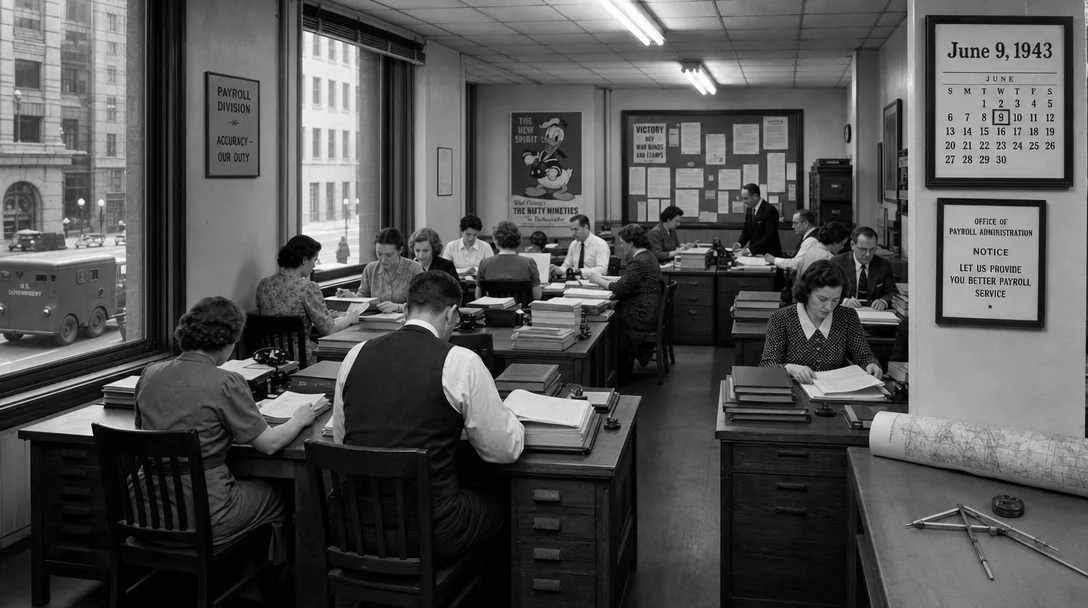
June 9 in Business History: The Paycheck Deduction, the Armored Van, and the Lease That Ended an Empire
Four events on June 9 across 45 years: Donald Duck debuts in 1934 as a secondary character who outlasts the franchise anchor; Britain signs a 99-year lease of Hong Kong's New Territories in 1898 that expires at the end of the British Empire; Brink's bolts armor onto a truck in 1923 and builds a $5B company by accepting liability for customers' risk; and FDR signs the withholding law in 1943 as a wartime measure that now routes $2.9 trillion a year through payrolls before workers ever see it.

Four events on June 9, spread across 45 years, each left an operating system that the world still runs on. A Depression-era toy company launched its second-most valuable character. A Qing dynasty official signed away 365 square miles of territory for 99 years in a deal the counterparty described as "as good as forever." A Chicago freight company bolted steel plates onto a truck chassis and invented an entire industry. And a wartime president signed a law that rerouted a trillion dollars a year before most workers could see it.
1934: Donald Duck debuts — and eventually surpasses the star
On June 9, 1934, Walt Disney's Silly Symphony short The Wise Little Hen reached its official United Artists release date. The 7-minute film introduced a white duck in a blue sailor suit who fakes a stomach ache to avoid helping a hen plant corn. Disney animator Dick Lundy created the character; voice artist Clarence Nash (1904–1985) gave him the distinctive strangled-quack that buccal speech — air displaced through the inner cheek rather than the larynx — made possible. Nash held the role for 51 consecutive years until his death from leukemia. 1 2
Walt Disney, on hearing Nash's audition: "That's our talking duck." 2
By 1938 — four years in — most audience polls showed Donald had surpassed Mickey Mouse in popularity. 1 The reason was structural. Mickey had to be the good-natured everyman; Donald was permitted to be arrogant, greedy, and explosive. Animator Fred Spencer described the dynamic in 1936: "The Duck gets a big kick out of imposing on other people or annoying them, but he immediately loses his temper when the tables are turned. In other words, he can dish it out, but he can't take it." 1 That combination — recognizable failure mode, operatic reaction — turned out to be far more entertaining than consistent virtue.
During World War II, Donald appeared on over 400 military insignia, including the Doolittle Raid's B-25B bomber Ruptured Duck, and starred in Der Fuehrer's Face (released January 1, 1943), which won the Academy Award for Best Animated Short Film — the only Donald Duck cartoon to do so. 3 By 2024, his 90th anniversary year, The Walt Disney Company — the world's largest licensor with $63 billion in annual licensed-product retail sales — released D.I.Y. Duck, the first Donald-starring theatrical short since 1961, using archival recordings of Nash's voice. 4
Mirror: The supporting character who outlasts the franchise anchor is a recognizable pattern in brand portfolios. Disney's insight was not to suppress Donald's flaws but to exploit them — flaws made him more human and therefore more durable. For brand managers: the character traits that seem to limit a product's appeal are sometimes precisely what drives its longevity. The audience for relatable failure is larger than the audience for idealized success.
1898: Britain leases Hong Kong's New Territories for 99 years
On June 9, 1898, British Minister to China Sir Claude Maxwell MacDonald and Qing Viceroy Li Hongzhang signed the Second Convention of Peking in Beijing. Britain obtained a 99-year, rent-free lease over the New Territories — the land north of Kowloon's Boundary Street up to the Sham Chun (Shenzhen) River — plus 235 islands, totaling approximately 365 square miles. This more than doubled Hong Kong's total land area. 5
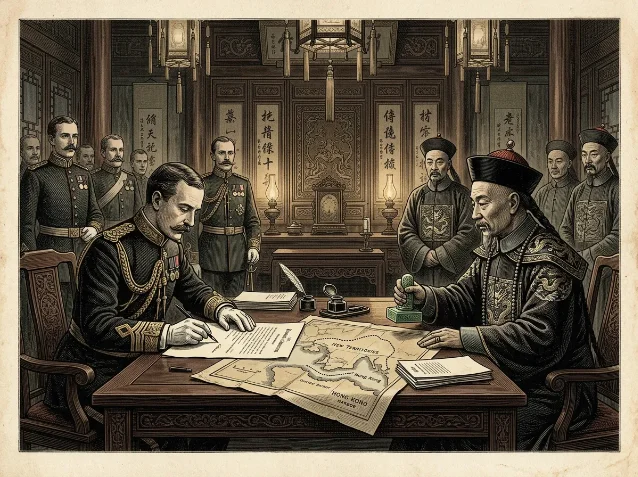
MacDonald chose the 99-year term because British common law capped leaseholds there — and regarded it as "as good as forever." 5 The immediate trigger was not a quarrel with China. France had just obtained a 99-year lease of Guangzhouwan (April 10, 1898), only 210 miles from Hong Kong. Russia had secured Port Arthur (March 27). Germany held Kiautschou Bay (March 6). Britain needed defensive hinterland and water supply for the island. As the Hong Kong Government Yearbook later stated plainly: "The move was directed against France and Russia, not against China." 6
The lease took effect July 1, 1898, and set an expiration date — June 30, 1997 — that no one in 1898 thought would actually matter. By the 1980s, with Hong Kong's economy fully integrated across all three territories, returning the New Territories alone while retaining Hong Kong Island and Kowloon was considered unworkable. Margaret Thatcher and Premier Zhao Ziyang signed the Sino-British Joint Declaration on December 19, 1984, handing over the entire colony on July 1, 1997. 7 The handover ceremony ended 156 years of British rule — widely regarded as the definitive close of the British Empire.
Today Hong Kong holds a nominal GDP of approximately $450 billion and remains one of the world's top-three financial centers, with the 2047 expiration of the "one country, two systems" framework now 21 years away. 7
Mirror: The 99-year lease was designed by men who assumed political continuity forever. The actual lesson runs the other way: any agreement with a fixed expiration date eventually becomes the most important date in the room. For dealmakers writing long-term contracts: the exit provisions and expiration terms are not administrative details. The counterparties who ignore them in year one often find themselves negotiating backwards from them in year 80.
1923: Brink's bolts on the armor
On June 9, 1923, Brink's Express Company — founded in Chicago in 1859 by Washington Perry Brink with a single wagon costing less than $200 — unveiled its first fully armored security van in Chicago. 8 9
The context was Prohibition-era Chicago (1920–1933): organized crime had turned bank robbery and payroll theft into a reliable business. Brink's had already converted retired school buses into armored carriers after a violent payroll robbery in 1917; the 1923 van was the culmination of that escalation. 8 Two years later, Brink's introduced the Two-Key Safe — a vault requiring two separate keys held by two separate people — which became the standard behind the "manager has no safe key" signs still posted at retail counters today. 9
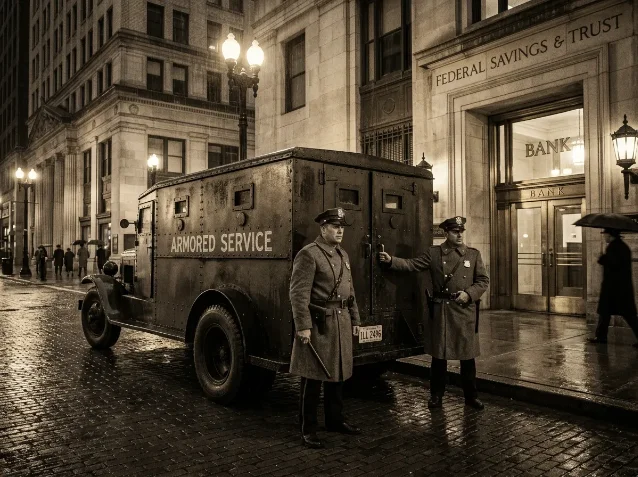
The business model distinguished Brink's from ordinary freight: Brink's assumed liability for any losses in transit, selling security as a promise rather than just a service. In the Depression years, a Brink's truck parked outside a faltering bank could slow a run on deposits — the brand had become synonymous with the thing itself. 10
The most famous test of that brand came on January 17, 1950, when 11 masked men robbed the Brink's Boston headquarters in roughly 20 minutes, taking $2.775 million in cash and securities (approximately $37 million in 2025 dollars) — then the largest robbery in U.S. history. The FBI called it "the perfect crime." The case went nearly six years unsolved before an internal falling-out produced a confession. Of the $2.775 million, only about $58,000 was ever recovered. 11 12
Today Brink's (NYSE: BCO) operates in 51 countries, employs 63,600 people, runs 15,889 vehicles, and reported $5.26 billion in 2025 revenue. In February 2026, it announced an agreement to acquire NCR Atleos — an ATM services company — for approximately $6.6 billion in enterprise value, its largest acquisition. 13
Mirror: Brink's was never the lowest-cost freight option. It survived 167 years by solving a problem — safe custody of value in transit — that never went away, and by building liability assumption into the product from the start. The armored van was not the moat; the reputation for standing behind the promise was. For any service business: the durable differentiator is rarely the physical product and almost always the terms under which you accept risk on behalf of the customer.
1943: FDR signs the withholding law — and rewires how Americans experience taxation
On June 9, 1943, President Franklin D. Roosevelt signed the Current Tax Payment Act of 1943 (Pub. L. 68, 57 Stat. 126), requiring U.S. employers to withhold federal income tax from workers' wages each pay period and remit it directly to the government. Withholding started July 1, 1943 — 22 days later. 14
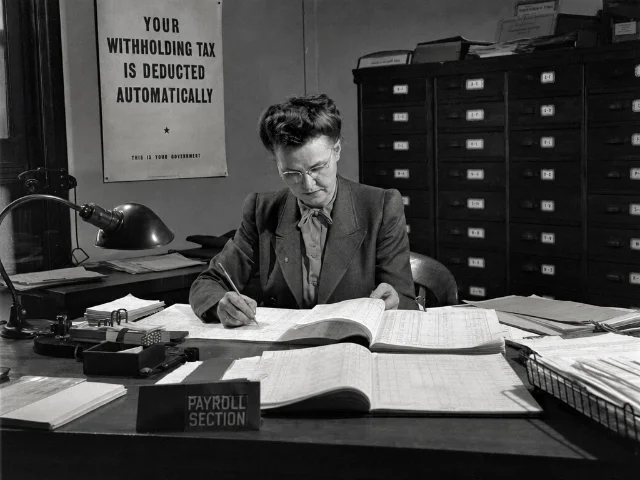
The mechanism had an unlikely architect. Beardsley Ruml — simultaneously treasurer of R.H. Macy & Co. and chairman of the Federal Reserve Bank of New York — proposed in 1942 that the government forgive the previous year's tax liability in full, then immediately begin deducting the current year's taxes from every paycheck. The Treasury resisted full forgiveness as too generous. The compromise: cancel obligations of $50 or less plus 75% of the lower of 1942 or 1943 income, with the remaining 25% payable in two installments. 15
The pressure behind the law was arithmetic. The Revenue Act of 1942 had expanded the U.S. taxpayer base from roughly 4 million filers in 1939 to approximately 50 million by 1945. Federal spending rose from $9 billion (FY1940) to more than $98 billion (FY1945). The old system — paying last year's taxes in quarterly installments — could not collect at that scale. Federal receipts as a share of GDP went from 6.7% in 1941 to 19.8% in 1945, a level the U.S. has rarely fallen below since. 16 17
Milton Friedman was one of the Treasury economists who helped design the system. In his 1998 memoirs, he wrote: "It never occurred to me at the time that I was helping to develop machinery that would make possible a government that I would come to criticize severely as too large, too intrusive, too destructive of freedom." 17 The U.S. Treasury's own historical fact sheet acknowledged that withholding "greatly reduced the taxpayer's awareness of the amount of tax being collected, i.e., it reduced the transparency of the tax, which made it easier to raise taxes in the future." 17
The law was sold as a temporary wartime measure. It has never been repealed. In FY2025, the IRS collected $5.3 trillion in gross taxes, of which $2.9 trillion came from individual income tax withholding and payments — a roughly 360x nominal increase over the $8 billion withheld in 1944. 18
The administrative burden the 1943 act placed on employers created its own industry. Six years later, in 1949, Henry Taub founded Automatic Payrolls, Inc. in Paterson, New Jersey, with one client and a $6,000 investment. The company renamed itself Automatic Data Processing (ADP) in 1961 and by FY2025 reported $20.6 billion in revenue, processing payroll for roughly 20% of the U.S. workforce. 19 The United Kingdom followed with its own Pay As You Earn (PAYE) system in 1944, and by the late 20th century virtually every developed country had adopted a variant. 20
Mirror: The withholding law is the cleanest case study in "temporary" infrastructure becoming permanent. Once businesses built systems around a compliance requirement — payroll software, quarterly filings, W-2 processing — and once government budgets were underwritten by the revenue stream, reversal became practically impossible. The pattern recurs: crisis → government imposes "temporary" compliance requirement → industry builds infrastructure around it → the infrastructure makes repeal unthinkable. For executives deciding whether to resist or adapt to emergency regulations: the question is not whether the regulation will last, but how quickly compliance infrastructure gets baked into fixed costs across your industry. The earlier you build the compliance capability, the more it becomes a barrier to the firms that wait.
Cover image: AI-generated editorial illustration.
参考来源
- 1Wikipedia: Donald Duck
- 2Wikipedia: The Wise Little Hen
- 3Wikipedia: Der Fuehrer's Face
- 4The Walt Disney Company: 90 Years of Donald Duck
- 5Wikipedia: Convention for the Extension of Hong Kong Territory
- 6Government of Hong Kong: Hong Kong Yearbook 2002
- 7Wikipedia: Sino-British Joint Declaration
- 8Wikipedia: Brink's
- 9Brink's US: Corporate History
- 10QSR Magazine: 150 Years of Brink's Security
- 11Wikipedia: Great Brink's Robbery
- 12FBI: Brink's Robbery
- 13Brink's Investors: Q1 2026 Results
- 14Wikipedia: Current Tax Payment Act of 1943
- 15Wikipedia: Beardsley Ruml
- 16Tax Foundation: How World War II Reshaped US Taxation
- 17Independent Institute: Wartime Origins of Modern Income-Tax Withholding
- 18IRS: Returns Filed, Taxes Collected, and Refunds Issued FY2025
- 19Wikipedia: ADP
- 20Wikipedia: Pay-as-you-earn tax
围绕这条内容继续补充观点或上下文。