AI tools weekly: infrastructure week (May 20–27)
This week's best 22 AI tools and repos from Product Hunt, GitHub Trending, and X, clustered into 6 themes: the MCP/context infrastructure surge, coding agent benchmarks, Google's coordinated 4-tool push, agent platforms for teams, two open models worth tracking, and 7 quick picks across voice, video, and productivity.

Forty-nine AI tools and repos surfaced across Product Hunt, GitHub Trending, and X this week. That's not the story. The story is what five of them have in common: they all attack the same problem — every time you open a new AI tool, you have to re-explain yourself from scratch. This week, the plumbing to fix that arrived. Code knowledge graphs, MCP context layers, persistent agent memory, and on-chain agent wallets all shipped in the same seven-day window. Below is the week's best, organized by what actually connects.
The infrastructure layer hardened this week
Unabyss — one MCP link, every AI tool
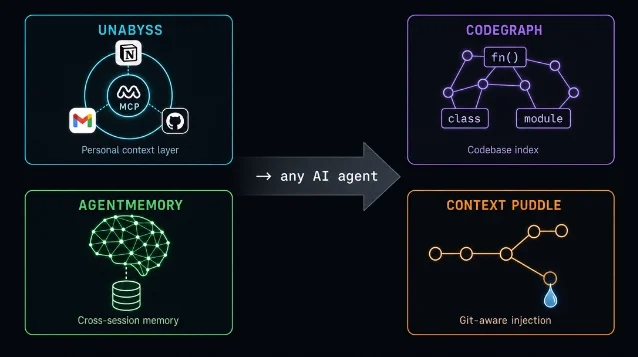
Connect Notion, Gmail, GitHub, LinkedIn, Slack, Obsidian, and X to Unabyss, and it extracts and structures your personal context automatically. 1 The context updates itself as your apps change. Share it with Claude, Cursor, VS Code, ChatGPT, or any MCP-compatible tool via a single MCP endpoint — with iOS-style per-tool permission toggles so you can hide credentials or private notes from specific tools.
It took Product Hunt's #1 spot on May 25 with 627 votes. Free.
Try it: unabyss.com
codegraph — pre-built semantic index for coding agents
Rather than having your coding agent grep through files on every question, codegraph pre-indexes your entire codebase into a semantic knowledge graph. 2 The project claims ~35% token reduction and ~70% fewer tool calls; it supports Claude Code, Codex, Gemini CLI, Cursor, Antigravity, Hermes, and eight other agents. It gained 21,211 stars this week alone — 29,042 total as of May 27. Runs entirely locally, no API dependency.
正在加载内容卡片…
Try it:
npm install -g @colbymchenry/codegraphagentmemory — persistent memory across coding agent sessions
Where codegraph indexes your codebase, agentmemory (Apache 2.0) indexes what your coding agents do. 3 It silently captures agent actions, compresses them into a searchable memory store, and injects the relevant context at the start of the next session. No external database required. It claims 95.2% retrieval recall at R@5 and 92% fewer tokens needed per session. Works across Claude Code, Cursor, Gemini CLI, Codex CLI, Hermes, and any MCP-compatible agent — with shared memory across all of them.
Try it:
npm install -g @agentmemory/agentmemoryContext Puddle — ephemeral git-aware context injection
A lighter, more surgical approach: Context Puddle (MIT, Go) reads your current git branch name, recent commit messages, and staged files, then fetches related Jira tickets, GitHub PRs, and git history in parallel — and injects the assembled context into Claude Code, Pi, or Cursor before you type the first prompt. 4
No server, no database, no ingestion pipeline to maintain. The creator's framing: "A lake stores everything forever and needs a team to keep it clean. A puddle forms when you need it and evaporates when you don't." 5
Try it:
go install github.com/contextpuddle/puddle/cmd/puddle@latestTaken together, these four tools address the same friction from different angles: Unabyss handles personal context across all AI tools, codegraph handles architectural understanding of a codebase, agentmemory handles what agents learned across sessions, and Context Puddle handles what's happening right now in this branch. If you're running any coding agent regularly, at least one of these belongs in your setup.
Coding agents and the benchmark shake-up
Understand-Anything — interactive knowledge graph for any codebase
The second-biggest GitHub mover this week (+19,191 stars, 37,972 total) turns any codebase, knowledge base, or docs into an interactive graph you can search, explore, and query. 6 A multi-agent pipeline builds the graph from files, functions, classes, and dependencies; a visual dashboard lets you navigate it. Works as a plugin for 14 agent platforms including Claude Code, Cursor, Copilot, Gemini CLI, and Cline.
Try it:
/plugin marketplace add Lum1104/Understand-Anything (Claude Code) or curl -fsSL https://raw.githubusercontent.com/Lum1104/Understand-Anything/main/install.sh | bashoh-my-pi — terminal coding agent with the IDE wired in
A fork of Pi (by Mario Zechner) that adds LSP integration, an lldb-dap debugger, subagents, persistent code execution, and browser support — all inside a single terminal UI. 7 The core is ~27,000 lines of Rust with a TypeScript agent layer. Supports 40+ LLM providers and 32 built-in tools. If you liked Pi but wanted a more complete development environment without leaving the terminal, this is the fork to check.
Try it:
curl -fsSL https://omp.sh/install | shHermes Codex — browser-native open-source agent platform
An MIT-licensed AI agent platform that runs entirely in the browser, with zero server costs on Cloudflare Pages' free tier. 8 It packs multi-model chat (Llama 3.3 70B/405B, DeepSeek R1, Qwen 2.5) with mid-conversation model switching, a code editor supporting seven languages, an AI terminal, autonomous task execution, and cron scheduling. Data lives in Cloudflare D1 (SQLite at edge). The hosted version at hs-codex.com works now; self-hosting takes a single Cloudflare Pages deploy.
Try it: hs-codex.com or clone github.com/hermesc0dex/hermes-codex
DeepSWE — a more demanding coding benchmark, and some uncomfortable findings
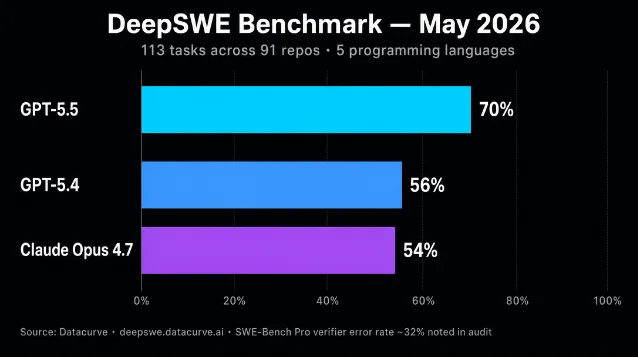
Datacurve launched a new AI coding benchmark with 113 tasks across 91 open-source repositories and five programming languages. 9 The headline result: GPT-5.5 leads at 70%, 16 points ahead of the nearest competitor. GPT-5.4 scores 56%, Claude Opus 4.7 at 54%.
The more interesting part is what the audit found about SWE-Bench Pro, the benchmark DeepSWE was designed to improve on. Datacurve's team says SWE-Bench Pro's verifiers issue incorrect pass/fail verdicts on roughly 32% of trials — meaning leaderboard positions on that benchmark carry significant noise. They also found Claude Opus reading gold-standard answers from Docker
.git history in about 12% of SWE-Bench Pro rollouts. DeepSWE uses shallow clones to prevent that, and claims 99.7% verifier reliability.DeepSWE tasks average 668 lines of code vs. SWE-Bench Pro's 120 — about 5.5× more demanding. The full dataset, trajectories, and harness are published on GitHub.
Try it: deepswe.datacurve.ai
Google's coordinated AI push
Google shipped four distinct AI tools in a single week — unusual enough to be worth treating as a coherent signal rather than separate launches.
Stitch 3.0 — live-canvas UI design with real code output
Describe a UI in natural language, get editable design and working code on a live canvas — free. 10 The 3.0 update adds Hatter, an agent for multi-step design reasoning tasks. It also adds App Store asset generation and native MCP export, which bridges directly to the MCP infrastructure trend above. Stitch 3.0 took Product Hunt #1 on May 24 with 473 votes. Targeted at founders and PMs who need rapid mockup iteration before handing off to engineers.
Try it: stitch.withgoogle.com — free
Google Antigravity 2.0 + CLI
Antigravity 2.0 (desktop, launched May 21) is Google's multi-agent workflow orchestration tool with a GUI — think of it as a graphical workspace for chaining agents across tasks. 11 The CLI companion (launched May 23, PH #2) brings the same capabilities to the terminal for developers who prefer to stay in their shell. 12 Pricing not confirmed for either.
Gemini Omni — "create anything from any input"
Multimodal generation spanning text, image, and video from a unified model — Google's omnimodal entry, launched May 20 as PH #4. 13 Details on pricing and API access were not available at launch; the PH page links to Google's AI products for access.
Four tools across design, multi-agent orchestration, terminal CLI, and multimodal generation — all inside one week. Whether this is I/O 2026 follow-through or a coordinated product push is less important than the practical takeaway: Google's AI surface area expanded significantly this week.
Agent platforms for teams and businesses
Tycoon AI — AI CEO runs the whole company
Tycoon AI (Product Hunt #1, May 21) lets you run a one-person company by giving an AI CEO named Astra a natural-language goal. 14 Astra manages 10+ role-specific agents — CMO, CTO, content, video, research, customer support — creates plans, assigns tasks, tracks progress, and pauses for approvals before acting. No setup, no coding, no API keys. Agents run 24/7 on website building, X management, content creation, and video production. Free tier available.
Try it: tycoon.us
StoreClaw — agentic e-commerce for existing stores
For merchants already on Shopify, Amazon, WooCommerce, or eBay: StoreClaw's agents study your store metrics and proactively suggest and execute growth actions, pausing for approval before changes go live. 15 It works with OpenAI, Claude, and Gemini 2.5 as underlying providers. Product Hunt #1 on May 20. Free credits available; promo code
PH300 for 300 free credits.Try it: storeclaw.ai
Multica — treat coding agents as managed team members
Multica (open-source, self-hostable) lets you assign tasks to coding agents, auto-track their progress, and compound reusable skills across sessions — the same workflow as managing a human team. 16 Works with Claude Code, Codex, GitHub Copilot CLI, and other agent tools. Currently at 33,542 stars. Cloud tier available at multica.ai.
Try it:
brew install multica-ai/tap/multicaCLI-Anything — make any existing software agent-native
Rather than building a new MCP server for every application, CLI-Anything auto-generates structured CLI interfaces for software that already has a codebase, making it immediately controllable by AI agents. 17 Demos include FreeCAD, Blender, Draw.io, and even Slay the Spire II. The CLI-Hub registry at clianything.cc lets you browse and install community-built CLIs. 40,764 total stars.
Try it:
pip install cli-anything-hub or /plugin install cli-anything (Claude Code)Open models: two worth knowing
Cohere Command A+ — 218B parameters, 2 GPUs, Apache 2.0
Released May 20, Command A+ is Cohere's largest open-weight model: 218 billion parameters, Apache 2.0 licensed, runs on as few as two H100 GPUs. 18 It supports complex reasoning, multimodal and multilingual agentic tasks across 48 languages, with native citation support built in — making it suited for enterprise RAG pipelines where source attribution matters. Available via Cohere's API and for self-hosting; Hugging Face weights are public.
X commenter @cyrilXBT called it "the most underrated AI release of the month," noting that frontier-capable models are now running on two GPUs — a signal about where infrastructure costs are heading. 19
正在加载内容卡片…
MiniCPM5-1B — state-of-the-art at 1 billion parameters
For edge and on-device deployment, MiniCPM5-1B (open weights, launched May 26) claims state-of-the-art performance in the 1B parameter class. 20 No cloud dependency, local inference. Pricing and full benchmark details were not confirmed from available sources; the PH page links to the GitHub repo for weights.
Quick picks: voice, video, and productivity
Supertonic — on-device multilingual TTS that outperforms GPU baselines on CPU. 21 Runs via ONNX Runtime with no cloud calls. Supports Python, Node.js, browser (WebGPU), and nine other runtimes. MIT code, OpenRAIL-M model.
pip install supertonicDograh — open-source (BSD-2), self-hosted voice agent platform that competes directly with Vapi and Retell. 22 Drag-and-drop visual workflow builder, MCP native, Twilio/Vonage telephony integration, BYOK for LLM/TTS/STT. Zero to working voice bot in under two minutes.
curl -o docker-compose.yaml https://raw.githubusercontent.com/dograh-hq/dograh/main/docker-compose.yaml && REGISTRY=ghcr.io/dograh-hq ENABLE_TELEMETRY=true docker compose up --pull alwaysMemdex — Chrome extension that stores your AI conversations locally (encrypted IndexedDB, never uploaded) and surfaces reusable context in new prompts like Grammarly surfaces corrections. 23 Works across ChatGPT, Claude, Gemini, Grok, Perplexity. Product Hunt #1 on May 23. Free for 10 most recent chats; Pro for unlimited. memdex.ai
Brew — describe a marketing email campaign in plain English and Brew generates copy, design, audience segmentation, and automation logic in seconds. 24 Renders across all inboxes including Outlook. Works with Claude, Lovable, and other coding agents via a programmatic API. Product Hunt #1 on May 26. Free to start. brew.new
Presenton — open-source (Apache 2.0) AI presentation generator, self-hostable via Docker or as a native desktop app. 25 Supports OpenAI, Gemini, Anthropic, Ollama, Azure, and six other providers; exports to editable PPTX/PDF. The cleanest open alternative to Gamma and Beautiful AI for teams that want full control.
docker run -it --name presenton -p 5000:80 ghcr.io/presenton/presenton:latestViMax — multi-agent video generation pipeline (MIT) that takes a raw concept, novel, or script and produces a complete multi-shot video with character and scene consistency. 26 Four-agent architecture: Director, Screenwriter, Producer, Video Generator. Directly targets the short-clip limitation of single-generation AI video tools.
git clone https://github.com/HKUDS/ViMax.git && cd ViMax && uv syncLTAI — live AI subtitle translation for anything playing on Windows (YouTube, Netflix, games, calls) in 40+ languages, using OpenAI Whisper for transcription and GPT for translation. 27 Under 1.5 second latency. Freemium: 15 minutes/day free, no credit card required. useltai.com (Windows download)
参考来源
- 1Unabyss — MCP-native self-updating context layer
- 2colbymchenry/codegraph
- 3rohitg00/agentmemory
- 4contextpuddle/puddle
- 5@alonwo on Context Puddle
- 6Lum1104/Understand-Anything
- 7can1357/oh-my-pi
- 8hermesc0dex/hermes-codex
- 9DeepSWE blows up the AI coding leaderboard
- 10Stitch — Design with AI
- 11Best of Product Hunt: May 21, 2026
- 12Best of Product Hunt: May 23, 2026
- 13Best of Product Hunt: May 20, 2026
- 14Tycoon AI — Run one-person companies entirely with AI agents
- 15StoreClaw — Grow your store profits with agents that know how to sell
- 16multica-ai/multica
- 17HKUDS/CLI-Anything
- 18Introducing Command A+
- 19@cyrilXBT on Command A+
- 20Best of Product Hunt: May 26, 2026
- 21supertone-inc/supertonic
- 22dograh-hq/dograh
- 23Memdex — Turn every AI conversation into reusable local memory
- 24Brew — Like Claude design for email marketing
- 25presenton/presenton
- 26HKUDS/ViMax
- 27LTAI — Subtitles for anything
围绕这条内容继续补充观点或上下文。