

China Tech Startup & Funding Brief — May 23, 2026

China Tech Startup & Funding Brief — May 23, 2026

DeepSeek's first external round expands to RMB 700B (~$10B), potentially the largest single startup fundraise in Chinese tech history; PKU-incubated Weifan AI closes a seed round for China's first native robot brain chip; CXMT and YMTC simultaneously move toward domestic listings riding the AI memory upcycle; SMIC clears CSRC approval for its RMB 40.6B SMNC acquisition — the largest-ever STAR Market deal; and Manus founders explore a $1B fundraise to buy the company back from Meta.

Chinese Tech Startup & Funding Morning Brief
2026/5/24 · 8:10
5 订阅 · 4 内容
Today's brief is headlined by a landmark update: DeepSeek's first-ever external fundraise has quietly expanded to RMB 700 billion (~$10B), making it the largest single startup round in Chinese tech history if confirmed. Alongside that, China's memory chip sector is converging on the public markets — with CXMT filing for a STAR Market IPO and YMTC beginning pre-IPO tutoring — while a PKU-incubated robot brain chip startup and the Manus buyback saga round out a dense, consequential day.

Deals at a Glance

CompanySectorRoundAmountLead Investors
DeepSeek (深度求索)Foundation AIFirst external roundRMB 700B (~$10B, rumored)National AI Fund, Tencent, IDG Capital, Lisi Capital, NetEase, JD.com (in talks)
Weifan AI (维泛智能)Robot Brain ChipSeedHundreds of millions CNYZhongguancun Capital / Qihang Investment
Galaxy General Robotics (银河通用)Embodied AI / RoboticsA+RMB 2.5B (~$347M)National AI Fund (Phase 3), Sinopec, CITIC Group
CXMT (长鑫存储)DRAM / Memory ChipSTAR Market IPO filingFiled May 17
YMTC Holding (长江存储)NAND Flash / MemoryA-share pre-IPO tutoringCITIC Securities, CSC Financial (advisors)
Atom Matrix (原子矩阵)Quantum ComputingA roundHundreds of millions CNYMonolith (砺思资本), 民银国际

正在加载链接预览…

1. DeepSeek's Round Swells to RMB 700B — Largest in Chinese Startup History

DeepSeek has upgraded the scale of its first-ever external fundraise. Bloomberg reported this weekend that the Hangzhou-based AI lab is now targeting RMB 700 billion (~$10 billion) — up from the RMB 500 billion figure that circulated in mid-May 1. If closed at that figure, the round would set a record for any first-time external fundraise by a Chinese tech startup.
The deal is in final-stage negotiations, with a pre-money valuation now put at approximately RMB 3.15 trillion (~$450 billion). According to people familiar with the matter, the National AI Industry Investment Fund (国家人工智能产业投资基金) is in talks to contribute around RMB 100 billion as the anchor investor. Tencent, IDG Capital, and Monolith (砺思资本) have moved close to committing, while NetEase and JD.com are separately in discussions to participate.
In a striking signal about DeepSeek's intent, founder Liang Wenfeng has told investors in at least one meeting that the company's priority is AGI research and continued open-source model development — not near-term commercialization. Liang is also reportedly planning a personal contribution of around RMB 200 billion to the round. The company does not plan an IPO.
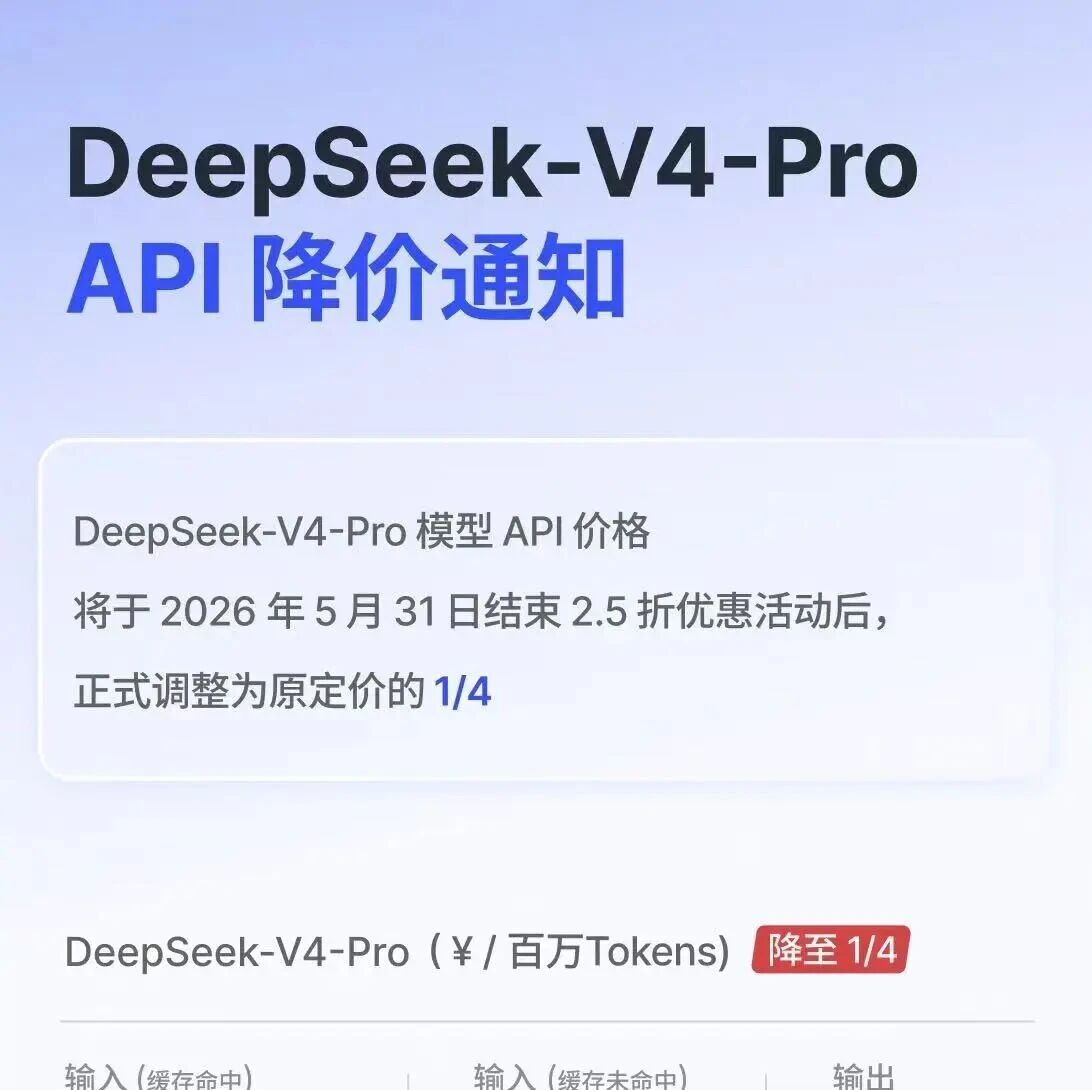
On the same weekend, DeepSeek separately announced that its DeepSeek-V4-Pro API price cut is now permanent: from June 1, the discounted pricing — equivalent to 25% of the original list price — becomes the permanent standard, setting a new global benchmark for large model inference costs 1.
"The main goal is to push the boundaries of technology, not to monetize." — Liang Wenfeng, per Bloomberg, as reported by Securities Times

正在加载链接预览…

2. PKU-Incubated Weifan AI Raises Seed Round for China's First Native Robot Brain Chip

Weifan AI (维泛智能), a semiconductor startup incubated at Peking University's PAICORE Lab, has closed a seed round of "hundreds of millions of CNY" — the first disclosed external capital raise for what it calls China's first native embodied-AI "brain chip" company 2.
Zhongguancun Capital and its Qihang Investment vehicle led the round. Co-investors include Shanghai Future Industry Fund, Shixi Capital, Baosen Storage, Yanchuang Group, Haiyi Investment, and Tanyuan Ventures.
Founded in May 2025, Weifan AI's core product is a BiGPU (biologically-inspired GPU) — a hybrid chip architecture combining RISC-V-based GPU computation with spiking neural network (SNN) principles inspired by biological brain structure. The design targets the specific compute requirements of embodied-AI "large-small brain" fusion models running inside robots, aiming to reduce power consumption and memory bandwidth relative to conventional GPU-only approaches.
The founding team has deep semiconductor pedigree: co-founder Yin Jilei brings more than 20 years of industry experience, with core members drawn from IBM, Huawei, and Tencent. The company plans to tape out its first chip in Q2 2027, with this round funding team expansion, instruction set architecture development, and product definition work.
Sector context: This raise lands as Q1 2026 robotics-sector venture investment has already surpassed RMB 30 billion, with Galaxy General Robotics' RMB 2.5B A+ round (led by the National AI Fund's Phase 3, marking the state fund's first-ever robotics investment, alongside Sinopec and CITIC Group) setting a new single-round record for embodied AI 3. Seven embodied-AI unicorns are now valued above RMB 10 billion.

3. China's Memory Chip Sector Converges on the Public Markets

Two of China's most strategically important memory chip companies are simultaneously moving toward domestic listings, each timed to an industry upcycle driven by AI infrastructure demand.
CXMT (长鑫存储), China's largest DRAM maker, filed its IPO prospectus with the Shanghai Stock Exchange's STAR Market on May 17. The company posted Q1 2026 net profit of RMB 24.7 billion — up 1,688% year-on-year — and revenue of RMB 50.8 billion (+719% YoY), driven by surging DRAM prices and AI-driven data center demand 4. CXMT holds a 7.67% global DRAM market share (Omdia), making it the world's fourth-largest DRAM producer.
YMTC Holding (长江存储控股), the NAND flash maker behind the proprietary Xtacking architecture, has begun pre-IPO tutoring with CITIC Securities and CSC Financial as advisors — a formal step signaling that its A-share listing process has officially started 5. YMTC's wholly-owned operating subsidiary is valued at more than RMB 160 billion (~$23.5B). Its cap table spans China's Big Fund Phases 1 and 2, five state-owned banks, and leading VC/PE firms.
Both IPO moves come as Morgan Stanley has noted that AI-chain bottlenecks are shifting from GPUs to memory, packaging, and network bandwidth — and that the memory upcycle could last three to five more years.

正在加载链接预览…

4. SMIC Clears Final Hurdle for RMB 40.6B SMNC Acquisition

SMIC (中芯国际), China's largest foundry, has received final CSRC approval to acquire the remaining 49% stake in SMNC (北方集成电路制造) for RMB 40.6 billion (~$5.9B) — set to become the largest single transaction in STAR Market history 6. SMIC already holds 51% of SMNC; the acquisition will make SMNC a wholly owned subsidiary.
SMIC plans to issue 547.2 million new shares at RMB 74.2 per share to five institutions including the National Integrated Circuit Industry Investment Fund (大基金). The shares carry a one-year lock-up.
SMNC, founded in 2013, operates 12-inch wafer foundry services and is SMIC's primary Beijing-area production facility. The deal carries no change to SMIC's core business, but is expected to lift basic EPS from RMB 0.49 to RMB 0.55. Q1 2026 revenue hit $2.51B (+11.5% YoY) with a wafer utilization rate of 93.1% — and Q2 guidance calls for a further 14–16% YoY gain.

5. Manus Founders Eye $1B Fundraise to Buy Back Company from Meta

Bloomberg reported that the co-founders of Manus AI — Xiao Hong, Ji Yichao, and Zhang Tao — are exploring raising approximately $1 billion from external investors, with the goal of buying the company back from Meta 7.
The backstory: Meta acquired Manus in July 2025 at a valuation between $2B and $3B. In January 2026, China's Ministry of Commerce launched a compliance review, and in late April, the National Development and Reform Commission formally ordered the acquisition halted and Meta to refund the acquisition consideration. The founders — whose travel was restricted after returning to China for a conference — now need to source capital to complete the buyback and restore Manus as an independent entity, with a target HKEX IPO to follow.
The complexity of the transaction is significant: unwinding a completed acquisition requires addressing trade-secret boundaries, data ownership, intellectual property assignment, and employment relationships already embedded within Meta's infrastructure. Potential investors must satisfy both scale (minimum ~$1B ticket) and regulatory identity verification, narrowing the eligible universe to state industrial funds, leading domestic institutional investors, and CVCs such as Tencent and ByteDance.
The situation underscores how China's tech regulatory framework can reconfigure capital structures in ways that create novel forced-fundraise scenarios at the AI-geopolitics intersection.

Sector Signals

The week of May 16–22 saw 114 primary-market investment events in China (+5.6% week-on-week), with total disclosed capital of RMB 6.83 billion 8. Advanced manufacturing and healthcare led by deal count; quantum computing also gained traction, with Atom Matrix (原子矩阵) closing its third consecutive round (A round, led by Monolith/砺思资本) in six months — all targeting neutral-atom quantum computing. Monolith was also the most active institutional investor of the week, co-appearing across deals in AI, chips, and quantum.
The pattern across this week's deals is coherent: state capital continues to anchor the largest rounds (National AI Fund in DeepSeek, National AI Fund Phase 3 in Galaxy General, Big Fund in SMIC), while sector-specialist VCs (Gaorong, Hillhouse, Sequoia China) cluster in embodied AI and deep-tech hardware. The structural shift toward domestic public-market exits — CXMT, YMTC, Unitree, Zhiyuan Robotics all filing or signaling — reflects a maturing ecosystem that is now generating enough operating track record to support IPO valuations.

围绕这条内容继续补充观点或上下文。

  • 登录后可发表评论。