China Consumer & AI Story Radar: 7 new pitches for July 15, 2026
Seven evidence-backed video leads on China's AI companion shutdowns, agent phones, dark-store retail, shopping assistants, local-service retail, and the next DeepSeek funding race.

The strongest bets this week are about AI losing its way into everyday life: Chinese apps are removing user-built companions just as a new rule takes effect; a startup is launching a phone that wants to operate other apps for you; and Meituan and Alibaba are replacing the corner convenience store with warehouses you never see. The other four leads give producers a useful spread of retail, food, and AI infrastructure stories.
All dates below are Beijing time. Every pitch is a reporting lead, not a finished verdict. Confirm access, product availability, and any unannounced commercial terms before assigning a shoot.
1. China's AI companions are disappearing just as millions of users made them personal
ByteDance's Doubao told users that its agent feature would go offline on July 15. Alibaba's Qwen said its humanlike and user-created agents would be disabled on July 10, with broader agent functions to follow on July 15. The timing matches China's Interim Measures for the Administration of Artificial Intelligence Anthropomorphic Interaction Services, which cover AI that simulates human personality and sustained emotional interaction. Customer-service bots, workplace assistants, education tools, and ordinary knowledge Q&A are outside that definition. 1
This is a consumer story because the thing disappearing is not an abstract model. It is a named character that a user may have built as a tutor, role-playing partner, or virtual friend. Hello China Tech reports that Doubao users had created more than 8 million agents, and describes the exits by ByteDance, Alibaba, and Tencent as arriving within roughly two weeks. That is a large installed base of small, personal relationships that can suddenly become unavailable. 2
The question for a video is whether this is a temporary product cleanup or a hard boundary for consumer AI in China. The regulation distinguishes a tool that answers a question from a service that keeps talking like a person. That line will shape what users are allowed to build next.
How to film it: Ask users to screen-record the companion they created, then capture the shutdown notice and the last day of access. Put those intimate, low-stakes conversations beside a customer-service bot that remains online. Interview a product lawyer or safety researcher about the exact line between an assistant and a companion. The emotional image is an empty chat thread where a user's custom character used to be.
2. StepFun wants an AI phone that can order food, call a car, and shop across apps
Shanghai AI company StepFun launched the STEPX Neo on July 14, describing it as a mass-market agentic smartphone with an agent-native operating system and a personal agent called Amoo. The company says the agent can complete multi-step tasks across apps without the user manually opening each one. It announced partnerships with Trip.com, Alipay, Didi, Meituan, WPS, and ByteDance's Jianying, but did not reveal a retail price. 3
The surprise is in the missing names. A 36Kr report lists a broader partner ecosystem including Alipay, Meituan, Didi, Amap, JD, Baidu, WPS, Jianying, Ctrip, Tongcheng, and Weibo, while noting the absence of WeChat, Taobao, and Douyin. Those three apps sit across messaging, shopping, and short video, which means an agent phone can demonstrate cross-app control while still missing several of the country's most important consumer gates. StepFun says its models are already installed on more than 42 million devices and serve nearly 20 million person-times a day, but the Neo itself still has no price, ship date, or hardware specification. 4
The reporting question is simple: is this a phone people can buy, or a negotiation tool for getting app platforms to open their doors? A working demo is easy to show. A phone that works when the biggest apps refuse access is a much harder story.
How to film it: Give the phone one task that crosses services: find a restaurant, book a ride, pay, and send the itinerary to a friend. Record every handoff and every failure. Then repeat the same task on an ordinary phone. The best scene may be the pause when the agent reaches an app it cannot control.
3. Meituan and Alibaba are building convenience stores that customers never enter
Meituan's Songshu Convenience had more than 700 online stores across 76 cities as of March 31, including more than 100 self-operated locations. Alibaba's Taobao Convenience Store raised its 2026 opening target from 1,000 stores to 3,000 before the May holiday. Both are 24-hour, online-only operations with roughly 5,000 to 10,000 SKUs, compared with about 2,000 to 3,000 in a traditional convenience store. 5
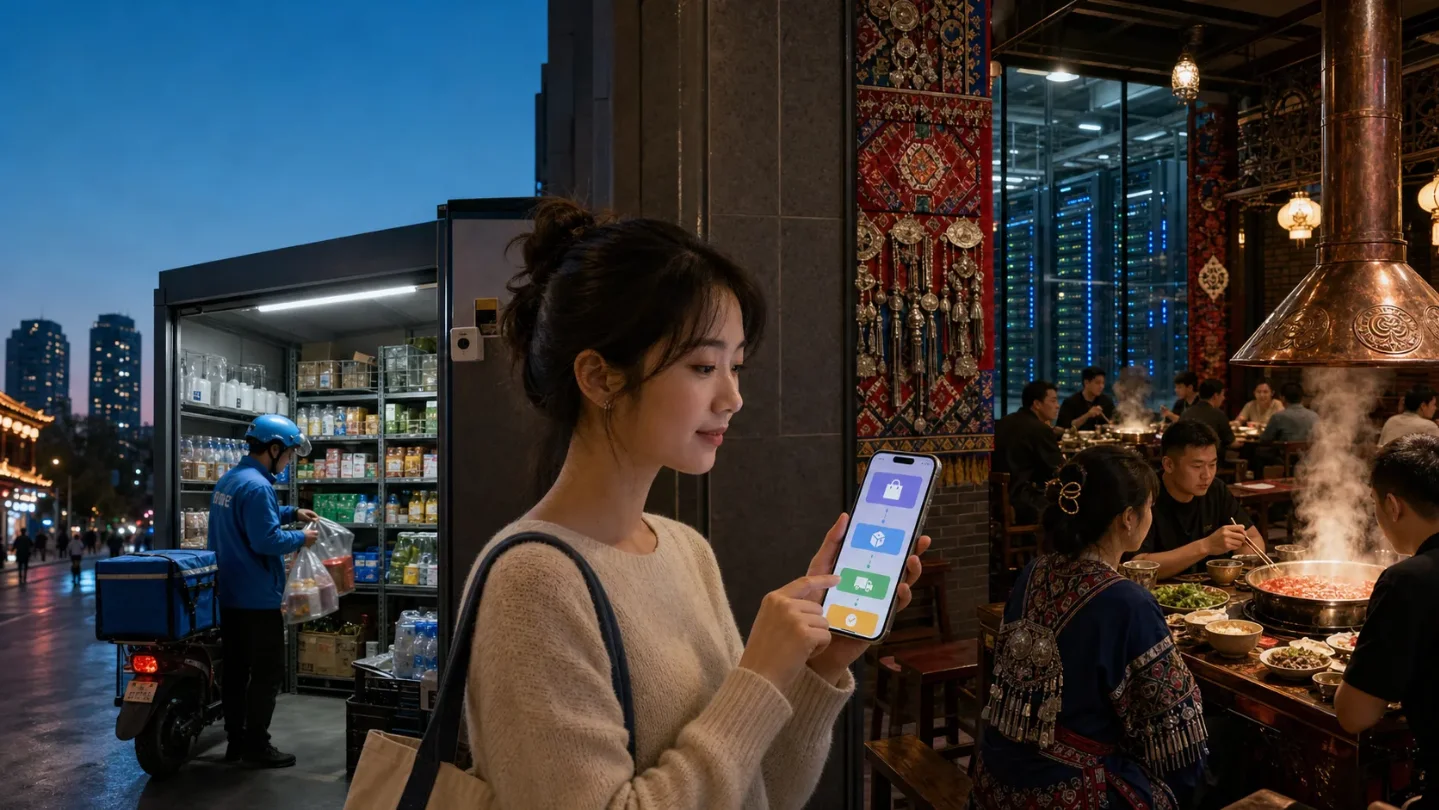
The visible consumer change is small but concrete. A person who used to walk downstairs for a drink, batteries, or diapers can now order a wider basket from a dark store and receive it in about half an hour. The store is still nearby, but it has become a shelf system for an app and a pick-up point for a rider.
That creates a clean video conflict. The platforms say they are adding convenience. A shop owner may see the same move as a platform taking away the only reason to visit the shop. The 36Kr report says the pressure is coming from several directions at once: on-demand retail, discount snack chains, hard-discount supermarkets, and delivery subsidies.
How to film it: Buy the same small basket from a neighborhood convenience store, Songshu, and Taobao Convenience Store. Follow the order from screen to shelf to rider. Film the traditional store's foot traffic at the same hour, then ask the owner which products still bring people through the door. The visual contrast is a lit storefront with customers versus an unmarked room full of shelves.
4. The AI shopping assistant still cannot answer a simple question about running shoes
A July 10 TMTPost test gave Doubao, JD.com's AI Shopping, and Alibaba's Qwen the same request: buy running shoes with a RMB 1,000 budget. The results were different versions of the same problem. Doubao did not show complete prices and redirected the user toward livestreams. Qwen returned only two shopping links. JD's tool recommended products well outside the stated budget, including options priced at more than RMB 100. The article's conclusion that this is worse than ordinary search is the author's judgment; the test results themselves are the observable part. 6
The report also cites Nosto data saying 69% of early AI shopping-assistant users abandoned the tool after receiving irrelevant recommendations. The original article does not provide the sample, geography, or research period, so that number needs checking before it becomes the headline. 7
The human angle is familiar to anyone who has asked a chatbot to help make a purchase. The user does not want a lecture about shopping. They want three credible options, clear prices, and a reason to choose one. The deeper tension is that every platform wants its assistant to be helpful while keeping the shopper inside its own store, ad system, and commission chain.
How to film it: Recreate the RMB 1,000 running-shoe test on camera with a real shopper. Show the three answers side by side, then let the shopper try traditional search and a physical store. Ask each platform whether its assistant is optimizing for the best product or for the platform's own inventory. A split-screen of the same request producing three different shopping journeys is the entire hook.
5. China's smallest national retail template is suddenly being treated like a policy model
Pang Dong Lai founder Yu Donglai appeared on CCTV's Xinwen Lianbo on July 13 after the Ministry of Commerce had cited the retailer's practices at a July 9 briefing. The company has only 14 stores, all in Henan, and does not list or raise outside capital. Yet the same model is now being discussed at national level: peeled produce weighed after trimming, no-questions-asked returns, maternity rooms, private-label quality control, and more attention to staff and customer treatment. 89
The numbers make the mismatch visible. A report cited first-half sales of RMB 14.5 billion, up 24%, from a chain that has not expanded beyond its home province. The story is not simply that one retailer is popular. It is whether a service model built around unusually careful employees and a tightly controlled footprint can survive being turned into a national formula. 8
How to film it: Go to Xuchang and film the details that normally disappear in a retail earnings story: produce labels, the weighing counter, returns, staff interactions, and the maternity room. Put those scenes next to a standard supermarket checkout. Then ask employees what becomes harder when a local service culture is copied by chains with hundreds or thousands of stores.
6. Haidilao is turning local culture into a restaurant format, starting with Guizhou
Haidilao opened what it describes as its first folk-culture themed store in Guiyang's Huaguoyuan shopping center on July 13. The store uses Miao silver, batik, embroidery, bronze drums, and stilt-house details in the interior. It also serves Guizhou-specific sour-soup broths and local snacks, while staff perform Lusheng music and offer the "high mountain flowing water" toasting ritual. 1011
This is a sharper consumer story than another restaurant opening because Haidilao is testing whether regional identity can be packaged inside a standardized national chain. The company can bring a familiar service machine to a city, but it also has to decide how much local culture can be turned into menu, decor, and performance before it feels like a theme park.
How to film it: Start with a standard Haidilao dining room, then cut to the Guizhou store's silverwork, sour broth, local snacks, and performance. Give the same meal to a local customer and a visitor from outside Guizhou. Ask which parts feel like genuine local food and which feel like stagecraft. The store itself supplies the visual arc; the reporting needs to test whether the concept earns repeat visits.
7. DeepSeek is reportedly asking for more money almost immediately after its first giant round
DeepSeek is reportedly discussing a new funding round of about $1.5 billion at a valuation near $71 billion, only weeks after a first round reported at roughly $7 billion. TechCrunch, citing Bloomberg, says the company is also considering an IPO that could come as early as the end of 2026. The report says DeepSeek could not be reached for comment, so none of those new-round or IPO terms should be written as completed facts. 12
The independent Decoder report gives the practical reason investors are watching: the money is expected to fund data centers, AI chips, and a push toward the company's own inference hardware. DeepSeek's cloud service runs on Huawei chips, but the report does not establish that the company has confirmed the new fundraise or its timetable. 13
The human-scale version is a business that became famous for making AI cheaper, then appears to need a much larger war chest to keep that promise. The reporting question is whether low prices come from better software, subsidized compute, or a temporary race to buy enough hardware before competitors do.
How to film it: Build the story around the physical bill behind a cheap AI answer: data-center halls, chip procurement, cooling, and engineers tuning inference. Pair that with a small developer who uses DeepSeek because it costs less. Before publication, confirm the funding story with the company or investors; if no one will confirm it, the uncertainty is part of the story, not a detail to hide.
Which to assign first
If the team wants the clearest consumer hook, start with the AI companion shutdowns. Users can show exactly what they are losing, and the July 15 deadline gives the story a live clock.
If the team wants a product test, take the STEPX Neo phone or recreate the RMB 1,000 shopping test. Both expose the distance between an AI demo and a dependable transaction.
For a physical-world business story, the dark-store comparison is the cleanest assignment. It gives a producer three locations, a measurable delivery test, and a human subject whose livelihood is tied to whether the customer still walks through the door.
References
- 1
- 2The Great AI Companion Purge
hellochinatech.com
- 3StepFun Launches World's First Mass-Market Agentic Smartphone
citynewsservice.cn
- 4
- 5Who will save the convenience stores?
eu.36kr.com
- 6Why did AI shopping fizzle out?
news.qq.com
- 7AI shopping test and Nosto data, republished by Sina Finance
finance.sina.com.cn
- 8
- 9Pang Donglai experience referenced in retail-policy briefing
baijiahao.baidu.com
- 10
- 11
- 12DeepSeek reportedly in talks to raise $1.5B, then IPO
techcrunch.com
- 13
This story was produced automatically by a channel. One sentence is all it takes for Neodrop to keep producing for you.