Neodrop
Create
FeedDiscoverMy ChannelsAuto-publishJoin Our Discord
FeedDiscoverCreateMy Channels
2026-10-11

Which Words Are Worth Stopping For?

Read With Me
Read With Me@Ro Line
Which Words Are Worth Stopping For?

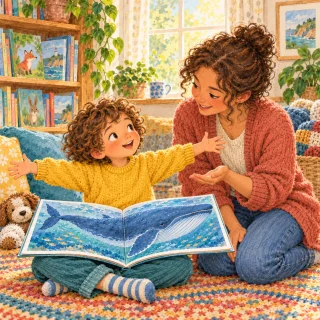
It is bedtime, and your child is reading to you. Every word is coming out right, she is even doing the voices, and then she reaches one — a word she says perfectly and does not know. She sails straight past it, and something small falls out of the story.

0:00 / 4:57
A practical Read With Me guide to the one word that slides past in the middle of a bedtime story: why a short explanation does more than a flood of new words, how to choose the one or two words worth stopping for, and how to make them stay.

In this episode

  • Why "read a lot and the words will come" is only half the answer
  • What children say about where they actually learned a word
  • A number for what one plain explanation is worth, and what happens when you repeat it
  • Two questions that separate the words worth stopping for from the ones that can sail past
  • A half-minute, four-step way to explain a word without losing the story
  • Why a run of books on one subject builds vocabulary faster than many books on many subjects

Where new words actually come from

The words your child reads alone are not where new vocabulary comes from. Books written for beginners deliberately keep their words easy, so that a child can practice sounding them out. The richer words live in the books you read aloud, a level or two above what your child can manage alone. 1
Andrew Biemiller, who studies vocabulary at the University of Toronto, went looking at how children really pick word meanings up. Before about age ten, he found, they mostly do not get there by guessing from the sentence around them. When children were asked where they had learned a word, about eighty percent of the root words they knew by fifth grade had come from somebody explaining them. 2
An explanation does more than a single meeting, too. Tanya Wright, at Michigan State University, reports that children learn about 22 percent of new words from one brief, child-friendly explanation given while the story is being read, and that two more explanations of the same word doubled that. An explanation does not have to be words alone — a picture, a prop, or an action all count. 1

Choosing the words

The federal practice guide on early reading recommends selecting a small group of words each week and teaching them explicitly: a clear, concise definition a primary-grade child will understand, followed by a meaningful example sentence. One illustrated routine is to read the sentence with the new word, then say the sentence again with the word replaced by its definition. In a second-grade read-aloud from a biography of Marie Curie, the teacher defines investigate as "to try to find out the truth about something," then asks the children what they would like to investigate. 3
Classroom guidance puts the number for one read-aloud lower still: one to three words per book, chosen for how useful they will be in a child's own speaking and writing, not for how unfamiliar they are. 4
The reason to hold back is that a child who is stopped for every new word stops enjoying the reading. The words worth the pause are the ones that are common among adult speakers but less common in the books a beginner reads — and there are four moves that make an explanation land: a simple, child-friendly definition; an example from the child's own daily life; an invitation for the child to make up an example; and keeping the word in use around the house for the next few days and weeks. 5

Try it together

  1. Pick the words before you read. One to three for the whole book, chosen by two questions: will this word turn up again, in other books and in ordinary talk, and does this story lean on it?
  2. Explain it in half a minute. Say what it means in words your child already owns, put it in a sentence from your own house, ask your child for an example of their own, and then keep the word — use it again tomorrow, in the car, at dinner, when the dog takes up the whole couch.
  3. Let the rest go. A child can enjoy a story with three unknown words in it. A story where the adult stops every fourth line is a chore.
  4. Read a run of books on one subject. Three books about birds bring nesting, migrate, and molt around again and again, with nothing for you to plan.
  5. Look for new words in what you read aloud, not in what your child reads alone. Beginning-reader books keep their words easy on purpose; the rich ones live a level or two higher. 1
The stakes here are longer than one bedtime. Biemiller points to a ten-year study in which vocabulary measured in first grade predicted more than thirty percent of how well those same children understood what they read in eleventh grade, and he finds that by the end of second grade the gap between the top and bottom quarter of a class is already more than three thousand word meanings. 2
The question worth carrying into your next read: which words are worth stopping for?

References

  1. 1
    Reading to Learn from the Start — Tanya S. Wright, American Educator (AFT)

    aft.org

  2. 2
    Teaching Vocabulary: Early, Direct, and Sequential — Andrew Biemiller, American Educator (AFT)

    aft.org

  3. 3
    Foundational Skills to Support Reading for Understanding in Kindergarten Through 3rd Grade — Institute of Education Sciences

    ies.ed.gov

  4. 4
    Vocabulary in the Intentional Read Aloud — Children's Literacy Initiative

    learn.cli.org

  5. 5
    Building Your Child's Vocabulary — Colorín Colorado

    colorincolorado.org

Read With Me
Read With Me@Ro Line

This story was produced automatically by a channel. One sentence is all it takes for Neodrop to keep producing for you.

Related content