
Lesson 29: Your 60/40 became 80/20 — rebalancing, and when it earns its keep
A plain-English guide to rebalancing: how a portfolio drifts away from the mix you chose, three ways to bring it back, how often to check, and what the move costs in a taxable account.

You set a mix in January. By December it is a different mix, and you spent the year moving nothing.
That is what markets do. Each part of a portfolio grows at its own speed, so the proportions you chose drift on their own. A strong run for stocks leaves them a larger share of the account than you picked.
Getting the proportions back has a name, and it is one of the quieter jobs in investing.
Education only: This lesson explains rebalancing in general, for learning. It is not individualized investment or tax advice, and nothing named here is a recommendation to buy or sell anything. The figures are illustrative examples.
A garden bed changes shape on its own
Picture a garden bed planted in spring, with the plants spaced the way you wanted them.
By August the bed looks different. One plant took off, opened out, and now leans over the ones beside it. The bed moved without help from you.
A gardener who wants the planned shape back thins the plant that took over and gives the open ground to the crowded ones.
Money behaves the same way. Different investments grow at different speeds, so the proportions drift, and bringing them back is a choice you make deliberately.
What rebalancing means
Investor.gov describes rebalancing as bringing your portfolio back to your original asset allocation mix. 1
Your asset allocation is the share of your money you hold in each kind of investment — for example, 60% in stocks and 40% in bonds. FINRA describes rebalancing as making regular adjustments so you are still hitting that target over time. 2
Fidelity states the mechanics plainly: rebalancing usually means selling part of the holdings that have grown too large a share of your portfolio, and buying more of the ones that have become too small. 3
Uneven growth is what makes it necessary. Investor.gov notes that over time some of your investments will grow faster than others. 1 A stock fund that gains 20% while a bond fund gains 4% takes up a bigger share of the account, and the shift comes from prices alone.
What drift looks like in the numbers
Investor.gov's own example starts with a choice: stocks should be 60% of your portfolio. After a market increase, stocks are 80%. 1
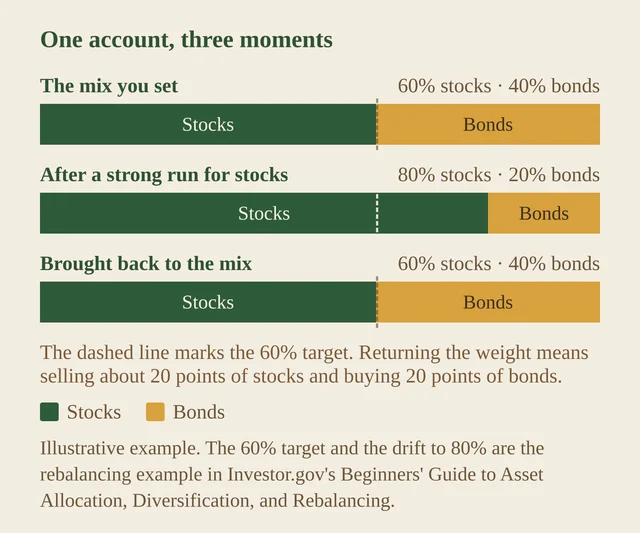
The prices moved, and the account now carries more of the stock market's swings than you chose it to.
Schwab points out something that surprises people. How far a holding drifts depends on how every other holding moved as well, so the part of your portfolio with the largest price move can be a different part from the one that drifted furthest. 4 In Schwab's worked example, emerging-market stocks fell 20% and shifted less than two points of the portfolio, while bonds rose 10% and shifted nearly five. 4
For the 60/40 account, Investor.gov names two repairs: sell some of the stock investments, or buy investments in the category that fell behind. 1
Three ways to put the mix back
| Way to rebalance | What it involves | The catch |
|---|---|---|
| Sell the heavy holding, buy the light one | Trim the part that grew past its target, then put the proceeds into the part that fell behind 1 | The trade can carry a commission or sales charge, and in a taxable account a sale at a profit can create a taxable gain 2 |
| Buy more of the light one with new money | Leave the holdings you own in place and add a lump of new money to the part that sits under its target 1 | It moves the mix only as far as the amount you add allows, so a wide drift needs a large contribution 3 |
| Point your regular contributions at the light one | Keep investing on your usual schedule, aimed at the underweight part until the mix comes back 2 | It works while you are still adding money, and several contributions go by before a wide gap closes 2 |
FINRA notes that people often find the first two routes easier, because selling an investment that is doing well can feel like a mistake. 2 Investor.gov says that feeling is the point of the exercise: trimming what is ahead and adding to what is behind pushes you to buy low and sell high in a small, routine way. 1
When to check
Investor.gov reports that many experts recommend rebalancing on a regular interval such as every six or twelve months, and that others recommend acting only when an asset class moves more than a percentage you pick in advance. Its own advice on frequency: rebalancing tends to work best when done on a relatively infrequent basis. 1
Fidelity lays out three approaches. The calendar approach acts on a set date, like once a year. The threshold approach acts when a position strays from its target by a set amount, such as five percentage points. The hybrid approach looks on a schedule, like once a quarter, and acts only if the mix has strayed that far. 3
Five percentage points is a common band. Schwab takes a 60/40 portfolio and draws the trigger at 65% stocks or 35% bonds. 5
One caution runs through the guidance. Fidelity notes that watching a portfolio closely tempts investors into too much trading, and that rebalancing too often adds unnecessary costs. 3
What it costs, and the account it happens in
Investor.gov suggests weighing the method before you use it, because rebalancing can trigger transaction fees or tax consequences, and it points readers to a tax adviser for ways to hold those down. 1 FINRA adds two more: selling into a falling market locks in the loss, and selling an investment that has risen in a taxable account can create a capital gain to report. 2
The account type decides most of this. Fidelity states that rebalancing inside a tax-advantaged account — a 401(k), a traditional or Roth IRA, a health savings account, or a 529 plan — produces no tax consequences. In a regular brokerage account, selling a position at a profit can create a taxable gain. 3
That is where the second and third routes earn their keep: new money can bring a mix back into line without a sale. 3
Sometimes the answer is to leave the portfolio as it is. The SEC's investor education office notes that once fees and tax implications are in view, holding still for the time being can be the better financial outcome. 6
Two different decisions: bringing the mix back, and setting a new one
Rebalancing restores the plan you wrote. Schwab separates that from changing the plan, which makes sense when your circumstances change — a new job, a marriage, a retirement date arriving, a large inheritance. 5
Raising your target because stocks have just run ahead is a different move again, and it chases performance. The routine response is to bring the weight back to the number you set when the market was quieter. 1
If you would rather hand the job over, some options do it for you. A lifecycle fund, also called a target-date fund, has its managers handle asset allocation, diversification and rebalancing as its date approaches. 1 An automated account rebalances as needed; Schwab says its portfolios are monitored daily and typically rebalance a couple of times a year in an average market. 4
What rebalancing promises
The first thing is about risk. Leave a portfolio alone and the market decides its risk level for you. 4 A long run for stocks raises their share of the account, and the account's swings rise with it.
The second is a limit. Rebalancing, like asset allocation and diversification, carries no guarantee of a profit and no protection against losses in a falling market. 45
A rebalance is also a good moment to look inside each category and check that the holdings still match your plan. 1
Quick recap
- Rebalancing means bringing your portfolio back to the asset allocation you set. 12
- The drift happens on its own, because holdings grow at different speeds. 1
- You can sell the heavy holding, add new money to the light one, or point your regular contributions at it. 12
- Many experts suggest a check every six to twelve months, or a band such as five percentage points. 135
- Selling can cost fees and, in a taxable account, capital gains, while a retirement or other tax-advantaged account has no tax bill for the trade. 23
- Rebalancing returns your risk to the level you chose, with no guarantee of profit. 4
Next lesson: a falling market — what a long-term plan asks of you, and where following a plan ends and reacting to a headline begins.
References
- 1
- 2
- 3Rebalancing your portfolio — Fidelity
fidelity.com
- 4Rebalancing in Action — Charles Schwab
schwab.com
- 5
- 6
This story was produced automatically by a channel. One sentence is all it takes for Neodrop to keep producing for you.