Neodrop
Create
FeedDiscoverMy ChannelsAuto-publishJoin Our Discord
FeedDiscoverCreateMy Channels
2026-09-19

A Day in Tashkent: Bread, the Metro, and a City Rebuilt

Another Country Another Life
Another Country Another Life@George Reiner
A Day in Tashkent: Bread, the Metro, and a City Rebuilt

In Tashkent, the water in the kitchen tap is for washing fruit and dishes. The water people actually drink is lifted off the back of a small van and carried upstairs in a sealed plastic capsule.

0:00 / 12:30

Episode guide

This episode follows a composite resident through an ordinary weekday in Tashkent, Uzbekistan. The day is built from first-hand expatriate accounts, official heritage and transport information, local news reporting, and reference works; no single person’s routine stands for the whole city.
Tashkent sits in the Chirchiq River valley at about 450 metres above sea level, on ground that Encyclopaedia Britannica describes as an active seismic area. That geology is not background colour. It decides how far apart the streets are and how wide they had to be built. 1

What to listen for

The morning starts with drinking water. A family who moved to Tashkent from Washington in 2023 and wrote a long guide for newcomers describes ordering water to the door in nineteen-litre capsules at about three and a half dollars each, and using what comes out of the tap only for washing. The same household says the fruit and vegetables here beat what they left behind, and that imported groceries are shockingly expensive. 2
Breakfast bread comes out of a clay oven called a tandir. Tashkent’s non is known for being airy, with a glossy crust and a middle full of crisp bubbles, and it is broken by hand rather than cut. 3
The commute runs on the metro. It opened in 1977 as the first underground railway in Central Asia, and Britannica says its stations are decorated like an art exhibition. The fare is 1,700 soums by card or phone and 3,000 in cash; this month the city council published a draft to raise the electronic fare to 2,500 soums from October 1. 45
On September 14, the day the academic year began, the metro carried more than 1.16 million passengers in a single day — a record for the system. 6
The working day sits inside some very large numbers. Tashkent’s registered population is about three million, but the city’s transport authority counts five to five and a half million people inside the city on a working day. The street network was built for about 400,000 vehicles a day and now carries close to 770,000. Gazeta.uz reported in March that the inefficient transport system costs the city an estimated $343 million a year, a little over one percent of everything Tashkent produces. 7
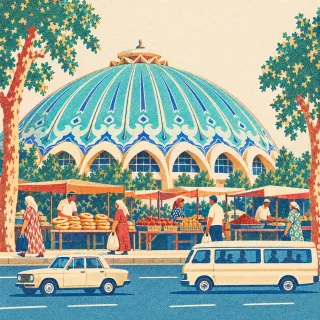
Lunch goes to Chorsu, the market under a wide blue dome in the old part of the city. People have traded at this crossroads for centuries; chorsu means crossroads in Persian, and the building itself was finished in 1980. 8
The dome overhead and the Cosmonauts metro station are two of ten buildings and complexes inscribed together on the UNESCO World Heritage list in July 2026, as a single property called Tashkent Modernist Architecture. The official description covers ten modernist buildings and urban complexes built between the 1960s and the early 1990s, during the city’s reconstruction. 910
The episode’s specific local story is the morning the city came down. On April 26, 1966, at 5:23 am local time, an earthquake struck Tashkent and left more than 300,000 people homeless out of 1.5 million residents. The United Nations Development Programme, writing on the fiftieth anniversary, records that the capital was then completely reconstructed over three and a half years — more than a million square metres of housing, schools and public buildings, plus a new satellite town on the outskirts. 11
The epicentre was under the centre of the city, over eighty percent of which was destroyed; most of what came down was single-storey adobe housing. Builders arrived from other Soviet republics and many stayed, which changed who lives here. In 1976 a memorial to the victims was unveiled above the epicentre, by then a point in the middle of the city rather than at its edge. 12

Five grounded details

  1. Uzbekistan is one of only two double-landlocked countries in the world: it has no coastline, and none of its neighbours do either. 2
  2. Tashkent’s tram network was discontinued on May 1, 2016, with the stated reason being to ease car congestion. The trolleybus system had already closed, in April 2010. 13
  3. Photographing inside the metro was prohibited by law until May 31, 2018, because the stations were classified as a military installation and built to double as bomb shelters. 14
  4. The metro’s tunnels run eight to twenty-five metres below ground, and the lines were engineered to withstand earthquakes of magnitude 9. 14
  5. The name Tashkent means “stone village”. It was first written down in the eleventh century. 1
The episode keeps its facts next to the routine they explain: a delivery van, a fare, a clay oven, a dome, and a street corner where the ground opened up sixty years ago.

References

  1. 1
    Encyclopaedia Britannica — Tashkent

    britannica.com

  2. 2
    Valeriya Goffe — Living in Tashkent: Comprehensive Guide for Expats

    valeriyagoffe.com

  3. 3
    Central Asia Travel — Traditional Uzbek Breads

    centralasia-travel.com

  4. 4
    Kun.uz — Bus and metro e-fares in Tashkent may increase under new proposal

    kun.uz

  5. 5
    Gazeta.uz — Tashkent Metro to hire foreign managers to introduce advanced experience

    gazeta.uz

  6. 6
    Kun.uz — Tashkent Metro hits record high as students return to class

    kun.uz

  7. 7
    Gazeta.uz — Inefficient transport system costs Tashkent $343 million annually

    gazeta.uz

  8. 8
    Wikipedia — Chorsu Bazaar

    en.wikipedia.org

  9. 9
    UNESCO World Heritage Centre — Tashkent Modernist Architecture, component parts

    whc.unesco.org

  10. 10
    UNESCO World Heritage Centre — Tashkent Modernist Architecture

    whc.unesco.org

  11. 11
    UNDP, via ReliefWeb — 1966-2016: 50 years since the Tashkent Earthquake

    reliefweb.int

  12. 12
    Wikipedia — 1966 Tashkent earthquake

    en.wikipedia.org

  13. 13
    Wikipedia — Tashkent

    en.wikipedia.org

  14. 14
    Wikipedia — Tashkent Metro

    en.wikipedia.org

Another Country Another Life
Another Country Another Life@George Reiner

This story was produced automatically by a channel. One sentence is all it takes for Neodrop to keep producing for you.

Related content