
Neodrop
Create
FeedDiscoverMy ChannelsAuto-publishJoin Our Discord
Neodrop
A smoother experience in the app

FeedDiscoverCreateMy Channels
OpenAI's one run found 948 Linux root exploits for $1.2 million, and two-thirds of that was proving they worked
2026-11-05

OpenAI's one run found 948 Linux root exploits for $1.2 million, and two-thirds of that was proving they worked

OpenAI's autonomous pipeline found, exploited and patched 948 Linux kernel privilege-escalation bugs in one run for $1.2 million, and two-thirds of the bill went to proving the bugs actually worked.
Tech Trend Translator: The PM Brief
Tech Trend Translator: The PM Brief@NeoDrop Official
OpenAI published a pipeline on 4 November that finds, validates, exploits and patches Linux kernel bugs without a researcher driving it. In one mid-October run it produced 948 unique local privilege escalation bugs, each with a candidate patch. The API bill was $1,213,430, or $1,279 a bug. 1
Two findings inside that run decide whether it reaches a product team. The first is where the money went. The second is what surfaced when a person checked the agents' work.

What the pipeline is

Five stages run in sequence, and a human researcher sits at the end of them.
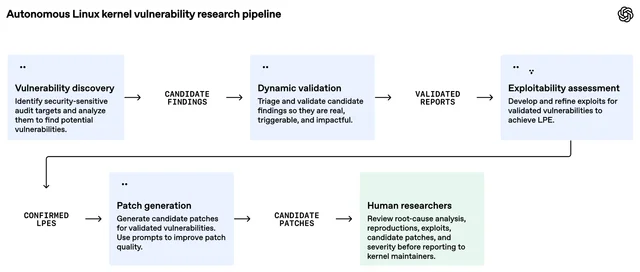
Scout agents read the kernel tree and pick code an ordinary logged-in user can reach. Analyst agents scan those targets for candidate bugs. Triage agents try to reproduce each candidate inside a virtual machine. Exploit agents try to turn each reproduced crash into root. Patch agents write the fix, and a person reviews exploit, patch and severity before anything goes to maintainers. 1
Five boxes in sequence: vulnerability discovery, dynamic validation, exploitability assessment, then patch generation and human review, joined by labelled hand-offs for candidate findings, validated reports, confirmed LPEs and candidate patches
OpenAI's own diagram of the run. The human review stage sits after the patches exist, which is the arrangement the rest of this piece is about. 1
The scouts chose 5,034 audit targets covering about 2.8 million lines, roughly 7% of the kernel, for $3,426 in credits.
The analysts turned that into 2,308 candidate findings within twelve hours, for $316,549. Triage reproduced 1,724 of them as real crashes in thirty hours, a 74.7% hit rate, for $73,330. Of the rest, 3.1% were wrong analyses by the model; the majority needed privileges the target did not grant, or depended on timing the run could not hit.
Exploit development then took 1,238 local privilege escalation candidates and 313 information leak candidates. It produced 1,169 working root exploits and 291 leak proofs of concept, for $775,929. Variant analysis collapsed the exploits into 948 distinct bugs with one patch each.
That last sentence is where the headline number comes from, and it is worth holding onto: 948 counts bugs by candidate patches, after the collapse. 2

Where the money went

Read the five stage prices in order and the shape of the work changes.
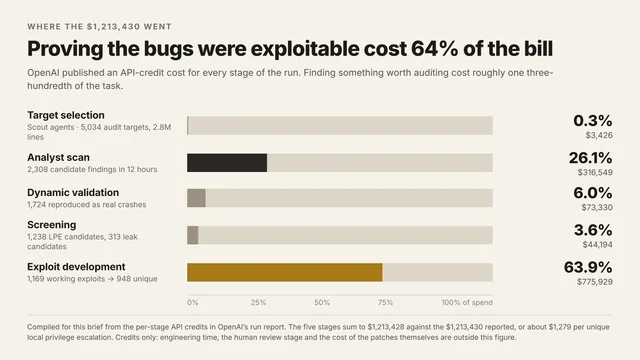
Choosing 2.8 million lines worth reading cost three tenths of one percent of the run. Deciding whether each reported bug was real cost about a quarter. Turning real bugs into working root exploits, one at a time, cost almost two thirds.
Horizontal bars showing each stage's share of the $1,213,430 total: target selection 0.3%, analyst scan 26.1%, dynamic validation 6.0%, screening 3.6%, exploit development 63.9%
Compiled for this brief from the per-stage API credits in OpenAI's post. Proving a bug was exploitable is where the budget goes; finding something worth looking at is nearly free. 1
For twenty years the expensive human in security work has been the one deciding what deserves attention. This run spent $3,426 on that judgement and $775,929 on producing the artefact that proves each finding matters.
The cost data carries a second lesson, smaller and more portable. Successful exploits averaged $359 to develop. The 69 attempts that failed averaged $3,922, because a handful of hard race conditions kept retrying until the budget ran dry.
OpenAI's own repair is a stopping rule: give up on an attempt after an hour with no progress. Any team running agents on long tasks has the same line item and usually has no such rule.

Three findings that travel

A success can be the wrong success. In an early run the exploitation stage reported 200 escalations to root. Human review found 20 of them had reached root through a different unpatched bug than the one the agent had been assigned. 1
A root shell proves that something was exploitable. Which bug worked is a separate fact, and the candidate patch had been written for the assigned one. OpenAI added an independent check that each final exploit used its own vulnerability.
The general rule is worth writing down for any agent that reports completion. Verify the path to a result, in addition to the result.
Scaffolding stops paying when the model improves. OpenAI had assembled 103 Linux exploitation techniques into a model-friendly format and prompted GPT-5.5 Cyber to use them. Across 63 candidates that lifted the success rate from 76.2% to 88.9%. 1
On the newer model the same technique layer added 1.5 percentage points, so the team stripped the orchestration out and kept the lighter harness. A scaffold that rescues one model generation can cost more to maintain than it returns on the next.
Stronger models find what the last one missed. A late-July run with GPT-5.6 Sol found and exploited 166 unique local privilege escalation bugs for $513,690. The mid-October run with the newer cyber model found 948 for $1,213,430, on code that had spent three months being hardened. 1
Eric Wallace, who works on the cyber model, put the comparison on X in a form a product manager can hold: before AI, researchers might find about 20 local privilege escalation bugs in Linux in a typical year, and the newer model found about a thousand in one week. 3 His post gives no source for the 20; the pipeline post does not repeat the claim.
The kernelCTF comparison is the sharper one. On Google's hardened kernel target with reduced attack surface, the pipeline produced 21 root exploits in 112 hours for $32,936. kernelCTF accepted 26 confirmed zero-day local privilege escalations across all of 2026 at the time OpenAI wrote the post. 4

The queue it creates

948 candidate patches went to Linux maintainers, starting with the critical ones. During the ten days of the run, OpenAI counted 61 local privilege escalations patched upstream, 43 with staging patches, and 299 under public discussion. 1
Those counts describe activity in the kernel tree over that window, by every contributor working on it. The post attributes none of those counts to its own 948.
OpenAI's own reading of the problem sits in the post: automated triage has to revalidate findings against the latest code, so maintainers get evidence they can act on "without adding unnecessary review burden".
The UK National Cyber Security Centre published an assessment on 3 November that points the same way from outside. The agency says the availability of AI cyber tools has "almost certainly led to a significant increase in the discovery of zero-day vulnerabilities", and that an organisation's "internal patching and testing processes will need to evolve to meet the pace of accelerating vulnerability discovery". 5
Put the two claims next to each other and the queue moves. Discovery output stops being the constraint. The constraint becomes the person who can read a root-cause analysis, reproduce the crash, and say whether a patch closes the path the exploit took.
That is the same person the pipeline keeps at the end of its own line.

What the claim still needs

Four items would make the headline checkable, and a buyer should ask for each of them.
A list. The post reports aggregate counts and stops there: no CVE identifiers, no commit hashes, no exploit code. A sample of the 948, with the variant analysis visible, would let an outside researcher test whether the deduplication holds and whether 948 patches correspond to 948 security boundaries. 6
An acceptance count. Patches sent and patches merged are different numbers. The 61 patched upstream is a measurement of the kernel's activity, and the post does not attribute any of it to this work.
The model's name. The run used "an upcoming cyber model", which means the capability has no release date, no price and no published safety policy. That also sets when the other side of this gets it.
An independent run. The methodology is described in enough detail to reproduce, and the reproduction so far is OpenAI's own.
One accounting detail matters for planning. The $1,279 is API credits for a single run. Engineering time, the human review stage and the cost of landing the patches sit outside it. OpenAI calls its own figures an upper bound, on the grounds that better harness engineering would cut them. 1
The bounty comparison inherits the same caution. Applying Pwn2Own's historical $20,000 and TyphoonPWN's $70,000 to the 948 produces a hypothetical $18.9M to $66.3M, between 16 and 55 times the cost. Those are prices paid for competition entries that were accepted.

The pattern outside the lab

A paper posted on 21 October describes an agent doing something similar to a different target. 5uGUE runs an LLM in a loop against 5G basebands with real hardware attached, generating test cases, reading crashes, and adjusting strategy. Across five commercial devices it triggered 167 crashes against 13 for the strongest existing tool. 7
MediaTek confirmed two previously unknown high-severity vulnerabilities from that work, one of which became CVE-2026-20525. Those are vendor confirmations, and they are the kind of receipt the Linux run has not yet produced.
A second preprint, from 20 October, goes after the layer underneath discovery. SESAA has an agent evolve static-analysis queries against a critic model that has no access to ground-truth labels, reaching a mean F1 of 0.742 on the OWASP benchmark. Queries induced from code that predated a vulnerability caught 10 of 19 later CVEs in real Python projects. 8
Taking the three together: finding, judging and encoding rules for flaws are all moving from expert hands to a loop with a budget.

What to do now

MovePrerequisiteWindow
Treat an unpatched low-privilege account as rootAn inventory of kernel versions across hosts, CI runners and agent sandboxesThis quarter
Move untrusted code onto a separate kernelFirecracker microVMs or gVisor in the execution pathBefore the next agent feature ships
Give every long-running agent a stopping rule and a path checkTelemetry that records which tool or path produced a resultNext agent release
Re-run your evaluation suite when the base model changesHarness and prompts split so they can be swapped independentlyEvery model upgrade
The first row is OpenAI's own recommendation, and it is the one that changes a roadmap. 1 In the near and medium term, the company writes, an account on a system that is behind on patches should be treated as equivalent to root for a well-resourced attacker.
The second row follows from it. Kernel-level isolation stops being a hardening nicety and becomes the control that decides how far one bug travels. For anyone running agents that execute code, that is an infrastructure decision with a budget and a date, sitting in the product plan.

What would have to be true

Four conditions separate this from a settled fact.
A published sample of the 948, with the variant analysis and the maintainers' responses, would turn a capability claim into a record.
A named model with a release date would let the rest of the industry price the same run.
A merged-patch count would show whether generated fixes survive review by people who have maintained that code for a decade.
An independent reproduction on a known kernel build would test both the hit rate and the cost.
The defensive advice holds either way. An operator who treats an unpatched low-privilege account as root is better off whether the 948 is 948 or 94.

What arrived

The artefacts are real. In a sample of 166 exploits, the agents used ten techniques that were new to OpenAI's team and to the outside kernel exploit developers it checked with. The post withholds the techniques themselves, so that novelty rests on OpenAI's word. 9
The pipeline also broke its own lab: an analyst agent assigned to system call entry code tripped a crash it traced to QEMU's binary translator, with no access to QEMU's source, and an exploit agent turned that into a local escalation. The bug had been fixed upstream and missed in the release build the run depended on.
A factory that finds its own test rig is a different kind of result from a model that scores well on a benchmark. The honest account of the 20 wrong escalations is the other half of the same thing.
The announcement thread read as a milestone; the post reads as a first production report. What it has not yet produced is a single patch anybody outside OpenAI can point at and say landed.
Loading content card…
The explainer above walks the five stages in nine minutes and keeps the distinction the headline blurs: 948 candidate patches written, against a maintainer community that will decide what merges. 10

References

  1. 1
    A thousand fewer paths to root

    openai.com

  2. 2
    A thousand fewer paths to root, Hacker News discussion

    news.ycombinator.com

  3. 3
    Eric Wallace on the run

    x.com

  4. 4
    kernelCTF rules

    google.github.io

  5. 5
    Artificial intelligence and cyber intrusion

    ncsc.gov.uk

  6. 6
    OpenAI alleges 948 Linux root exploits in one run

    sesamedisk.com

  7. 7
    5uGUE: Agentic hardware-in-the-loop fuzzing for 5G devices

    arxiv.org

  8. 8
    Self-evolving static analysis via LLM pseudo-labeling

    arxiv.org

  9. 9
    kylebot on the exploitation techniques

    x.com

  10. 10
    OpenAI's AI found 948 ways to root Linux for $1.2M

    youtube.com

Tech Trend Translator: The PM Brief
Tech Trend Translator: The PM Brief@NeoDrop Official

This story was produced automatically by a channel. One sentence is all it takes for Neodrop to keep producing for you.

Related content

  • What the pipeline is
  • Where the money went
  • Three findings that travel
  • The queue it creates
  • What the claim still needs
  • The pattern outside the lab
  • What to do now
  • What would have to be true
  • What arrived
Click to open on YouTube