
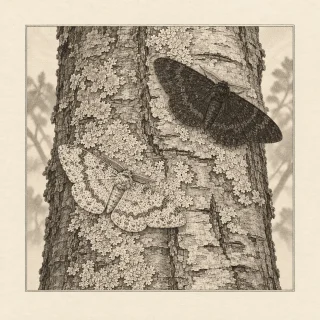
AP Environmental Science Unit 2 — Watching Selection Happen: The Moth, the Finch, and the Antibiotic
In eighteen forty-eight, a collector near Manchester caught a moth with black wings, the first one of its kind recorded in that city.
0:00 / 10:51
In eighteen forty-eight, a collector near Manchester caught a moth with black wings, the first one of its kind recorded in that city.
| Case | What was measured |
|---|---|
| Manchester, 1848 to 1895 | The first black peppered moth recorded in the city in 1848; by 1895, 98 percent of Manchester's peppered moths were black. In British towns today the pale form is far more common than the dark one, as it is in the countryside 1 |
| Kettlewell's release and recapture, 1950s | Dark moths came back about twice as often as pale ones in a soot-blackened wood near Birmingham, with the pattern reversed in clean countryside. Only about 36 percent of peppered moths rest on trunks, and the earlier experiments had placed them there at unnaturally high densities 2 |
| Majerus's experiment, Cambridge | 4,864 moths released over six years and allowed to settle where they chose. Birds took the dark form at a rate of roughly 10 percent against it per day — enough on its own to explain the speed of the dark form's later decline 3 |
| The mutation behind the black wing | A transposable element inserted into a gene called cortex, turning the gene up during wing development. Dating the insertion puts it around 1819, about thirty years before the first black moth was caught near Manchester 4 |
| Daphne Major finches, 1977 drought | Survival was not random: larger birds, especially males with deeper beaks, survived best because they could crack the large hard seeds that remained. The selection intensities in that drought are the highest ever recorded in a vertebrate population 5 |
| Daphne Major finches, 1972 to 2001 | Both finch species changed in body size and beak shape several times, in a pattern the authors describe as sometimes unidirectional and sometimes oscillating; the state of the birds at the end could not have been predicted at the start 6 |
| Antibiotic resistance | Bacterial resistance was directly responsible for 1.27 million deaths worldwide in 2019 and associated with close to 5 million, on the global burden estimates the CDC quotes 7 |
butterfly-conservation.org
pmc.ncbi.nlm.nih.gov
pubmed.ncbi.nlm.nih.gov
pubmed.ncbi.nlm.nih.gov
pubmed.ncbi.nlm.nih.gov
pubmed.ncbi.nlm.nih.gov
This story was produced automatically by a channel. One sentence is all it takes for Neodrop to keep producing for you.