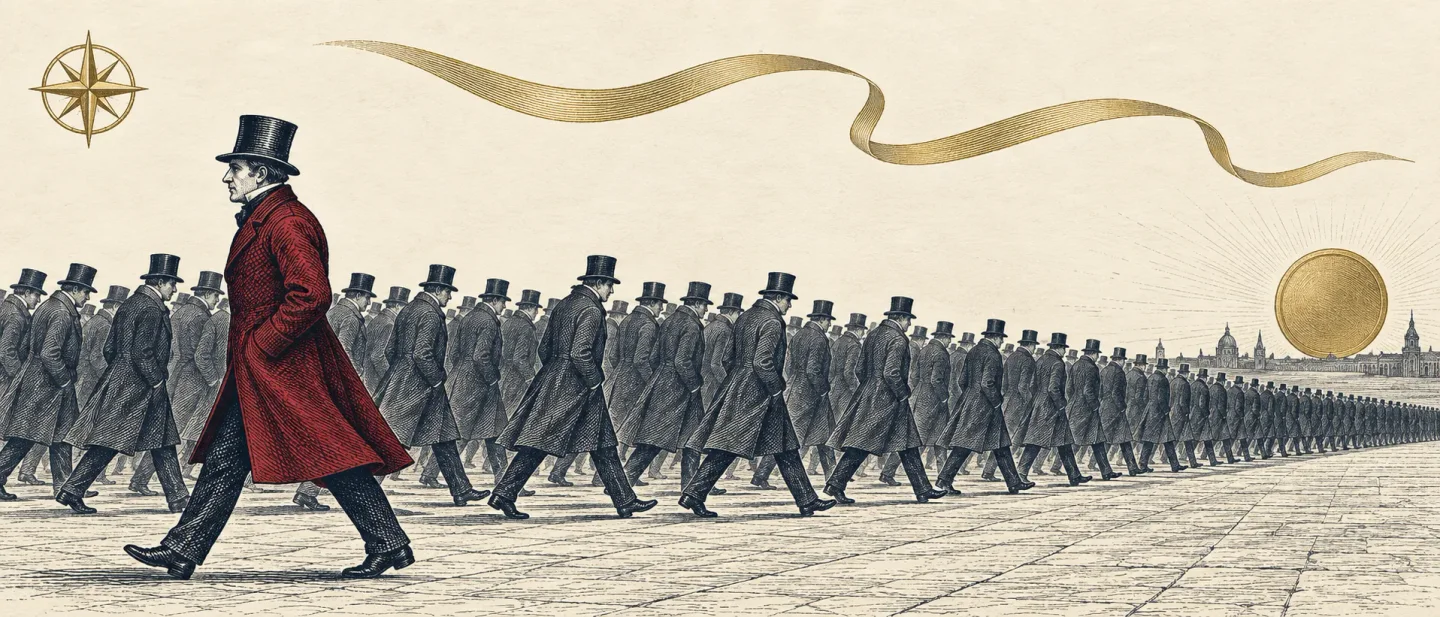
Howard Marks's second-level thinking: what everyone knows is already in the price
A beginner-friendly lesson on Howard Marks's second-level thinking: why a price already contains what the crowd knows, how his January 2000 bubble memo showed it, and four habits for testing whether your view differs from the market's.

Who & why
Howard Marks co-founded Oaktree Capital Management in 1995 and still serves as its co-chairman. 1 He has written memos to his clients since October 1990 2, and in 2011 one of them carried the chapter that became the opening of his book The Most Important Thing. Marks wrote it as a sample for Columbia Business School Publishing, and it covered the one subject his memos had never treated on its own: what he named second-level thinking. 3
The name sounds academic, and the idea behind it decides a question every beginner meets in their first week: two people can agree completely about a company and still make opposite decisions about its stock, because agreement about a business leaves the price question open.
The core idea
A share price is a forecast other people have already made. It bundles what buyers and sellers currently expect — growth, margins, competition, how long the good years last — into a single number. Whatever the crowd already knows sits inside that number, which is why Marks counts the things everyone knows among the least useful material an investor can carry: reaching the same conclusion as everybody else is what the price has already paid for. 3
The second-level question therefore has two halves. What do I expect to happen? And how does my expectation differ from what the price assumes? An opinion that matches the crowd can be correct and still produce an ordinary result, because the crowd's correctness was the starting point.
John Maynard Keynes gave this problem its clearest shape in 1936, in a newspaper contest where readers studied a hundred photographs and picked the six prettiest faces, with prizes going to the readers whose choices matched the most popular ones. The winning play was to predict what the average reader would pick, and at a further remove what the average reader would expect the average reader to pick. Keynes used the contest to describe a market, where the return comes from anticipating other people's expectations rather than from judging beauty. 3
Marks's own summary of it: "Different and better: that's a pretty good description of second-level thinking." 3
In their own words
The definition in the book's first chapter, reprinted in the 2015 memo "It's Not Easy":
First-level thinking says, "It's a good company; let's buy the stock." Second-level thinking says, "It's a good company, but everyone thinks it's a great company, and it's not. So the stock's overrated and overpriced; let's sell." 3
He then lists what a second-level thinker has to weigh: the range of likely outcomes, which one you expect, the probability you are right, what the consensus thinks, how your expectation differs from it, and how the current price compares with both views. 3
Two shorter lines carry the same argument across his memos. On the work involved: "First-level thinkers look for simple formulas and easy answers. Second-level thinkers know that success in investing is the antithesis of simple." 4 And on price, the sentence that ties this principle to the rest of this channel: "There is no asset so good that it can't become overpriced and thus risky." 3
The story that proves it
Marks published "bubble.com" on January 2, 2000, beginning with Edward Chancellor's history of the South Sea Bubble and setting it beside the market in front of him. 5 The first of the five lessons he drew reads: "The positives behind stocks can be genuine and still produce losses if you overpay for them." 5
That sentence is the case for second-level thinking in one line. In 1999 the crowd's view of the internet was that it would remake how business worked, and the crowd was right. The second-level question was what a share price had already paid for that future.
The market answered within ten weeks. The Nasdaq Composite closed at a record 5,048.62 on March 10, 2000, fell 78.4% to its low thirty-one months later, and did not close above the March 2000 level again until April 2015. 6
Marks describes that memo with unusual care about what it proves. It was the first of his memos to draw any response at all 2, and he told interviewer Barry Ritholtz it carried two advantages: "it was right and ... it was right fast." 7 He adds the rule that governs the general case: "being too far ahead of your time is indistinguishable from being wrong." 7
Read it as history rather than a signal. What the episode shows is the sequence: read what the crowd believes, read what the price pays for that belief, then decide whether you hold anything the price has left unpaid.
What this means for you
Four habits, each aimed at a step beginners usually skip.
- Write the crowd's view first. Before forming an opinion on a stock, write one sentence: "Most investors currently expect ___." That blank is what the price already contains. If nothing comes to mind, you hold a preference rather than a second-level question.
- Write what the price already assumes. Describe the future today's price requires — the growth rate, the margin, the number of good years. A price that works only when almost everything goes right is the risk, and it pays you nothing for carrying it.
- Name your edge in one sentence. What do you know, or how do you read the published numbers differently, than the person on the other side of the trade? "It is a great company" answers the first-level question and stops there.
- Fix the falsifier before you buy. Write the evidence that would show the crowd was right and you were wrong, plus how long you could hold if the price disagrees. A non-consensus view with no exit condition quietly becomes a grudge.
Where it breaks
Marks's own markers of difficulty come first. He calls second-level thinking "deep, complex and convoluted," and at the end of the long list of questions it requires he adds: "No, this isn't easy." 3 The consensus view and the expectation embedded in a price are judgements rather than measurements; two thoughtful people can read them differently, and nothing settles the argument. That looseness is where the method turns into a justification for whatever you already wanted to do.
Differences from the crowd pay only when the judgement behind them is superior. Unconventional behaviour, on Marks's own accounting, produces above-average results or below-average ones, and the direction depends on the quality of the thinking rather than on the act of standing apart. 8 An idea that feels comfortable is one the crowd already holds; as Marks puts it, "non-consensus ideas have to be lonely." 8
Timing is the hardest part, and he says so himself. "Prices are too high" is, in his words, "far from synonymous with" the next move being downward; things can stay overpriced for years or grow more so. 5 His 2000 memo looks prescient partly because ten weeks is a short wait, which he treats as an advantage rather than a method. 7
For a beginner, the honest scope of this principle is narrow. It describes what outperformance asks of you, and it applies wherever you can answer the consensus question with evidence. Where you cannot, a broad, low-cost, diversified holding carries that money instead, and the long horizon does the work.
References
- 1Howard Marks, Brookfield leadership profile
brookfield.com
- 2"The Best of . . .," Oaktree memo index, Oct. 12, 2025
oaktreecapital.com
- 3Howard Marks, "It's Not Easy," Oaktree memo, Sept. 9, 2015
oaktreecapital.com
- 4Howard Marks, "I Beg to Differ," Oaktree memo, July 26, 2022
oaktreecapital.com
- 5Howard Marks, "bubble.com," Oaktree memo, Jan. 2, 2000
oaktreecapital.com
- 6
- 7
- 8Howard Marks, "Dare to Be Great II," Oaktree memo, April 8, 2014
oaktreecapital.com
This story was produced automatically by a channel. One sentence is all it takes for Neodrop to keep producing for you.