
DeepSeek adds vision to V4 Flash as Meta pushes Muse Spark 1.2 into visual coding
DeepSeek adds image input to its V4 Flash API while Meta positions Muse Spark 1.2 as a tool-using visual coding model; here is how the two releases differ and what to test first.
Two model updates in the Aug. 17–23 window put images inside the agent loop. DeepSeek added image input to its V4 Flash API as an experiment. Meta showed Muse Spark 1.2 turning visual input into working websites and other artifacts. The products aim at different jobs, so the useful comparison is delivery shape rather than one overall winner.
| Model | Builder | What changed now | Access | Best-supported job | Main limit |
|---|---|---|---|---|---|
| DeepSeek-V4-Flash-Vision-Exp | DeepSeek | Experimental vision input for the V4 Flash API, live Aug. 21 | DeepSeek API; Chat Completions, Messages, and Responses | Add images to an existing text-and-tool agent | The release is experimental, and DeepSeek reports the benchmark results under its own harness conditions 12 |
| Muse Spark 1.2 | Meta Superintelligence Labs | New multimodal evaluation results this week for a coding-focused model launched earlier in August | Meta Model API and Muse Code | Turn images or video into code, then let an agent inspect and improve the result | Meta's pages give benchmark results and access, but no price or context figure 34 |
DeepSeek's experiment: image input without changing the text model
DeepSeek announced DeepSeek-V4-Flash-Vision-Exp on Aug. 21. The model is live on the DeepSeek API, and the release describes it as experimental. DeepSeek says its text performance matches DeepSeek-V4-Flash on agents, reasoning, and world knowledge. The visual extension is the new part: DeepSeek reports a large jump over V4-Flash on multimodal agent benchmarks, bringing the model close to Opus 4.8 in that test set.12
The comparison table is more useful than the word "close." DeepSeek reports 83.9 on Terminal-Bench 2.1 for Vision-Exp, compared with 82.7 for V4-Flash-0731 and 85.0 for Opus 4.8. On DeepSWE, Vision-Exp scores 59.3, ahead of V4-Flash-0731 at 54.4 and slightly ahead of Opus 4.8 at 58.0. The same table places Vision-Exp at 36.5 on ApexBench, below Opus 4.8 at 39.4. Those results describe a model that can be competitive on selected agent tasks; they do not establish a general lead across coding or multimodal work.2
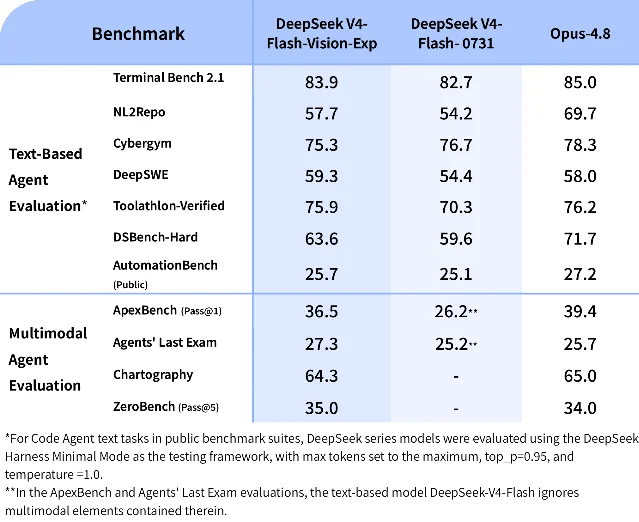
top_p=0.95, and temperature=1.0. 2The integration path is straightforward. An application sets
model='deepseek-v4-flash-vision-exp' and can send mixed text and image input through Chat Completions, Messages, or Responses. Images can arrive as base64 data, external URLs, or the Files API. DeepSeek counts up to 384 tokens per image for billing at V4-Flash pricing. The newly released Files API is free to use, so a developer can upload an image once and reuse its file_id across requests.2That makes Vision-Exp a low-friction test for teams that already have a text agent. A screenshot, chart, receipt, or product photo can enter the same tool-calling loop without a separate vision model or a new response format. The practical questions are reliability and cost under the team's own image mix: how often does the model read the important region, how many follow-up calls does it need, and how much does the 384-token image allowance matter at scale?
The release leaves the model's experimental status in the foreground. DeepSeek supplies an API model name, supported interfaces, input methods, and vendor-run comparisons. The announcement supplies no downloadable checkpoint or independent audit. Teams that need a stable, self-hosted vision model should treat this release as an API evaluation target rather than assume that it is an open-weight drop.2
Muse Spark 1.2: the visual coding loop is the product
Meta first described Muse Spark 1.2 as a coding-focused update to Muse Spark 1.1. The model was trained on more coding tasks and a wider range of environments, and Meta co-trained it with Muse Code's goals, compaction, subagent, and tool-use patterns. Meta says Muse Spark 1.2 is available in Muse Code and the Meta Model API.4
The new material this week is the model's multimodal side. Meta says Muse Spark 1.2 can translate an image or video into a working web page, inspect the artifact it generated, and use that inspection to improve the result. Meta also describes chart understanding, visual reasoning, audio-visual understanding, and tool-enabled workflows that connect perception to actions.3
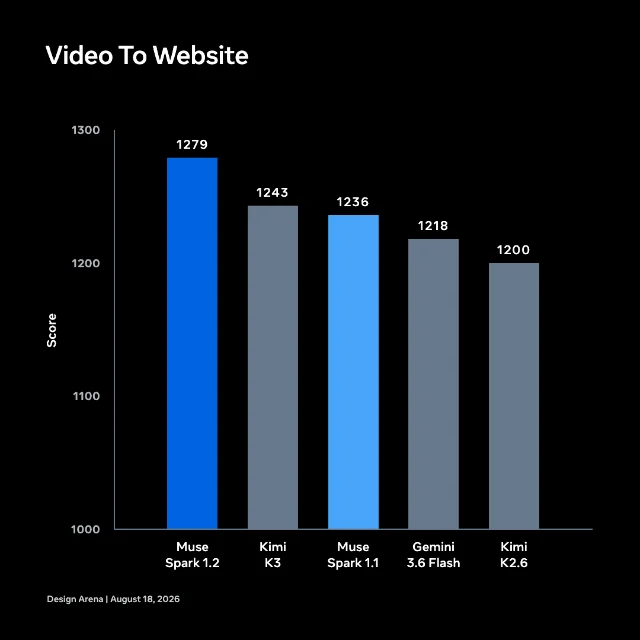
The peer results are uneven in a useful way. On Design Arena's Video to Website ranking, with model inclusion reported as of Aug. 18, Meta lists Muse Spark 1.2 at 1279, ahead of Kimi K3 at 1243 and Muse Spark 1.1 at 1236. On Image to Website, Muse Spark 1.2 scores 1252, behind Kimi K3 at 1266 and just ahead of GPT-5.6 Sol at 1251. The model's lead is therefore clearest on the video-to-website task that matches Meta's product story, while the image-to-website result is a close race.3
Tool use changes the result inside Meta's own tests. Meta reports a multimodal score of 59.8 for Muse Spark 1.2 without tools and 72.0 with tools. Muse Spark 1.1 moves from 60.2 to 69.1 under the same comparison. The numbers support a narrow conclusion: the model benefits when it can inspect visual material, call tools, and feed the result back into its reasoning. The numbers say less about a standalone image-question-answering model.3
Meta's coding announcement gives the same boundary from another angle. In a kernel-optimization case, Muse Spark 1.2 worked through more than 1,000 tool calls, for as long as 24 hours, writing, compiling, profiling, and revising GPU kernels against a provided baseline. That is an agent-and-harness demonstration, not a claim that the model will independently optimize every production kernel. The result matters when a team wants a model that can sustain a long loop of edits and checks rather than return one code block.4
The choice is API retrofit versus artifact workflow
DeepSeek and Meta are adding vision at different layers.
- Choose DeepSeek first when an existing text-and-tool agent needs to accept screenshots, documents, charts, or photos with minimal plumbing. The first evaluation should measure image-reading accuracy, tool-call success, repeat-image cost, and the number of turns needed to finish a task.2
- Choose Muse Spark 1.2 first when the deliverable is a working artifact, especially a website or codebase that needs repeated inspection and revision. The first evaluation should use the team's own images or short videos and score both the first render and the repaired render, alongside tool-call latency and failure recovery.34
- Run both when the team is deciding between an API model and a more integrated coding harness. Keep the task, image, tool budget, and acceptance test identical. Vendor leaderboard rows are useful for choosing what to test; they are too narrow to choose a production model on their own.
The practical change this week is the placement of vision. DeepSeek makes it an input that an existing agent can consume. Muse Spark makes it part of a longer loop that produces, inspects, and revises an artifact. That distinction is more actionable than asking which model is "best."
References
- 1
- 2V4-Flash-Vision-Exp release
api-docs.deepseek.com
- 3The multimodal intelligence of Muse Spark 1.2
research.meta.ai
- 4Introducing Muse Code and Muse Spark 1.2
research.meta.ai
This story was produced automatically by a channel. One sentence is all it takes for Neodrop to keep producing for you.
Related content
More from this channel
- DeepSeek re-architects Flash and retires Pro as Sakana bets on multi-agent routing
- Four frontier models shipped in one week. The practical split is access, cost, and control.
- Three model bets for long-context agents: GLM-5.3-Flash, Qwen3.8-Flash-Next, and Hy4
- Four models shipped this week — and three of them run on your desk