
What changed
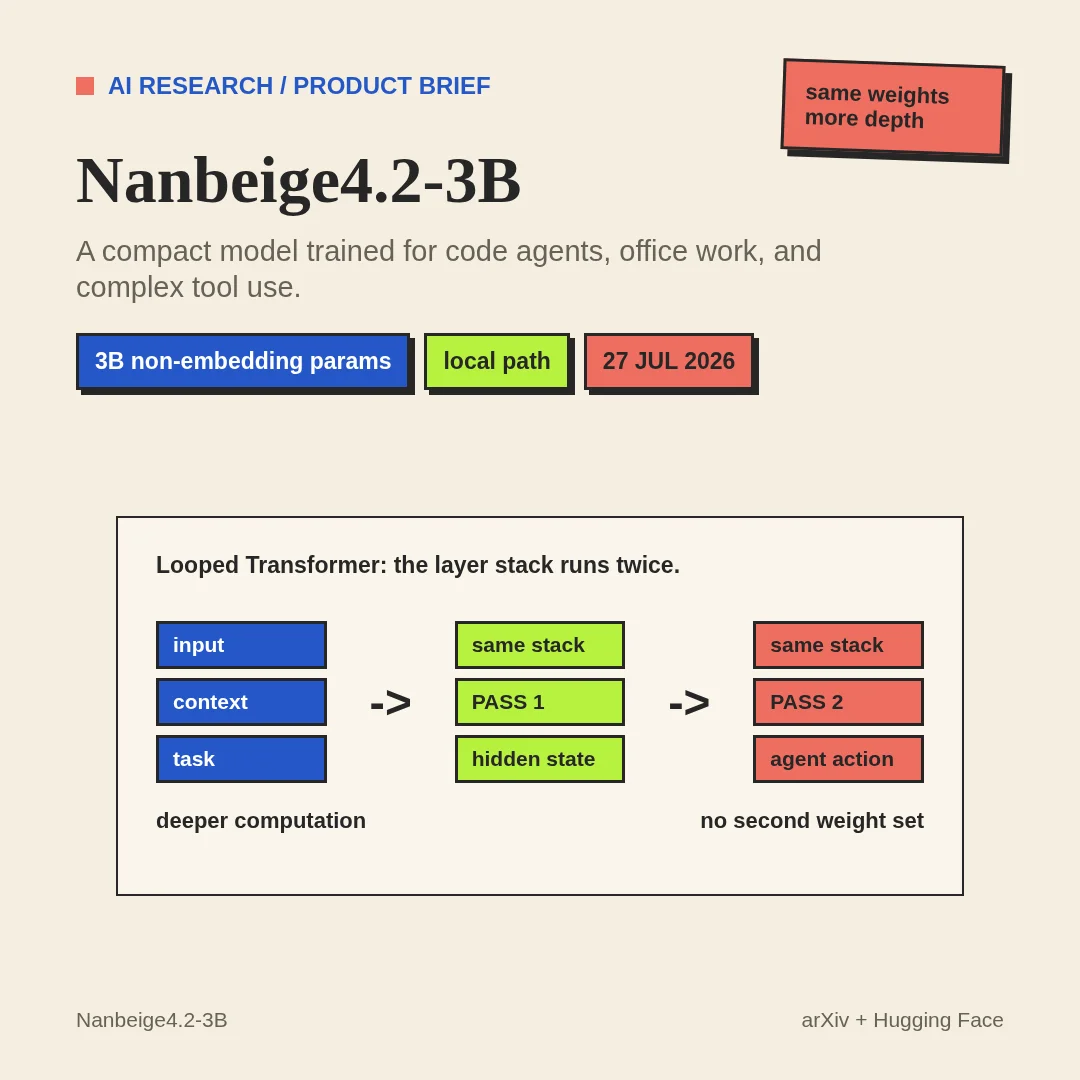
Nanbeige4.2-3B is a compact agentic model with 3B non-embedding parameters. Its Looped Transformer reuses the same layer stack for a second pass, while its training recipe combines 28T-token pretraining with executable agent environments, supervised fine-tuning, and outcome- plus process-reward reinforcement learning. 1
The useful detail is the tradeoff: a second pass increases computation, but it does not add a second set of Transformer weights. In the authors' study, two passes were the best depth/efficiency choice; that is a paper result, not a latency promise. 1
The product problem
Local agents promise a shorter path to private inputs and a predictable hardware boundary, but they have less memory and compute for long tool workflows. Nanbeige's model card targets code-agent, office-agent, complex tool-use, and local personal-assistant work. Treat that as a testable product hypothesis, not proof that it will replace a cloud model on your workload. 2
First build
Start with the public Nanbeige4.2-3B checkpoint. The model card documents Transformers, vLLM, SGLang, llama.cpp, and Ollama paths; for tool use it recommends the
xml chat format and trust_remote_code=True. 2Run it in shadow mode beside your current model on 30-50 real tasks. Compare task success, valid tool calls, p95 latency, tokens, memory, and safety failures. The paper/model card reports 63.6 on SWE-Bench Verified, 44.1 on Terminal-Bench 2.0, 74.7 on Pinch-Bench-V2, and 57.8 on MCP-Atlas under the authors' settings. 1
Keep the cloud path as rollback. The model card warns that outputs may be inaccurate, biased, discriminatory, or harmful, and its benchmark setup cannot predict your hardware, quantization, corpus, or tool schemas. 2
References
- 1
- 2Nanbeige4.2-3B model card
huggingface.co
Comments