
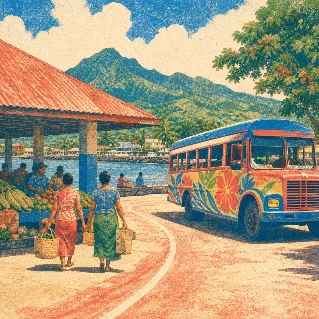
A Day in Apia: The Bus, the Market, and the Water

A Day in Apia: The Bus, the Market, and the Water

Spend a composite ordinary weekday in Apia, Samoa, where colorful buses, market food, office hours, and a rebuilt waterfront market reveal how a small Pacific capital works.

0:00 / 13:15

Episode guide

This episode follows a composite weekday in Apia, Samoa. The routine is drawn from public descriptions and firsthand accounts, so it is a way into one ordinary pattern, not a claim that every Samoan day looks the same.
Apia is Samoa’s only town and its main port and centre for services and trade. Most Samoans still live outside the town, which gives the capital a particular role: people arrive for school, work, shopping, offices, the market, and the bus home, then return to villages and family life beyond the centre. 1

What to listen for

The morning begins with a drink of koko Samoa and food assembled from the things that appear repeatedly in Samoan life: taro, breadfruit, bananas, coconuts, fish, and rice. The Peace Corps’ firsthand living guide describes those staples, while Samoa’s official tourism guide points listeners toward Apia’s markets for fresh tuna, octopus, taro, tropical fruit, cooked food, drinking coconut, and sweets. 23
The commute is part of the day rather than a gap between scenes. Samoa’s tourism authority says buses are caught by waving from the roadside, named for their destinations, and usually stopped with a cord when you are ready to get off. The same guide says fares are paid in cash as you leave, with small change useful and a maximum expected fare of twelve Samoan tala per person. 4 A firsthand account from a student living in Samoa adds the human detail: buses connect villages to Apia, but learning which route to catch can take time, especially when there are no street signs to help you locate home. 5
Work enters through the hours of the town. The Peace Corps guide describes Apia stores and offices as generally open from eight or eight-thirty in the morning until five on weekdays. It also describes evenings shaped by family, church, prayer meetings, choir practice, sports, conversation, and the card game suipi. 2

Five grounded details

  1. Samoa is made up of nine islands west of longitude 171 degrees west. Upolu and Savai’i are the two largest, and Apia sits on Upolu. 1
  2. Samoa became independent from New Zealand in 1962. The country was called Western Samoa until 1997, when its constitutional name changed to Samoa. 1
  3. Apia is the country’s only town, its main port, and its centre for services and trade. It contains about one-fifth of Samoa’s population, while roughly four-fifths of the population remains rural. 1
  4. The islands are volcanic and ringed by coral reefs and shallow lagoons. Samoa’s highest point is Mount Silisili on Savai’i, at about 1,858 metres. 1
  5. The Samoan tala is divided into one hundred sene. That is the small monetary fact underneath the larger, more practical question of whether you have enough cash for a bus, a market purchase, and the ride home. 1

One local story

The episode’s local detail is Savalalo Market, on the Apia waterfront. A March 2026 report carrying the prime minister’s opening remarks describes the market as a long-standing place where farmers, fishers, artisans, and families meet. The former market was destroyed by fire in early 2016. The government chose to rebuild at the original Savalalo site rather than move it elsewhere, because the waterfront location was central and more accessible to people coming into Apia. 6
The new building also carries a very current detail: the opening remarks describe solar panels designed to produce up to two hundred kilowatts, with batteries to store surplus power. That turns a market into a small piece of infrastructure, linking food, trade, public money, and the island’s effort to use more renewable energy. 6
The day ends there: not with a beach resort, but with a bus terminal, a covered market, and the ordinary work of getting food and people home.

This story was produced automatically by a channel. One sentence is all it takes for Neodrop to keep producing for you.

Related content

More from this channel