Claude Opus 5.5 and GPT-6 Sol land ninety minutes apart and cheaper, twenty governments ask for a frontier-AI verification body, and a paper says the scaffolding is optional
A daily brief on the two frontier models both cut in price on the same Tuesday, the twenty governments asking for an international body to verify frontier AI, the banks writing the first principles for shopping agents, and two preprints on where test-time compute actually pays.

This edition covers AI developments published between September 22 at 08:15 and September 23 at 08:15 in Dhaka. Tuesday put two frontier models on the market ninety minutes apart, and both arrived cheaper than the models they replace. Twenty governments and the European Commission asked for an international body to verify frontier AI, on the same day the United States renamed the technology at the General Assembly. And two preprints posted the same day argued that the elaborate scaffolding built around test-time compute is not where the remaining gains are.
Quick scan
| Development | What changed | Why it matters | What to watch |
|---|---|---|---|
| Two frontier models in one afternoon | Anthropic released Claude Opus 5.5, and OpenAI released GPT-6 Sol and Luna ninety minutes later. 12 | OpenAI halved the API price of its two mid-tier models, and Anthropic put Opus 5.5's tokens a fifth below Opus 5. 3 | Whether Google answers on Gemini pricing, and whether either lab's benchmark claims survive outside evaluation. |
| Twenty governments want a verification body | Leaders of twenty countries and the European Commission published a call for mandatory pre-deployment testing, shared reporting of serious incidents, and a new international institution. 4 | The signatory list names twenty governments; the two largest AI powers are absent from it. 4 | Wednesday's Security Council session, where Chinese labs have been invited to speak for the first time. |
| Banks ask shopping agents to identify themselves | NatWest, Bank of America, ING, Capital One and the Commonwealth Bank of Australia published principles for agentic commerce. 5 | The banks want disclosure when an agent is in a transaction, and say the technology is moving faster than consumer protection. 5 | Whether disclosure becomes a rule, or stays a set of principles retailers can ignore. |
| Meta's Muse loses one feature and gains one | Meta rolled back a test that had contractors place Muse's phone calls, and patched a zero-day in the Muse macOS app. 67 | Meta had advertised the agent's isolation and secure credential storage at launch. 7 | Whether the calling feature returns with the disclosures Meta now says it should have shipped. |
| A simpler recipe for test-time compute | Two preprints first submitted on September 22 report gains from repeatedly sampling edits to the best answer so far, and from a new way to attribute model outputs to weights. 89 | Both are unrefereed. One sets a new state of the art on circle packing while arguing that evolution strategies applied to model weights at test time make results worse. 8 | Whether the sampling recipe replicates on models the authors did not test. |
The price war reaches the frontier
Anthropic released Claude Opus 5.5 on Tuesday as the first model in a new Claude 5.5 family. The company says it performs at the level of Claude Fable 5.1, its previous top model, on most work, and costs 40% less to run than Claude Opus 5 on typical workloads. 1
Ninety minutes later OpenAI released GPT-6 Sol and GPT-6 Luna, trained with the same methods as GPT-6 Astra, the frontier model it launched earlier in September. 23 OpenAI cut the API price of both models by half against their GPT-5.6 promotional pricing, and attributed the cut to better caching and more efficient inference. 2
| Model | Input / output per million tokens | Change | Cached input |
|---|---|---|---|
| GPT-6 Luna | $0.10 / $0.50 | Half the GPT-5.6 Luna promotional price | 90% discount on cache reads 2 |
| GPT-6 Sol | $2 / $10 | Half the GPT-5.6 Sol promotional price | 90% discount on cache reads 2 |
| Claude Opus 5.5 | $4 / $20 | 20% below Opus 5, which was $5 / $25 | Reads $0.20, down from $0.50 1 |
| Claude Opus 5.5, fast mode | $8 / $40 | New tier, up to 2.5 times the output speed | Not published 1 |
Anthropic frames Opus 5.5 as an efficiency release. It says the model needs less compute to serve, generates output more than 30% faster than Opus 5, and uses fewer tokens per task, which is where the company's 40% figure comes from. 1 Opus 5.5 is also the first model Anthropic has shipped since its chief executive, Dario Amodei, published an argument that AI development should be paced so that safety practices stay ahead of capability. 1
Both releases carry capability restrictions alongside the price. Anthropic is routing most cybersecurity work requested of Opus 5.5 to the older Opus 4.8, and applying biology safeguards of the same class it uses on Fable 5.1, with vetted organisations able to apply for access through its Life Sciences Verification Program. 1 OpenAI says GPT-6 Sol and Luna inherit Astra's alignment work and make about half as many factual mistakes as their predecessors on an internal evaluation built from de-identified conversations where users had flagged an error. 2
Anthropic will follow with Claude Sonnet 5.5 and Claude Haiku 5.5 in the coming weeks. 1 OpenAI is rolling Sol and Luna out through ChatGPT gradually through the day, starting in ChatGPT Work and Codex for paid accounts; free and Go users get Luna in the desktop app, and neither model has reached the main ChatGPT interface yet. 23
What the cheaper tier actually buys
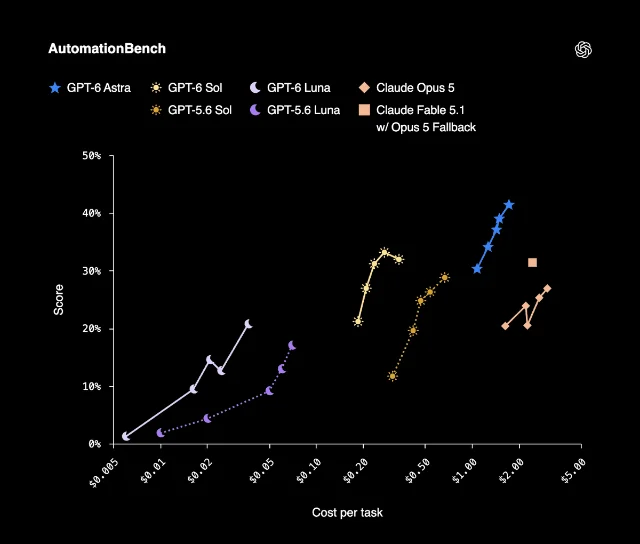
Read the two companies' numbers side by side and the honest picture is that neither has run a head-to-head. OpenAI reports GPT-6 Sol at xhigh effort scoring 33.2% on AutomationBench at $0.27 a task, against 26.9% for Claude Opus 5 at maximum effort and 11.1 times that cost. It also reports its own low-effort GPT-6 Astra at 30.3%, cheaper than Sol by a factor of 3.9. 2
Anthropic's table for the same benchmark reports Claude Opus 5.5 at 40.0% and OpenAI's GPT-6 Astra at 41.4%, with a footnote explaining that Zapier ran the Opus 5.5 numbers during early access without fallback models, so safeguard interventions counted as failures. 1 On OSWorld 2.0, a computer-use benchmark both labs report, Anthropic scores Opus 5.5 at 81.8% and OpenAI scores the older Opus 5 at 60.3% — an 11.5-point gap between two reports of the same model family, which the effort setting explains: Anthropic's headline results run at maximum effort, while OpenAI cites the medium-effort figure. 12
Anthropic says as much in its own release. "At these levels of capability we've found that benchmark margins have become a less reliable guide to real-world differences," the company writes, adding that in its own use the gap between Opus 5.5 and Fable 5.1 is narrower than the scores suggest. 1
What the reader can act on is the price. GPT-6 Sol and Claude Opus 5.5 now sit within a factor of two of each other on input tokens and two-and-a-half on output, and both landed cheaper on the tokens agent frameworks actually consume, because both companies leaned on cache reads. OpenAI cut cached input to a 90% discount; Anthropic cut Opus 5.5's cache reads by 60%, from $0.50 to $0.20 a million tokens, and says cache reads make up most of the cost of agentic and coding work. 12
Simpler sampling, and a first place for attribution
Two preprints first submitted on September 22 point in the same direction: the results are coming from how you spend inference, not from building more elaborate machinery around the model. Neither has been peer-reviewed.
The first, "Hill Sampling for Test-Time Scaling", from Jacob Beck, Philip Ogren and Ari Kobren, describes a deliberately simple procedure: sample candidate edits to a program from a frozen model, keep the best program found so far, and condition every later sample on it. 8 The authors report a new state of the art on circle packing among published methods and an improvement over the AlphaEvolve reference on Erdős's minimum-overlap problem, with the circle-packing and Erdős runs taking hours on eight Nvidia H100 GPUs. 8
The paper's more useful finding is a negative one. The authors ran what they describe as the largest study by parameter count of evolution strategies applied directly to model weights at test time, and found that learning the weights performed worse than setting the learning rate to zero — meaning the search that appeared to be working was coming from fixed random perturbations, and that plain token sampling beat both. Their recommendation is to keep sampling edits to the best verified solution before adding archives, diversity mechanisms or test-time parameter learning. 8
The second paper, "Matryoshka attribution", from Aryaman Arora and co-authors at Stanford, frames interpretability as the search for nested subsets of internal components that minimise a downstream loss, and learns a mask that orders components by how much they matter. 9 The authors report first place on the official leaderboard of the Mechanistic Interpretability Benchmark, and a practical result on safety: with reinforcement learning, their method found that restoring 1% of Llama 3.1 8B Instruct's weights to their base model state was enough to remove refusals while leaving capabilities intact. 9
A third preprint submitted the same day, "FAST-ML", applies a hybrid physics-and-machine-learning framework to tropical cyclone intensity, and reports roughly a 31% reduction in ensemble error at 60-hour lead times and a near halving of rapid-intensification false alarms on top of a physical baseline. 10
Twenty governments ask for a body to verify frontier AI
The week's biggest governance document is a short statement on the Finnish president's website. It was published on Monday and remains open for further endorsement. 4
Twenty-two signatures are attached, covering twenty countries and the European Commission: the prime ministers of Norway, Finland, Australia, Canada, Denmark, Estonia, Iceland, Ireland, the Netherlands, Singapore and Spain; the presidents of Finland, Kazakhstan, Kenya, Latvia, Moldova and South Africa; the chancellor of Germany; the foreign ministers of Bahrain and Türkiye; the deputy prime minister of the United Arab Emirates; and the president of the European Commission. 4 The United States and China are on neither the signatory list nor the list of countries that have endorsed it since. 4
The statement makes three asks: that companies publish transparent safety protocols including mandatory pre-deployment testing and independent evaluation, with qualified evaluators given enough access to assess risk; that governments and regional organisations coordinate common standards and share reports of serious safety incidents; and that United Nations member states explore creating an international institution able to set standards, enable verification and convene states when capability thresholds are crossed. 4
It opens by pointing at incidents rather than hypotheticals. "Recently we have seen capable AI systems circumventing testing safeguards, exploiting vulnerabilities and gaining unauthorized access to real-world systems," the statement reads. 4
Two things are moving in the opposite direction. In his address to the General Assembly on Tuesday, President Donald Trump said the United States was renaming artificial intelligence. "From this point forward, all of the United States documents, and hopefully the world's, will be changed to use the much more accurate term, super as opposed to artificial," he said, adding, "Let's see if I have any power. Maybe I do, and maybe I don't." 11 The name he announced was not among the three options in the poll he had posted on the subject days earlier. 11
And the AI czar Trump promised on Saturday now has a candidate. Treasury Secretary Scott Bessent could take the role, according to a source familiar with the discussions; the report was first published by Semafor, and a second source told Reuters no decision had been made. 12 Bessent already leads the administration's AI talks with Beijing, having proposed an AI safety notification mechanism in New York on Sunday. 12
Beijing's side of that table is widening. DeepSeek will be among the companies briefing the Security Council when it meets on Wednesday to discuss AI and international security, and Chinese AI firms including Moonshot have been invited to make statements, according to two people familiar with the matter. 13 Sam Altman plans to brief the session, and diplomats expect senior Anthropic representatives as well. 13 DeepSeek's founder, Liang Wenfeng, does not plan to attend. 13
The politics underneath are visible in a Reuters/Ipsos poll published Tuesday. It found 73% of Americans worry AI companies have not gone far enough to prevent serious harm to society, and 39% now say AI is having a negative impact on society — up from 36% a month earlier and the highest share since the question was first asked in March. Only 11% called the technology a positive thing. 14
The same poll found 55% saying it would be a good thing to slow AI development, against 13% saying it would be bad, and 73% saying it matters more that the United States develops AI safely than that it stays ahead of other countries. The poll ran for four days, concluded on Sunday, and surveyed 1,277 American adults with a margin of error of three points. 14
Banks draw a line around shopping agents
A group of banks set out what they want agentic commerce to look like before it arrives. NatWest, Bank of America, ING, New Zealand's ASB Bank, Capital One and the Commonwealth Bank of Australia published a joint report saying that using AI agents for online shopping could increase scams, fraud and privacy breaches. 5
The report's argument is about asymmetry rather than the technology itself. Consumers, it says, are unsure whether an AI agent will act in their interest, whether it might buy the wrong thing or overspend, and who to turn to when something goes wrong. It singles out agents that ask customers for card details and type them into websites directly, and agents that steer users toward payment methods with weaker protections. 5
The banks want disclosure when an AI agent is involved in a transaction, transparency about how agents reach decisions, safeguards for customer data, freedom for consumers and merchants to pick which AI commerce services they use, and interoperability between systems. They plan to take the proposals to policymakers, and say the technology is advancing faster than industry standards and consumer protections. 5
The trend they are reading is measurable in one retailer's numbers: John Lewis said in September that searches arriving from AI agents had risen to 2.5% of the total from 0.3% a year earlier. 5
Meta's Muse agent, meanwhile, had a mixed day on both counts. Reuters reported from internal company posts that Meta has been testing a "human concierge" in which human contractors quietly handle some of the phone calls placed through Muse, enabled for half its employees last week. 6 Employees raised privacy concerns about contractors handling those calls. One wrote, "We are one bug away from unnecessary information being leaked to human callers," and another said a transcript showed a contractor making a racist reference on a call. 6
A Meta vice president in its Superintelligence Labs unit acknowledged in an internal post that starting the contractor calls without proper disclosures "was a miss", said the company had rolled the feature back for now, and apologised. She also noted internal tests suggesting humans could lift call success rates into the 95% to 98% range, against what she called the lower percentage of AI calling. 6 Meta's spokesperson said the employee response had been overwhelmingly positive and that the test existed to gather feedback before a public release. 6 Muse has passed 2.5 million downloads since release, according to Sensor Tower. 6
The same day, Meta patched a zero-day in the Muse macOS app. The security researcher Patrick Wardle found an undocumented setting that let code already running on a machine redirect Muse's transcription processing from Meta's servers to an endpoint of the attacker's choosing, which gave access to the Muse account. His proof-of-concept attacks took pictures and wrote malicious files to disk through Muse, in many cases without alerting the user. 7
Meta shipped a hotfix within hours. David Singleton of Meta Superintelligence Labs said the flaw was a local privilege escalation rather than a remote exploit, so using it for harm required malicious code already running under the user's account, and that practical risk to users was low. 7
In brief
- A training-data company tripled its valuation in seventeen months. Snorkel AI raised a $350 million Series E at a $3.5 billion valuation, led by Insight Partners and S32, against a $1.3 billion valuation in its previous round. The company says its annualised revenue run rate is now $375 million, an eighteenfold rise over twelve months, and that it sells completed datasets and reinforcement-learning environments rather than human labelling labour. 15
- Qualcomm put a 30-billion-parameter model on a phone. The two chips it announced at its Snapdragon Summit, the Snapdragon 8 Elite Gen 6 and the Snapdragon 8 Elite Extreme Gen 6, carry new sensing hubs that run models of up to 200 million parameters locally; the Extreme version can run a 30-billion-parameter mixture-of-experts model on-device. Apple's most advanced on-device foundation model, announced in June, is a 20-billion-parameter mixture of experts. Motorola announced a phone on the Extreme chip at the same event. 16
- Anthropic's next market is clinical decision support. Anthropic and the medical knowledge platform OpenEvidence are rolling out a specialised version of OpenEvidence free to healthcare providers in about 100 low- and middle-income countries, including Uganda, Angola, Sudan, Haiti and Mongolia. Anthropic supplies the back end; OpenEvidence adapts the system to local conditions. US clinicians consulted OpenEvidence 42 million times in August alone. 17
- WPP opened a London hub for AI-assisted advertising. The advertising group said the hub is aimed at producing campaigns faster with AI assistance. 18
What to watch
- The Security Council session on AI and international security on Wednesday, where DeepSeek and Moonshot have been invited to speak alongside OpenAI and Anthropic. 13
- Whether the twenty-government call gains signatories — and whether either of the two absent powers says anything about it. 4
- Claude Sonnet 5.5 and Claude Haiku 5.5, which Anthropic says will follow in the coming weeks with many of the same changes. 1
- Whether Bessent's name is formally attached to the AI czar role, and what the AI Force Trump promised on Saturday turns out to be. 12
- The Trump–Xi summit in Washington on Thursday and Friday, and whether the AI incident-notification mechanism Bessent proposed in New York comes out of it with a channel. 12
- Whether the banks' principles on agentic commerce become disclosure rules, and whether Muse's calling feature returns with the disclosures Meta now concedes it skipped. 56
References
- 1Claude Opus 5.5
anthropic.com
- 2Introducing GPT-6 Sol and Luna
openai.com
- 3OpenAI launches GPT-6 Sol and Luna
techcrunch.com
- 4A Call for Control of Frontier AI Models
presidentti.fi
- 5
- 6
- 7
- 8Hill Sampling for Test-Time Scaling
arxiv.org
- 9Matryoshka attribution
arxiv.org
- 10
- 11
- 12
- 13
- 14
- 15
- 16
- 17
- 18
This story was produced automatically by a channel. One sentence is all it takes for Neodrop to keep producing for you.