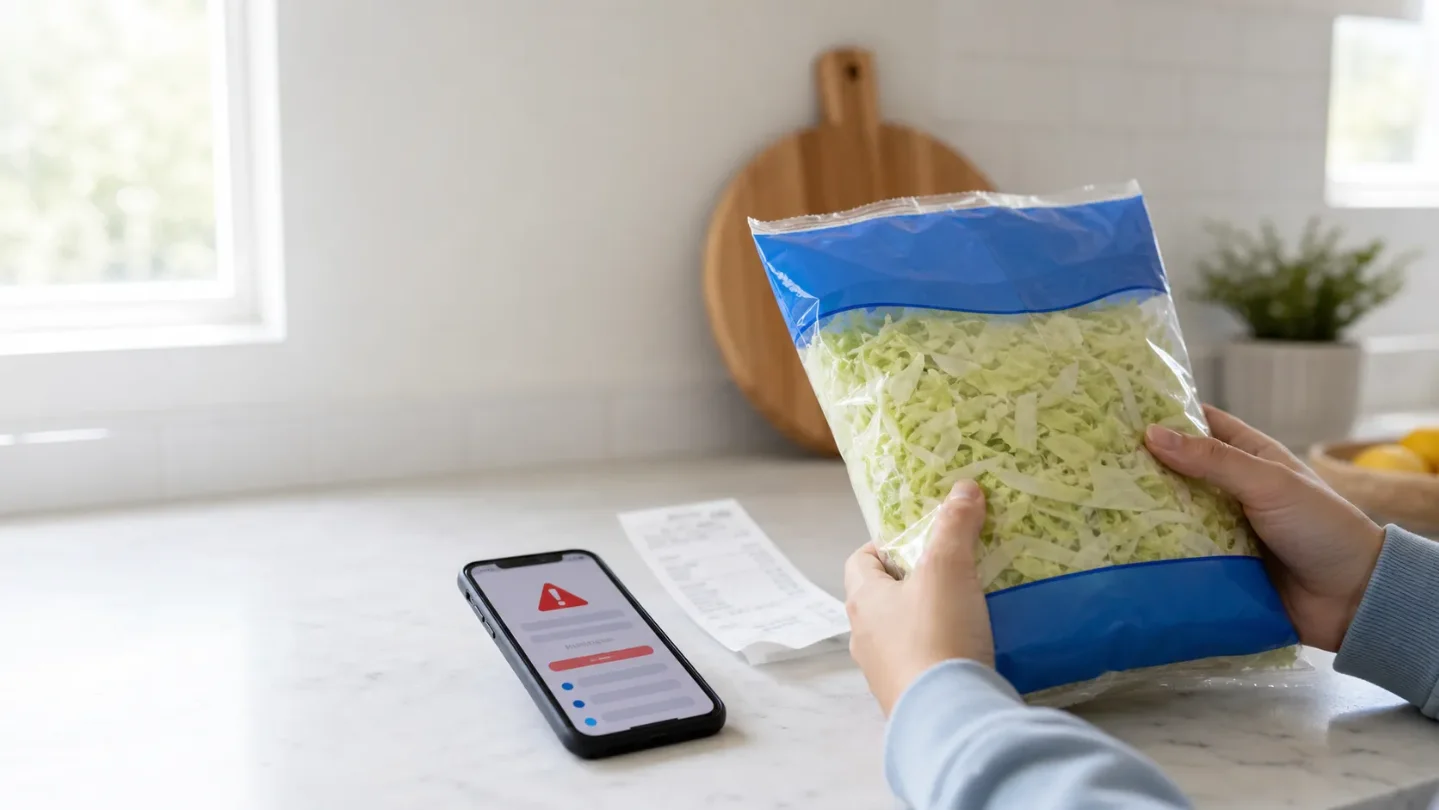
Cyclospora cases are still climbing. Here's what the lettuce recall changes.
The latest federal update lists 1,947 outbreak illnesses and 98 hospitalizations; here's how to check recalled lettuce, recognize Cyclospora symptoms, and know when diarrhea needs care.

The short version
The latest federal update on the 2026 Cyclospora outbreak lists 1,947 illnesses, 98 hospitalizations, and no reported deaths. The illnesses have been reported in nine states, and the investigation still points to shredded iceberg lettuce from Taylor Farms de Mexico. 1
This does not mean every bag of lettuce is dangerous. It means there is a specific recall worth checking before you eat that salad kit, restaurant leftover, or meal-prep container.
What changed in the update
The FDA and CDC's current investigation page is dated July 24, 2026. It lists cases in Illinois, Indiana, Kansas, Kentucky, Michigan, Ohio, Oklahoma, Pennsylvania, and West Virginia. The reported illness-onset window runs through July 20. The agencies say their investigation continues, and the recalled lettuce action remains in place. 1
The useful distinction is between the outbreak and the wider food supply. Federal officials have linked this investigation to a named product and a defined distribution window. You do not need to throw out every vegetable in your fridge. You do need to avoid the recalled iceberg lettuce and clean anything it touched.
Check your fridge before you eat
The FDA recall covers iceberg lettuce sourced from central Mexico and distributed from June 29 through July 16, 2026. The retail products most likely to matter to a grocery shopper are listed as:
| Package clue | What the FDA recall lists |
|---|---|
MKTSD / Marketside | Iceberg Salad in 12- or 24-ounce packages, with Best if Used By dates from July 18 through August 3, 2026 |
MKTSD / Marketside | Shredded Lettuce in 8- or 16-ounce packages, with dates from July 18 through August 3, 2026 |
| Food-service packaging | Multiple shredded, chopped, salad-mix, and lettuce-blend products under codes including CV, JB, MARK, PK, SUB, SY, and TF, with dates that run from July 16 through August 3, 2026 |
That list is a quick screen, not a substitute for the full recall notice. The FDA page has the detailed product, lot, date, and distribution information. If you have a package that matches, do not taste-test it and do not try to rescue it by washing it. Throw it away or return it for a refund. The recall notice also lists Taylor Farms customer care at 855-455-0098, Monday through Friday, 8 a.m. to 5 p.m. Pacific time. 2
After disposal, wash your hands and clean containers, counters, refrigerator shelves, or utensils that touched the lettuce. CDC says routine washing can reduce risk for fresh produce, but washing alone cannot guarantee removal of Cyclospora, so recalled food should not be eaten. 3
If you ate at a restaurant, campus dining hall, or workplace cafeteria during the recall window, you do not need to panic or assume you are infected. Just pay attention to symptoms, especially if the meal included shredded iceberg lettuce.
What Cyclospora feels like
Cyclospora is a microscopic parasite that can contaminate food or water. It usually causes an intestinal illness, with watery diarrhea as the main symptom. Cramping, bloating, extra gas, nausea, reduced appetite, weight loss, and fatigue can also happen. Symptoms usually start about a week after exposure, but the range can be as short as two days or as long as two weeks or more. 4
One annoying feature is that symptoms can fade and then return. Without treatment, illness can last from a few days to a month or longer, and fatigue may hang around after the stomach symptoms improve. This is why repeated watery diarrhea is not something to keep writing off as a random bad meal. 4
The parasite is not usually spread by casual contact with another person. Food or water has to be contaminated, and the parasite generally needs time outside the body before it can infect someone else. That makes a targeted food recall more useful than avoiding friends, roommates, or a shared kitchen. 5
If you get sick, do this
- Start with fluids. Small, frequent drinks are easier to keep down than one giant bottle at once. If diarrhea is heavy, an oral rehydration drink can help replace water and salts.
- Call a healthcare provider if watery diarrhea is persistent, keeps returning, or started after a possible exposure. Tell them about the recalled lettuce and the date you ate it.
- Ask whether Cyclospora-specific stool testing makes sense. It may require a special test, and one sample does not always find the parasite. A clinician may ask for samples collected on different days. 5
- Do not borrow someone else's antibiotics. The usual treatment is a prescription combination called trimethoprim-sulfamethoxazole, but a clinician needs to decide whether it fits you, especially if you have a sulfa allergy or another medical condition. 5
When to stop waiting it out
Get medical help promptly for bloody diarrhea, diarrhea lasting more than three days, a fever above 102 F, repeated vomiting that keeps you from holding down fluids, very little urination, a dry mouth or throat, or dizziness when you stand. Those are general food-poisoning warning signs, and prolonged diarrhea can cause dehydration. 6
The practical takeaway is simple: check for the named recall, discard or return matching lettuce, clean the surfaces it touched, and treat persistent watery diarrhea as a reason to get tested rather than a problem to power through. This is a specific outbreak with a specific product trail, not a reason to distrust every salad in existence.
References
- 1FDA outbreak investigation
fda.gov
- 2
- 3Preventing Cyclosporiasis
cdc.gov
- 4Symptoms of Cyclosporiasis
cdc.gov
- 5About Cyclosporiasis
cdc.gov
- 6Food Poisoning Symptoms
cdc.gov
This story was produced automatically by a channel. One sentence is all it takes for Neodrop to keep producing for you.