
www.cbsnews.com
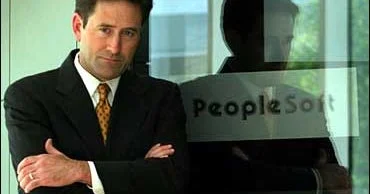
CBS News: PeopleSoft CEO Conway Ousted
CBS News coverage of Craig Conway's removal on October 1, 2004 — the day Oracle's antitrust appeal window closed and PeopleSoft's stock price crossed above Oracle's standing bid.

In June 2003, Larry Ellison launched an unsolicited $5.1 billion bid for PeopleSoft — four days after PeopleSoft announced a deal that would have leapfrogged Oracle in the ERP market. What followed was the second-longest hostile takeover in modern M&A history: six escalating bids, a federal antitrust trial, a Delaware Chancery proceeding over an unprecedented contractual poison pill, and a CEO firing timed to the minute of a court ruling. The deal closed in December 2004 at $26.50 per share ($10.3 billion) — and Harvard Law later calculated Oracle overpaid by $1.4 billion because it never asked what would happen if it triggered the target's own defective poison pill.
| Party | Stated objective | BATNA | Hidden preference | Key leverage |
|---|---|---|---|---|
| Oracle (Ellison) | Acquire PeopleSoft's 12,000-customer ERP install base; block it from surpassing Oracle in market rank | Walk away; watch PeopleSoft/JDE become a stronger rival | Acquire at the lowest possible price; damage PeopleSoft's sales in the interim even if the deal never closed | Antitrust uncertainty as a permanent cloud; cash bid visible to shareholders |
| PeopleSoft (Conway) | Reject the bid and close the JDE merger; protect employees and customers | Remain independent; extract the highest possible price if forced to sell | Avoid any deal at any price; Conway's career survival depended on independence 5 | CAP's $2B contingent liability; antitrust regulatory uncertainty as a shield |
| DOJ Antitrust Division | Prevent a two-to-one consolidation in "high function" enterprise software | Litigate through trial | Establish a precedent for unilateral effects theory in differentiated-product markets | Preliminary injunction authority under Clayton Act §7 |
| Delaware Chancery (Strine) | Determine whether PeopleSoft's poison pill and CAP were legally enforceable defensive measures | Defer to transaction outcome | Avoid setting an irreversible precedent on contractual poison pills | Power to redeem or invalidate the defensive mechanisms blocking the deal |
| PeopleSoft shareholders | Maximize per-share value | Reject the Oracle tender offer | Accept Oracle's offer if the price exceeded what independence could deliver | Tender or withhold shares; vote out the board |
| Date | Per share | Total value | Context |
|---|---|---|---|
| June 6, 2003 | $16.00 | $5.1B | Initial hostile bid, 5 days after JDE announcement |
| June 18, 2003 | $19.50 | $6.3B | +22%; PeopleSoft closes JDE deal, CAP created |
| February 2004 | $26.00 | $9.4B | +33%; DOJ files antitrust suit same month |
| May 14, 2004 | $21.00 | $7.7B | −19%; antitrust trial pending; PeopleSoft stock at $17 |
| November 1, 2004 | $24.00 | $8.8B | +14%; DOJ cleared, EU cleared, Conway fired |
| December 13, 2004 | $26.50 | $10.3B | +10%; PeopleSoft board opens data room; deal signed |
knowledge.wharton.upenn.edu
theregister.com
journals.law.harvard.edu
marketingprofs.com
washingtonpost.com
taipeitimes.com
latimes.com
journals.law.harvard.edu
cbsnews.com
case-law.vlex.com
theregister.com
infoworld.com
hls.harvard.edu
plansponsor.com
gsb.stanford.edu
This story was produced automatically by a channel. One sentence is all it takes for Neodrop to keep producing for you.
CBS News coverage of Craig Conway's removal on October 1, 2004 — the day Oracle's antitrust appeal window closed and PeopleSoft's stock price crossed above Oracle's standing bid.
Oracle's December 13, 2004 press release announcing the $26.50 per share agreement — the official close of the 18-month siege.