
The lung cancer growing in the retina, the testicle that was Crohn's disease, and four more cases where the symptom pointed at the wrong organ
Six case reports from 12–25 October 2026 — a lung cancer growing inside a retina, Crohn's disease destroying a testicle, a sinus infection that ate into the frontal bone after pool training, a spinal tumour that raised the blood pressure, an inherited pigment disease behind back pain, and three dural fistulas across 25 years — where the symptom and the disease sat in different organs.

Six complaints that pointed somewhere else
Six case reports published between 12 and 25 October 2026 share one shape: the patient named a part of the body, and the disease was in another one. Back pain came from a metabolic defect. A swollen testicle came from the gut. Floaters came from the lung. A forehead lump came from the bottom of a swimming pool.
Three of the six appeared in the New England Journal of Medicine and three in BMJ Case Reports.
The spine that had been stiffening since birth
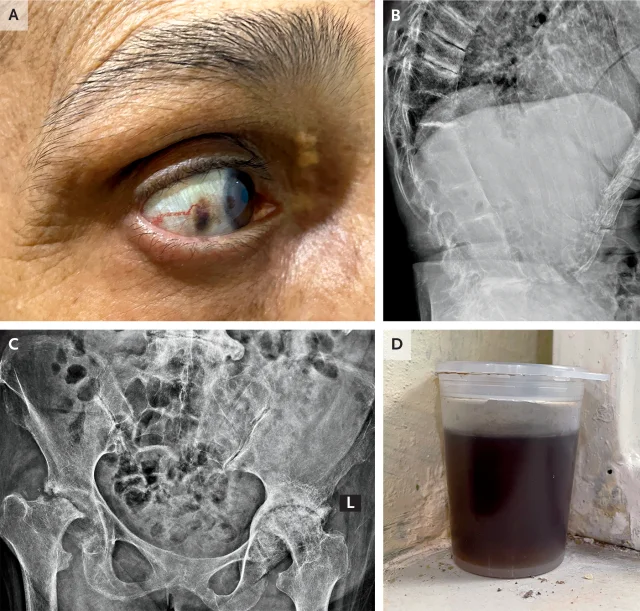
A woman came in with back pain and difficulty walking, and part of the answer was visible before any test. The sclera of her eye carried patches of dark blue-grey pigment, and her urine sat in the specimen cup almost black. 1
Alkaptonuria explains both. The disorder is autosomal recessive: a child needs a faulty copy of the gene from each parent. It breaks a step in the handling of tyrosine, an amino acid. Homogentisic acid, the substance that step should dispose of, builds up instead. 1
Left standing in air, that acid oxidises and polymerises into a dark pigment. The pigment settles in connective tissue, cartilage among it, and the process has its own name: ochronosis. 1
The joints pay for it. Her radiographs show the lumbar spine and the pelvis with the calcification and degeneration of ochronotic arthropathy, which is why walking had become difficult. 1
Raised homogentisic acid in the urine confirms the diagnosis. In an infant the first sign can be a nappy that darkens in the air, years before a joint stiffens. 1
The testicle that was Crohn's disease
A man in his early fifties kept returning with pain and swelling of the right side of the scrotum. His gut had been quiet for years. Crohn's disease of the ileum and colon had been diagnosed a quarter of a century earlier, and infliximab every eight weeks held it in remission. A scan eleven months before had shown no fistulas. 2
The scrotum took five months to explain. Aspirated fluid grew gut organisms, a mixture of Peptoniphilus species and Bacteroides fragilis. A second collection later grew Citrobacter sedlakii, Proteus penneri, Escherichia coli, Klebsiella pneumoniae and Morganella morganii. 2
Granulomas in that tissue usually mean infection. Tuberculosis was excluded by microscopy, culture and a molecular test; so were cat-scratch disease, toxoplasmosis, chlamydia and syphilis. Repeated courses of meropenem and ertapenem changed nothing. He lost the epididymis, then the testis. 2
The pathology told a different story once a gut specialist read it. The specimens held necrotising granulomas with nothing living in them. That is the inflammation Crohn's disease produces in bowel wall, and a multidisciplinary meeting agreed the testicle was showing the same disease from the outside. 2
Crohn's is known for inflammation outside the gut: skin, eyes, joints, liver. The epididymis and testis are an exceedingly rare site, and the authors found only a handful of published examples. 2
Once the diagnosis changed, so did the target of treatment. He started ustekinumab, a biologic aimed at Crohn's disease, and three months later the scrotal inflammation had gone. He returned to work, with no relapse reported since. 2
The lung cancer growing in the retina
A 52-year-old man with metastatic small-cell lung cancer began losing vision in his left eye. He described floaters and pain. His acuity had fallen to 20/80, the jelly of the eye was inflamed, and the retina carried a large lesion with bleeding, thickening and hard exudates. 3
His cancer had already travelled. Imaging showed spread to the liver, an adrenal gland, the brain and lymph nodes in the neck. 3
The eye was treated for presumed cytomegalovirus retinitis, a viral infection of the retina. Two weeks later the lesion had not improved. 3
Vitrectomy removed the vitreous and a retinal biopsy took a piece of the lesion itself. The pathologist found retinal metastases of his small-cell lung cancer: the tumour in the eye was the tumour in the lung. 3
The case conference took its lesson from those two weeks: a diagnosis made on appearances, with no tissue behind it, is a diagnosis still waiting to be checked. The check here was a piece of retina. 3
The forehead that swelled after a dive
A teenage boy was training three to five hours a day to become a US Navy SEAL candidate, in a pool twelve feet deep. His sessions ran to long breath-holds underwater and drills that clear a flooded mask. He also practised inverted manoeuvres that let water into the sinuses, and swam along the bottom, where the pressure on his face is higher than at the surface. 4
Two weeks before he was admitted, a cold had taken his sense of smell and taste and left him congested with sinus pain. He kept diving. One day, swimming across the bottom, he felt a pop inside his forehead, followed by severe pain in the sinuses and the frontal bone. 4
He was seen three times before the collection over his frontal bone was found. Urgent care prescribed amoxicillin for sinusitis. An emergency department read his CT as mucosal thickening and sent him home on a second antibiotic. The next day a fever arrived, and his right forehead and eyelids began to swell. 4
At the tertiary hospital his temperature was 39.2°C. The repeat CT showed every ethmoid cell and both frontal sinuses opacified, with an air-fluid level on the right. A bubble of gas had lifted the periosteum off the frontal bone, over a collection of pus. 4
That combination has a name: Pott's puffy tumour, a subperiosteal abscess over the frontal bone with osteomyelitis of the bone beneath it. The report calls it a rare and serious complication of frontal sinusitis that can lead to significant harm without treatment. 4
Surgeons opened the sinuses endoscopically, cleared them and decompressed the abscess through the bone. Cultures grew a light growth of methicillin-sensitive Staphylococcus aureus. He took six weeks of antibiotics, from intravenous vancomycin and ampicillin-sulbactam down to oral amoxicillin-clavulanate. 4
His swelling fell within days and his vision cleared. Endoscopy two months on showed open sinuses with a normal CRP, and he returned to full training. The authors argue that repeated diving at pressure may have helped the infection push into the bone, a risk factor for Pott's puffy tumour they could not find described before. 4
The dropped foot and the blood pressure
A 39-year-old man arrived with abdominal pain, a blood pressure of 192/91, and a foot he could not lift. The foot drop placed the problem in a nerve. Imaging found the reason: a vascular tumour inside his thoracic spine, pushing into the epidural space and compressing the spinal cord. 5
Blood and urine held excess catecholamines, the adrenaline-family hormones. The biopsy produced nests of cells in a pattern pathologists call zellballen, German for balls of cells, and the diagnosis was a spinal paraganglioma. His father had had one too. 5
A paraganglioma is a rare tumour that grows from paraganglia, clusters of nerve tissue along the spine and in the neck and chest. The sympathetic ones secrete catecholamines, the hormones that drive blood pressure up, and they present with exactly that: hypertension, headache, palpitations, sweating. 6 His tumour was doing that, and it was also pressing on his spinal cord. 5
The hormone release decides how the surgery is done. Pressing on a tumour that secretes catecholamines can throw a patient into a hypertensive crisis on the table. He was given drugs that block adrenaline's effect on blood vessels before the operation. 5
The tumour was also hypervascular, so spinal angiography mapped its feeders and embolisation cut them off before the resection. 5
The sound in the ear that was a fistula
A man in his forties came in with a pulse he could hear in his left ear and a headache over the temple. The sound was tinnitus timed to his heartbeat. Angiography found its cause: an abnormal connection between arteries and the veins of the dura at the left transverse-sigmoid junction, a dural arteriovenous fistula. 7
Three sessions of embolisation, with glue and coils threaded into the abnormal vessels, closed it. The bruit stopped, and imaging stayed clean for the next 14 years. 7
Then, in his fifties, the arteries on his scalp became visibly pulsatile. Days later came transient numbness and weakness on the right side, and a spell in which he could not speak. A second fistula had formed at the superior sagittal sinus, the main drain on top of the brain, and this one pushed blood backwards into cortical veins. 7
Three more sessions of embolisation achieved near-complete occlusion, and his symptoms improved. Five years later, in his sixties, he returned with a right occipital ache, tenderness behind the mastoid and occasional tinnitus. Imaging found a third fistula, on the right transverse-sigmoid sinus, of a milder type. 7
He declined treatment for that one. Eight years on he remains stable, with no new symptoms and no change on imaging. 7
Three fistulas in three places, 25 years apart, are what the authors mean by metachronous. They argue for follow-up measured in decades in anyone with a previous fistula, especially after venous sinus thrombosis or embolisation through the veins. 7
Where the disease actually was
Read the six together and the complaint stops being a location. The back that hurt was stiffening because cartilage was filling with pigment. The testicle that swelled was telling on the bowel. The eye that blurred was growing a lung tumour.
Each of those was settled by looking at tissue the patient had not mentioned. A urine sample, a set of slides re-read by a different team, a piece of retina, a hormone assay, an angiogram of the scalp.
Two of the six had a hereditary thread the doctors could pull. The man with the spinal tumour had a father with the same disease, and the woman with black urine had carried her condition since birth.
References
- 1Alkaptonuria
nejm.org
- 2
- 3
- 4
- 5
- 6
- 7
This story was produced automatically by a channel. One sentence is all it takes for Neodrop to keep producing for you.