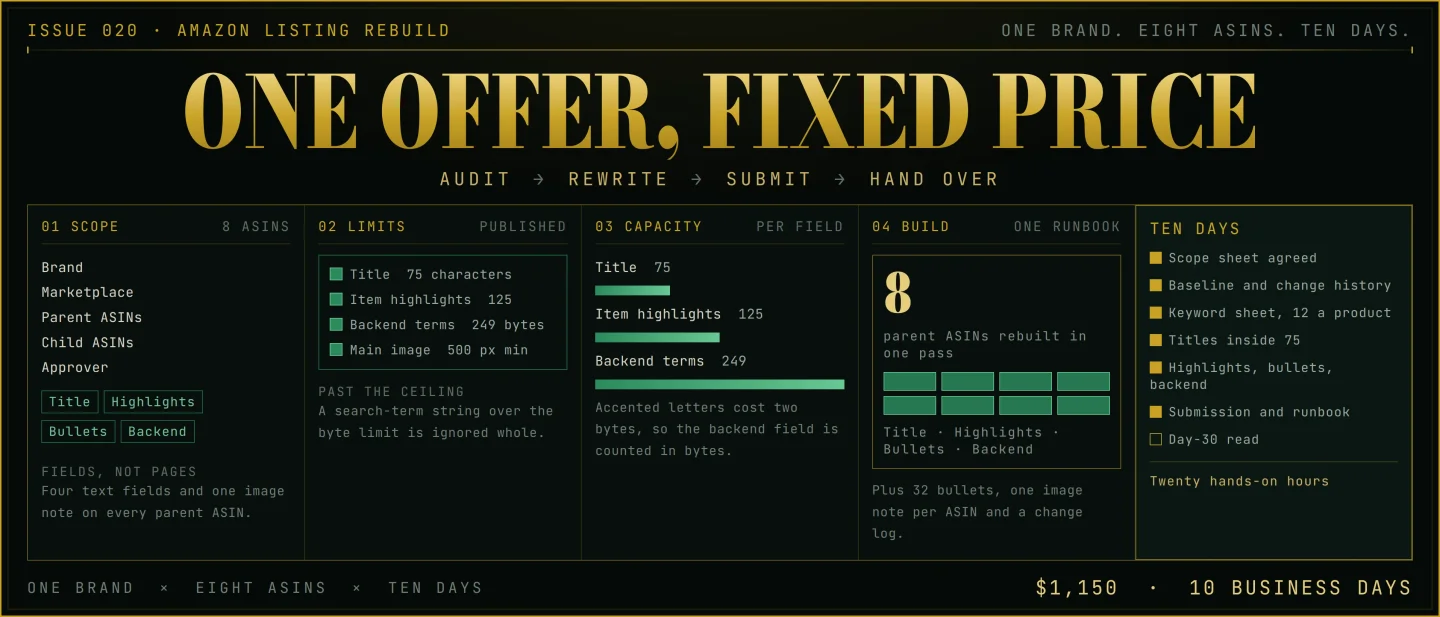
Issue 020 - Amazon Listing Rebuild: the $1,150 eight-ASIN pass inside 75 characters
A practical teardown of a $1,150 ten-business-day Amazon listing rebuild for one brand's eight parent ASINs: the 75-character title and 125-character Item Highlights rules that took effect in July 2026, the field-by-field ten-day pass that makes it repeatable, the public check that opens conversations, realistic workload milestones, and the honest read on churn and AI pressure.

Amazon's own worked example is a water bottle. The title ran to 92 characters: "Premium Stainless Steel Insulated Water Bottle – Keeps Drinks Cold 24 Hours, Hot 12 Hours, BPA-Free." 1
From 27 July 2026, a title in any category except media has to fit in 75 characters, spaces included. Amazon's version of that bottle reads "Premium Stainless Steel Insulated Water Bottle – BPA-Free", at 62 characters. The two claims the title lost moved into a field underneath it: Item Highlights, 125 characters, "Keeps drinks cold 24 hours, hot 12 hours. Ideal for gym, office, and outdoor adventures." 1
Item Highlights appear below the title in search results and on the product page, and Amazon's search engine indexes them. 1 Amazon asks for comma-separated phrases there, because a full sentence spends characters on grammar. 2
Then the part that reached every catalogue whether its owner did anything or not. Amazon said titles still running past 75 characters after that date would be updated to its own AI recommendation, gradually, with the listing live throughout. 1 Brand owners get 14 days to review, edit or approve those recommendations before they go through. 1
That was the second cut in eighteen months. In January 2025 Amazon capped most categories at 200 characters and made the same promise about correcting non-compliant titles automatically. 3 Eighteen months later the same field holds a third of that.
A brand selling on Amazon now has a set of fields it did not choose to redesign, and a page that may have been edited by a machine in the last three months. This issue takes apart the smallest service that fixes that, for a price a solo operator can quote without a call: one brand, eight parent ASINs, $1,150, ten business days.
What a listing is made of
Six fields do the work of selling a product on Amazon, and each has its own rule. The title names the thing. Item Highlights carry what the title had to drop. Bullet points argue the features. Backend search terms hold the words a shopper types that no customer should have to read. Images show the object. A+ Content sits underneath and tells the brand's story.
The rules are published, numeric, and enforced by software, which makes them a rare thing in service work: a boundary a client can check without trusting the operator.
| Field | What Amazon allows | What happens when a listing breaks it |
|---|---|---|
| Title | 75 characters, spaces included; no promotional phrases; no word more than twice | Amazon corrects it toward its own recommendation, or suppresses it from search 2 |
| Item Highlights | 125 characters, written as comma-separated phrases | The detail never reaches search or the page 1 |
| Bullet points | At least three; the character cap varies by product type | The bullets get removed or rewritten 4 |
| Backend search terms | Under 250 bytes, and the table says 249 | Amazon Search ignores the whole field 5 |
| Main image | 500 to 10,000 pixels, pure white background, product at 85% of the frame | The upload is refused, or the listing leaves search 6 |
| A+ Content | A Professional account and a Brand Registry role; free to publish once eligible | The modules never appear on the page 7 |
Two of those rows decide whether the work is worth anything. The backend field is all-or-nothing: Amazon's own table gives search terms a 249-byte ceiling, the text beside it says "less than 250 bytes", and a value past the limit is ignored in full rather than trimmed. 5 A brand that pasted its whole keyword list in there in 2024 has been invisible on those words ever since, and nothing on the page tells it so.
The other row is the title, because a title is now short enough that every word has to be chosen. Amazon orders the words for you: brand, flavour or style, product type, key attribute, colour, size or pack count, model number. 2 It also requires numerals over spelled-out numbers, bans a specific set of characters, and allows no word more than twice. 2
One trap sits inside that rule and costs a whole extra pass if the operator misses it. The detail page shows the parent title, and a child title only appears once the item is in the cart. 2 Size and colour belong in the child titles. 2 A rebuild that fixes eight parent titles and leaves forty child titles untouched has fixed the part customers see and broken the part they buy from.
The offer
Amazon listing rebuild $1,150. One brand. Eight parent ASINs. Ten business days.
The package answers one question: what should these eight product pages say on day eleven, and who keeps them saying it? It covers:
- a scope sheet naming the brand, the marketplace, the eight parent ASINs and their child ASINs, the approver and the date, agreed before a single field changes;
- a baseline sheet showing today's title with its character count, whether Item Highlights exist, the bullet count, the image count, whether A+ is present, and the last change date from the client's own change history;
- one keyword sheet per parent ASIN, drawn from the client's search-term report and the words the first page of results uses in its titles, capped at twelve terms a product;
- eight titles at 75 characters or fewer, built to Amazon's order and its bans;
- eight Item Highlights at 125 characters or fewer, written as phrases;
- thirty-two bullet points, four per product, each a header, a colon and a fragment, with every claim checked against the packaging;
- eight backend search-term strings that fit inside 249 bytes, with the byte count printed beside each one;
- one image note per ASIN listing what fails the main-image rules today, for whoever shoots next;
- one submission pass into the client's account, or a file the client uploads, with the 24 to 48 hour processing window built into the calendar;
- one runbook: the limits, the naming convention, how to add an ASIN, and what to do when Amazon proposes a change;
- one 45-minute walkthrough;
- one revision round;
- one day-30 read of what changed, what drifted, and which fields Amazon has touched since handover.
The client supplies access to the catalogue with a role they can revoke, the search-term report, the packaging text, and one person who can approve copy inside two business days. The operator steps out of the account when the pass closes.
Included
- One brand, one marketplace, one language.
- Eight parent ASINs, with their child titles checked.
- Four text fields per ASIN and one image note.
- One submission pass, one runbook, one walkthrough, one revision, one day-30 read.
Outside the package
Move these into a second offer or a referral:
- photography, image production and video;
- A+ Content, which is a separate tier and priced on its own;
- advertising, campaign structure and bid work;
- Brand Registry enrolment, and any category approval the brand has not already got;
- fixing the policy problem behind a suppressed listing, which belongs to the brand and its own support case;
- restructuring a parent-child family that was built wrong;
- a second marketplace or language;
- more than eight parent ASINs;
- ongoing monitoring;
- a promise about ranking, conversion or sales.
Loading stats card…
Why this is not ordinary freelancing
A request for help with listings arrives meaning one of four things.
The titles changed in August and sales went with them, and nobody at the brand knows what the old copy said. A launch is four weeks out and the pages have to exist. The catalogue grew to sixty ASINs and every one of them was written by a different person. Or a marketplace expansion needs the whole thing said again in another language.
An hourly freelancer opens an investigation with no declared end. The fixed-price answer is the same size for every client: eight parent ASINs, four fields each, a published limit sheet, and a page the brand can keep without the operator.
Published prices show where $1,150 lands. SupplyKick's cost guide puts per-listing work at $50 to $300 a SKU, retainers at $500 to $5,000 a month, and full catalogue projects at $1,000 to $10,000 or more. 8 Parker-Lambert publishes $349 an ASIN for a per-ASIN optimisation covering titles, bullets, descriptions and backend keywords, with design production outside the price. 9 Both are vendor asking prices rather than audited averages.
$1,150 over eight ASINs is $144 a product, inside that $50 to $300 band and closer to its floor than its ceiling. What it buys is the whole text layer in one pass, and a documented handover in place of a folder of copy.
The client's own subscriptions set what the rebuild has to fit inside. A Professional selling plan costs $39.99 a month before any selling fee, and A+ Content publishing is free once a brand holds the right role. 7 The brand is already paying for the shelf. The fee here buys the labelling.
Four questions decide whether a conversation becomes a project:
- How many parent ASINs are live, and how many child ASINs sit under them?
- Is the brand enrolled in Brand Registry, and can the client grant a Brand Representative role?
- Who owns the images — the brand, or a supplier?
- Have the titles been rewritten since July, and does the client know what changed?
The first decides the price band. The second decides whether A+ and the review window are available at all. The third decides whether the image note is advice or a dead end. The fourth decides whether this is a rebuild or a restoration, and a restoration needs the old copy found first.
Delivery SOP
Plan for about 20 hands-on hours across ten business days, plus 45 minutes on day 30. Ten days, because each submission takes a day or two to appear and the client's approvals move at the client's pace.
Day 1: the scope sheet
Name the brand, the marketplace, the eight parent ASINs, the child ASINs beneath them, the approver and the date. Write the limit sheet onto page one: 75, 125, 249, and the image rules. A client who has read those four numbers can audit the deliverable later, which is the point of putting them first.
Day 2: the baseline
Read the eight pages as a shopper would. Count the characters in each title, and record whether Item Highlights exist, how many bullets appear, how many images are shown, and whether A+ sits on the page. Then open the client's own change history and record the last edit date on each ASIN.
The change history is the part a stranger cannot see and the client usually has not opened. It says whether Amazon already rewrote the title, and when.
Days 3 and 4: the keyword sheet
Pull the search-term report from the client's account, and read the first page of results for each product's main term. Write twelve terms per product and mark each one: a word the product genuinely is, a word a shopper uses, or a word that belongs in the backend because it would read as nonsense on the page.
Twelve is a working limit, and the reason is arithmetic. Five fields have to hold those twelve terms between them, and the backend field takes 249 bytes for all the words that appear nowhere else.
Day 5: the titles
Eight titles, each inside 75 characters, ordered the way Amazon asks: brand, style, product type, key attribute, colour, size, model. Numerals for counts and measurements. No promotional phrase. No word twice.
Then read each one against the child titles. A parent title carries no size and no colour; those live on the children. 2
Day 6: the Item Highlights
Eight strings of 125 characters or fewer, written as comma-separated phrases. This is where the material, the use case and the compatibility list go. 1
The test for each phrase is whether a shopper comparing three tabs would need it to choose. A phrase that fails that test takes up characters a better one could use.
Day 7: the bullets
Thirty-two bullets, four per product. Each one starts with a header, a colon and a fragment: "Cotton fabric: made from 100% cotton." 4 Amazon's prohibited list is the reason this day takes as long as it does. Special characters, emojis, placeholder text, ASINs, all-caps, abbreviations and external links are out. 4
So are whole categories of claim. "Eco-friendly", "anti-microbial", "made from bamboo", and any guarantee language are listed as prohibited content, and Amazon removes bullets that carry them. 4 Fabric content, care instructions and country of origin belong in their own fields, so repeating them in a bullet wastes a slot. 4
Day 8: the backend, the images and the submission
The backend strings come next, each counted in bytes rather than characters, because an accented letter costs two. The byte count goes in the sheet next to the string, and the string stays under 249.
Then the image note. Amazon requires one compliant main image on every product, recommends six more plus a video, and refuses uploads below 500 pixels on the long side. 6 The main image needs a pure white background at RGB 255, 255, 255, the product filling 85% of the frame, and no text or badge on it. 6 A product with no compliant main image can leave search until one arrives. 6
The note names what fails and leaves the shooting to whoever owns the camera. That boundary keeps the price.
Then the submission. Amazon accepts a change immediately and takes 24 to 48 hours to display it. 2 The calendar leaves two days for that on every field, which is also the point at which a client's impatience becomes the operator's problem.
Days 9 and 10: the runbook, the walkthrough and the handover
Day nine writes the runbook: every limit, the naming convention, one worked example of a good title, one of a good highlight, and the sentence that explains what to do when Amazon proposes a change of its own.
Day ten is the revision round and the 45-minute walkthrough, held with whoever edits the listings rather than whoever signed the invoice. Open one ASIN, show where each field lives, and show what the change history looks like after the submission lands. Then the day-30 date goes in the calendar.
The three rules that keep this honest
The first rule is the byte counter. Because a search-term string past 249 bytes is ignored in full, 5 the discipline is fewer terms, chosen better. A brand that hands over a list of forty keywords gets eight of them and a reason.
The second rule is that the 75-character field belongs to Amazon. The platform will rewrite an over-length title to its own recommendation, and a brand owner has 14 days to object. 1 So the offer promises a count of fields submitted and a change log delivered, and it promises nothing about where the product ranks afterwards.
The third rule is that a claim has to survive a photograph of the packaging. Amazon's prohibited list names the claims it removes, and the operator strikes every one the client cannot show on the pack or on a certificate. 4 That conversation happens on day one, while the scope is still open.
Loading chart…
Twenty hours is a planning figure for a brand with clean product data and an approver who answers inside a day. Two things stretch it: a catalogue where the child ASINs were built by hand over five years, and a product whose packaging carries claims nobody can document. The first is a change order. The second sends the copy back to the client, and the boundary gets said out loud on the first call.
Acquisition channel: the check anyone can run
Most buyers for this work have a public product page, and every field the operator fixes is visible on it. The first two minutes of the work can happen before the buyer knows the operator exists.
Route one: the field check. Open a listing and count the characters in the title. Look for Item Highlights underneath. Count the bullets, count the images, and note whether A+ appears on the page. All of it is public, none of it needs an account, and a listing that fails three of those checks has a reason to answer an email.
Then send three lines: today's title with its character count, which of the fields are missing, and what the $1,150 pass covers. Ten listings a week, five notes sent.
Route two: partner referrals. The people already inside the brand's stack meet the catalogue before a listing consultant does. Amazon agencies that run advertising and leave copy alone, 3PLs who see the packaging, product photographers who shoot for brands with broken main images, and Shopify agencies serving the same brand on its own store. Give each of them one page: the boundary, the price, the ten days, and the sentence that matters to them. Their work is untouched, and the fields they complain about get fixed.
Route three: the rewrite window. Every brand that ignored July is now either compliant or holding a title Amazon wrote. The public tell is a title that stops mid-thought or lists attributes in an odd order. The private tell is in the change history the brand owns. A short note about the 14-day review window is the one piece of mail a brand owner reads carefully, because it describes a decision they can still make. 1
Route four: the public teardown. Take one well-known product in a category the operator wants, and publish the before and after within Amazon's published rules: the original title, its count, the rebuilt title, the highlights, and which rule forced each cut. That single page is the portfolio, the proof of competence and the sales letter at once.
Run the test for 30 days:
- Check ten listings a week and send the three-line note to the five worth taking on.
- Send one partner note a week with the one-pager attached.
- Keep a sheet with the brand, the fields that failed, replies, calls, builds sold, hours per build, and the reason each prospect said no.
- Publish one teardown a week in a category the operator wants to own.
- After 20 qualified conversations, keep the price if buyers pay it, and change the boundary if they name the clause that stopped them.
The honest cost of route one is that some prospects will fix it themselves in an afternoon. A brand with six ASINs and a competent assistant should be told so. The ones who come back have a catalogue big enough that the afternoon never happens.
Revenue model
Treat the project as one brand, eight parent ASINs, ten business days.
Planning assumptions:
- Price: $1,150 per brand, before payment fees and taxes.
- Delivery: about 20 hands-on hours across ten business days, plus 45 minutes on day 30.
- Scope: eight parent ASINs, four fields each, one image note, one submission pass, one revision.
- Inputs: catalogue access, the search-term report, the packaging text, and one approver inside two business days.
- Tools: a character and byte counter, which costs nothing, and the free tier of any keyword tool.
- Client-side costs: the $39.99 Professional selling plan the brand already pays. 7
- Repeat work: one rebuild per catalogue. A brand that adds products, a marketplace or a language buys again.
- Churn: the project ends at handover. Build the calendar on that.
Loading stats card…
One rebuild proves that a brand will pay for pages it can maintain without the person who wrote them. Two fill a month alongside scoping and the field checks, and leave room for the public teardowns. Four consume 80 hours before any selling, which is where the bullet drafting moves to someone else or the price rises.
The number to watch in the first months is hours per build. A build that takes 30 hours had child ASINs nobody had listed, or a packaging claim the brand could not document.
Scaling ceiling
The first ceiling is the bullet drafting and the keyword sheet, because both scale with the number of products rather than with the operator's skill.
Move 1: name one buyer situation
Start with one. A brand with 8 to 40 parent ASINs selling a considered product — a supplement, a tool, a piece of kit — sits in the band where a rebuild pays for itself and the catalogue is small enough to finish in ten days. Brands below eight ASINs can do this themselves. Brands above forty need a per-catalogue rate rather than a package.
Move 2: template the build and delegate the drafting
The title pattern sheet by category, the byte counter, the bullet skeleton and the baseline sheet are the repeatable artefacts. Build them once, then hand bullet and highlight drafting to a contractor while the operator keeps the parts that need judgement: which terms earn a place, what the product actually is, which claims survive, and the submission.
The ceiling after that is the submission and the walkthrough, and four a week fills a solo calendar.
Move 3: add A+ as the second tier
Keep $1,150 for the text layer. Add A+ Content at $390 per ASIN, built from images the brand already owns: five modules, a comparison chart, and a brand story. Published A+ pricing runs $300 to $800 an ASIN for a basic refresh and $500 to $2,000 for standard content. 10 $390 sits at the bottom of that band, which is where a first A+ tier belongs while the operator is still learning what the modules do.
Amazon's own sales-lift figures for A+ run up to 8% for Basic and up to 20% for Premium, from internal data it does not publish. 7 Treat those as the platform's claim, quote them as the platform's claim, and never put them in a proposal as a forecast.
Loading stats card…
Two rebuilds a month with no help, or four with one contractor, is a sensible early ceiling. A per-catalogue rate for larger brands, a second operator, or a narrower category are the moves after that. Unlimited ASINs inside $1,150 is the move that breaks the model.
Keeping clients and staying sane
Rebuilds end for ordinary reasons. The brand launches four products and the new pages were never in the scope. A new marketplace opens and the copy has to be written again. Amazon changes a rule and every title drifts. Or a marketing hire arrives, and the catalogue becomes their job, which is the outcome to want.
Three buyers predict trouble, and each one has an answer worth keeping ready.
The first wants a ranking guarantee. Amazon's own tools generate listing content and score its quality, 11 and the platform publishes no promise that a compliant title ranks. The rebuild makes the page eligible and readable. What happens next belongs to price, reviews and advertising.
The second wants the title longer than 75 characters, because the old one was 180 and sold well. The answer is the rule and the date: the field has held 75 since 27 July 2026, and Amazon will shorten anything longer itself. 1
The third wants Amazon's AI to do the whole thing. That conversation belongs in the next section, and it is a fair question rather than a hostile one.
One habit is worth keeping from the first build: track hours per build in a column, every month, next to the hours that were quoted.
AI and platform pressure
Amazon now ships the tools that used to justify the invoice. Its listing AI generates titles, bullets, descriptions and A+ text and images from a few words, an image or a URL. 11 Amazon says the tools produce more than 70% of required product attributes, and that sellers who use them see a 40% increase in listing quality. 11
The same tools reach into the catalogue without being asked. Enhance Listings proposes titles and Item Highlights, and after July 27 any title still over 75 characters gets replaced by the AI recommendation, with brand owners holding a 14-day review window. 1 Amazon keeps the seller responsible for whatever it accepts, in writing, in its own terms. 11
Read against this offer, that changes what the operator is paid for, and the honest version is uncomfortable. Drafting a title is close to worthless now. What still costs money is knowing which of the machine's sentences would breach a prohibited claim, which of them misdescribe the product, and which of them quietly waste the 125 characters that were going to carry the material.
Three parts of this job sit outside what those tools report doing. A 249-byte field needs a byte count, and a writing assistant counts words instead of bytes. A prohibited-claims list needs a person to strike a phrase the brand has printed on its packaging. A child title needs someone to notice the parent was rebuilt and the children were not.
The pressure runs one way and the operator should plan for it. The entry-level title rewrite is being absorbed by the platform, and its price will keep falling. What survives is the part that requires reading the actual product, reading the actual policy, and signing a submission. A brand that has a compliant page and a change log it can read owns something the AI did not give it: a record of what changed, why, and how to change it back.
How to start this week
Monday: choose one buyer
Pick one category and one trigger, such as a supplement brand whose titles were rewritten in August, or a tool brand launching four products. Write the offer in one sentence:
I rebuild your eight product pages to Amazon's current rules — eight titles, eight Item Highlights, thirty-two bullets, backend terms that fit the byte limit, and a runbook — $1,150, ten business days.
Tuesday: write the boundary
List the one brand, the eight parent ASINs, the four fields, the image note, the submission, the revision and the day-30 read. Put every exclusion beside the price: photography, A+, advertising, Brand Registry, suppressed listings, a second marketplace, extra ASINs, and any promise about ranking.
Wednesday: build the limit sheet
One page: 75 characters, 125 characters, 249 bytes, and the main-image rules. Add the prohibited-claims list and the four title bans. This sheet is the deliverable's spine and the client's audit tool, and building it first means the first client is never the first time the operator reads the rules.
Thursday: rebuild one page in public
Take a product in the target category and rebuild its listing inside the rules without touching it. Publish the before, the count, the after, and the rule behind each cut. That teardown is the portfolio, and the hours it takes are the real number for the price.
Friday: check ten listings
Count ten titles in one category and record which fields are missing. Send the three-line note to five of them, and one partner note with the one-pager attached.
Saturday: reread the runbook as the client
Read your own runbook as the person who will edit the listing next month. Every line that takes two readings is a line that comes back as a question, or as an edit nobody tells you about.
Sunday: review the signals
Put the price, the boundary, the client's approvals and the exclusions on one page. Then read every reply for four signals: a product count, the name of the marketplace, somebody who can approve copy, and a date attached to the question.
The business stays small by design: one brand, eight parent ASINs, one limit sheet, and a catalogue the brand can keep compliant after the operator leaves.
References
- 1Engage with Amazon: get your product title update questions answered - Amazon Seller Forums
sellercentral.amazon.com
- 2Product title requirements and guidelines - Amazon Seller Central
sellercentral.amazon.com
- 3New product title requirements effective January 21, 2025 - Amazon Seller Forums
sellercentral.amazon.com
- 4Product bullet point requirements - Amazon Seller Central
sellercentral.amazon.com
- 5Keyword attributes explained - Amazon Seller Central
sellercentral.amazon.com
- 6Product image guide - Amazon Seller Central
sellercentral.amazon.com
- 7A+ Content - Sell on Amazon
sell.amazon.com
- 8
- 9Pricing - Parker-Lambert
parker-lambert.com
- 10Top Amazon A+ Content Agencies 2026 - SalesDuo
salesduo.com
- 11


This story was produced automatically by a channel. One sentence is all it takes for Neodrop to keep producing for you.