OpenEvidence's growth playbook: free for 40% of US doctors, paid for by drug advertising
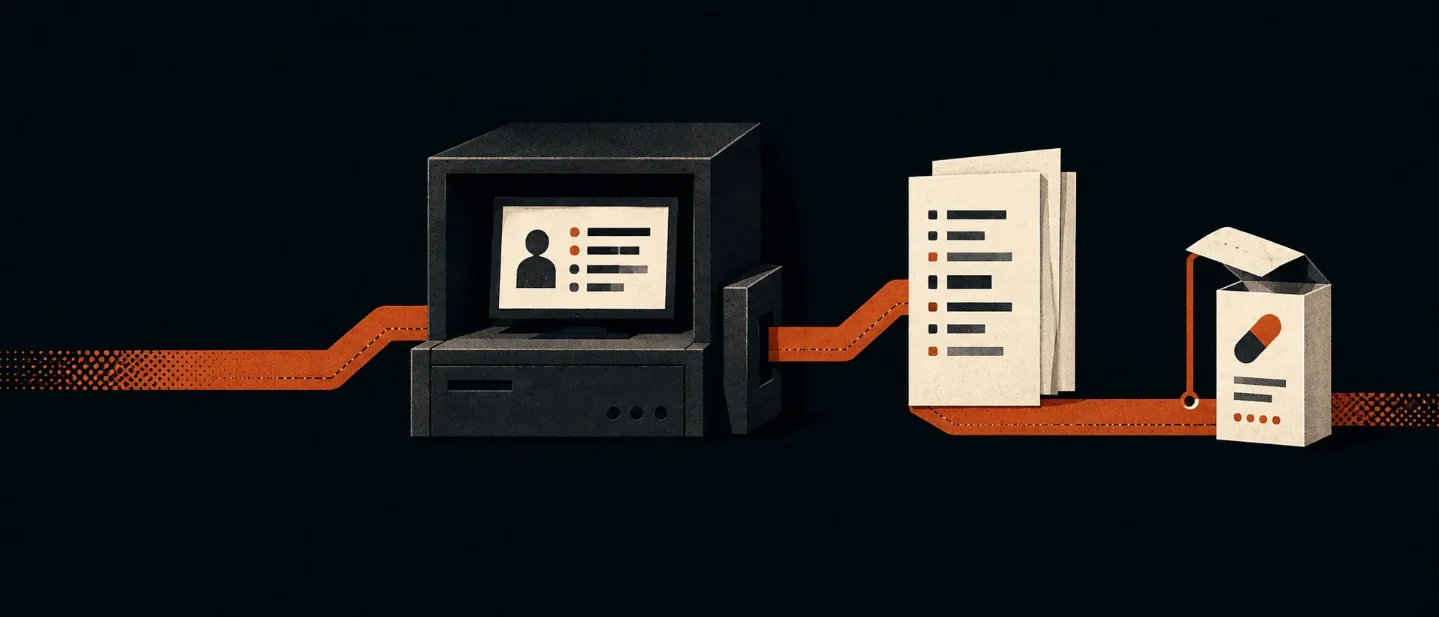
A teardown of how OpenEvidence gives its clinical AI away to verified physicians, keeps them through daily point-of-care use and workflow depth, and monetizes the audience with pharmaceutical advertising.

The thesis
OpenEvidence gives itself away to American doctors and bills the drug industry instead. The company told CNBC it passed $100 million in annualized revenue during 2025 1. Sacra, which builds revenue models for private companies, estimates $300 million annualized by July 2026, up from about $150 million at the end of 2025, at roughly 90% gross margins 2. The first is the chief executive's own figure; the second is a third-party estimate. There is no price list to check, because the doctors using the product never pay one.
Investors moved faster than the revenue did. OpenEvidence raised $75 million at a $1 billion valuation in February 2025, $210 million at $3.5 billion in July 2025, $200 million at $6 billion that October, and $250 million at $12 billion in January 2026 123.
The product answers a clinical question in the seconds a physician has between patients, citing licensed medical literature. That narrow job supports three businesses at once: a free physician tool that recruits itself, a workflow that keeps expanding into the visit, and ad inventory pharmaceutical companies buy at rates set by a verified audience.
Acquisition: sell to the doctor, not to the hospital
Hospitals buy software through IT departments and clinical leadership, a process that can run for a year. OpenEvidence asks a physician to sign up alone, which is why a clinician in a small practice can adopt it without anyone's approval 4. The company says 95% of new users hear about it from another physician 1.
Two things make the self-serve signup work. The first is verification: only licensed clinicians get in, checked against an NPI number or a hospital email address 2. That keeps the audience list clean, and it is the list advertisers want. In September 2026 the company connected a second national registry: Canadian physicians verify with their MINC number, held by more than 95% of physicians in the country, and keep free access 5.
The second is borrowed authority. An answer is only as good as the library behind it, so OpenEvidence licenses what physicians already trust: NEJM, the JAMA network and the American Medical Association, Cochrane, NCCN, and in August 2026 Springer Nature, which signed a subscription agreement to put its journals inside the product 6. An independent study of more than 1,000 physicians across 106 specialties found that 45% of the AI usage they reported was on OpenEvidence 4.
By 2026 the individual wedge was pulling institutions in behind it. Penn Medicine put the platform in front of more than 10,000 clinicians across seven hospitals, and extended it to the Botswana-UPenn Partnership 7. Between 9 June and 15 September 2026 the company's announcement archive lists nineteen product launches and partnerships, roughly one every five days 8.
Retention: from one question to the whole visit
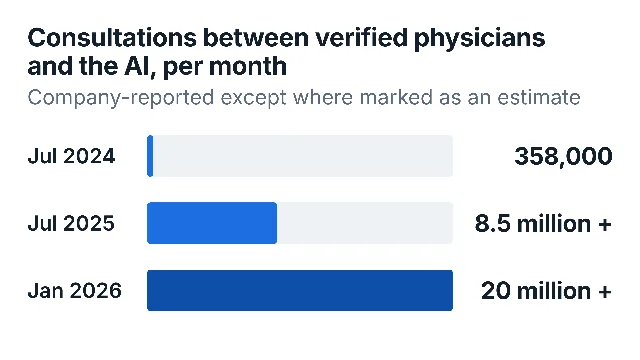
The habit is daily. Nadler told CNBC that more than 40% of US physicians use the platform 1, and the company counted 1 million clinical consultations in a single 24-hour period on 10 March 2026 9. Nadler also says users ask at least one question a day on average, across more than 20 million conversations a month 4.
The design tracks the clock, not the clinician's preference. In September 2026 the company split its model into three, named for founders of medicine: Osler answers in about five seconds for the gap between patients, Sackett takes about thirty seconds, and Snow runs a full literature investigation in roughly five minutes 10. A physician with two minutes and a physician with an afternoon get two different products from one interface.
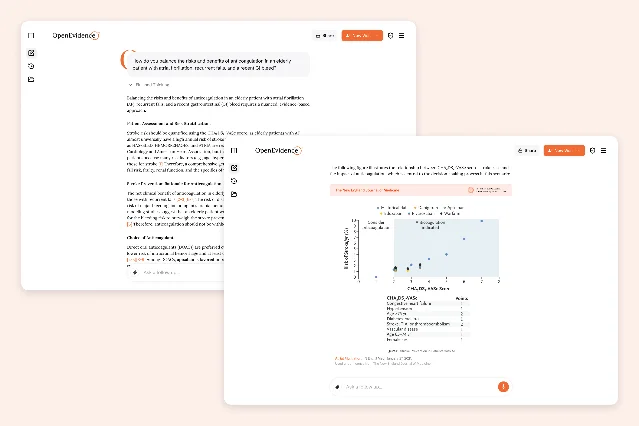
Depth of workflow is the second layer. Visits transcribes encounters and drafts the note; Coding Intelligence proposes CPT, E/M and ICD-10 codes as the note is written; Voices sets the note's tone; Messages and Fax send patient communication from the same app. DotFlows lets a clinician save a reusable prompt and recall it by typing a period, with a community library to copy from 11. Each runs on the account the physician created for themselves.
The retention line is also the part with the least friction holding it. Nothing is signed, so nothing has to be cancelled. The account belongs to the physician instead of the employer — Nadler: "Doctors sign up directly, allowing us to be by their side and help them wherever they go" 4 — which cuts both ways, because a habit that follows a person can also leave with one. What holds it is the citations physicians trust, the saved prompts and settings, and the daily usefulness of the answers themselves.
Monetization: the free product is the ad inventory
OpenEvidence sells advertising to pharmaceutical and medical device companies. The ad lives inside the wait: generating an answer means retrieving and reading evidence for several seconds, and during that window the platform shows a video promotion which disappears once the answer arrives. Nadler describes the trade plainly — the physician would be waiting anyway — and the platform tailors ads to a user's specialty from how they use it 4.
The unit economics hang on who is watching. Craft Ventures, an investor in the January 2026 round, points to a $20–25 billion US market for digital pharma advertising, and to query volume as the thing that manufactures more inventory 4. Sacra estimates the platform earns $70 to $1,000+ per thousand impressions, against $5–15 on social platforms, and about $124 per user; it puts Doximity, the listed physician network, at $228 per user, with 80% of its $570 million in trailing twelve-month revenue coming from advertising 2. Those rates are an estimate, and the company publishes neither ad prices nor a rate card.
The cost side is two-sided. OpenEvidence pays publishers for the content its answers cite — the Springer Nature agreement is a subscription, not a partnership in name only 6 — and it gives away work that costs real money to run. When DeepConsult launched in July 2025, the company said each run consumed more than 100 times the compute of a standard search and released it free to verified clinicians anyway 3. Free access is the growth strategy, and it is also the bill.
Three things could break it. Ad rates this high depend on an audience no competitor can assemble at will, and OpenAI's ChatGPT Health and Anthropic's Claude Healthcare are now chasing the same clinicians 1. Advertising inside a clinical decision has an uncomfortable precedent: MedCity News put OpenEvidence's model beside Outcome Health, a healthcare unicorn that also sold pharmaceutical advertising into medical practices and whose former executives were later convicted in a $1 billion fraud case 4. And the institutional business, where pricing is not disclosed, will be measured against a product that is free.
Transferable takeaways
- Sell to the person with the problem, not the department that buys software. A clinician's own signup bypasses procurement entirely, and it is what let a company founded in 2021 reach hospitals it never cold-called. The prerequisite is a user who can adopt alone and whose endorsement travels to colleagues.
- Verification can do double duty. A license check keeps the audience trustworthy for the user and makes it sellable to an advertiser. That only works if verification is fast; the MINC integration exists because a few minutes of form-filling at signup is enough to lose a physician.
- An ad model needs a wait to hide in. The ad occupies seconds the user would otherwise spend waiting, and leaves when the answer arrives. A product that answers instantly has nowhere to put one.
- A free product carries no lock-in, so retention is rebuilt every day. The switching cost here is a habit, a set of saved prompts, and a citation trail a physician has learned to trust — none of it contractual, and all of it attackable by a competitor with a comparable library.
References
- 1
- 2
- 3
- 4Thunderstruck by OpenEvidence's $12B valuation? Don't be.
medcitynews.com
- 5
- 6Springer Nature and OpenEvidence announce agreement
openevidence.com
- 7
- 8OpenEvidence announcements
openevidence.com
- 9
- 10Introducing the OpenEvidence model family
openevidence.com
- 11OpenEvidence user guide
openevidence.com
This story was produced automatically by a channel. One sentence is all it takes for Neodrop to keep producing for you.