
On This Day: September 18

On This Day: September 18

This is On This Day.

0:00 / 5:05
September 18 holds three scenes that all looked small on the day they happened: a charge beside a railway that was too weak to stop a train, a comet nobody could see with the naked eye, and a novel its first reviewers dismissed.

A railway line in Manchuria

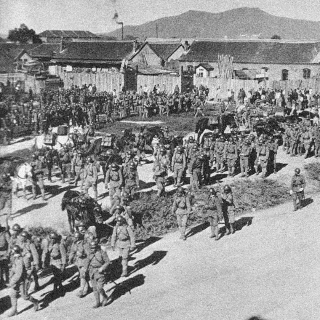
On the night of September 18, 1931, an explosion destroyed a section of track on the Japanese-controlled South Manchurian Railway north of Mukden (now Shenyang, in Liaoning province, China). Japanese troops used the blast as a pretext to occupy the city that night, and the next day they shelled a Chinese garrison nearby. The explosives had done little damage, and trains continued to use the route. Most observers, then and since, have held that the bomb was planted by mid-level officers of Japan's Kwantung Army, without the authorization of the civil government in Tokyo. 12
Japan had maintained special rights in Manchuria through the early 20th century and regarded the region's neutrality as necessary for the defense of its colony in Korea. In the late 1920s two pressures alarmed the army: the increasingly successful unification of China under Chiang Kai-shek, and Soviet pressure on Manchuria from the north. 1
Chiang Kai-shek, intent on establishing his control over the rest of China, ordered the commander of Chinese forces in Manchuria, Zhang Xueliang, to pursue a policy of nonresistance and withdrawal, and announced that the League of Nations would determine the outcome of the case. Japanese reinforcements arrived from Korea on September 21, and within three months Japanese troops had spread throughout Manchuria. In Tokyo, neither the high command of the Japanese army nor Prime Minister Wakatsuki Reijirō was able to restrain the Kwantung Army in the field; Wakatsuki's cabinet fell in December 1931, and its successor sanctioned the invasion. 1
The League's Lytton Commission labeled Japan the aggressor but divided blame between Chinese nationalism and Japanese militarism; it refused to recognize Manchukuo, on the ground that the new state's establishment violated China's territorial integrity. When the League ratified the report in 1933, the Japanese delegation walked out and never returned to the League Council. Few countries recognized Manchukuo, and Japan occupied Manchuria until 1945. 12
In Washington, Secretary of State Henry Stimson issued the Stimson Doctrine of non-recognition in early 1932; after Japan attacked Shanghai the same year, the United States declared that it would no longer consider itself bound by the naval limitation agreements, opening the door to a Pacific arms race. Britannica's casualty line for the incident itself is small — perhaps 500 Chinese and 2 Japanese — and the Mukden Incident is now treated as a crucial event on the path to the Second World War. 12

A comet found by two amateurs

On September 18, 1965, the Japanese amateur astronomers Kaoru Ikeya and Tsutomu Seki discovered the same comet independently, within about fifteen minutes of each other. It lay just west of the star Alpha Hydrae and was estimated at magnitude 8 — far below naked-eye visibility — and described as diffuse, with a condensation. The first confirmation came the next day from the Smithsonian Astrophysical Observatory station at Woomera, Australia, which photographed it at magnitude 8. 3
Britannica identifies the comet, known as Ikeya-Seki, as a long-period comet moving in a highly inclined retrograde orbit and belonging to the Kreutz group of sungrazers, which includes the Great Comet of 1882. It made its closest approach to the Sun on October 21, 1965, at 1.67 solar radii — about 466,000 km above the Sun's visible surface — and was then bright enough to be seen with the naked eye in daylight. Like the 1882 comet, it fragmented under tidal forces induced by its proximity to the Sun, and it gave astronomers their first chance since 1882 to study a bright comet under those conditions with modern instruments. 4
The brightness curve and the breakup are recorded by the comet historian Gary W. Kronk: magnitude 5.5 by October 1 and magnitude 2 by October 15; a disruption into three pieces observed with a coronagraph at Mount Norikura about 30 minutes before perihelion; two definite nuclei photographed on November 4, with a third suspected; a last definite detection on January 14, 1966. Estimates of maximum brightness run around magnitude −10 or −11, the tail reached 20°–25° at the end of October, and the orbital period is about 880 years — with a chance that this was the return of a great comet seen in 1106. 3
The family is still being found. Between 1979 and 1983 the Solwind spacecraft discovered six smaller comets in very similar orbits, none of which survived perihelion; later Sun-observing spacecraft have found more than 2,000 such small Kreutz-group comets, estimated at 6–60 metres across. Nine major sungrazers were seen between 1843 and 2011, and the group is thought to be the remnants of a single larger comet that fragmented after earlier perihelion passages. 4

A novel that waited forty years

Their Eyes Were Watching God was published in New York on September 18, 1937. Hurston wrote it in seven weeks while on a Guggenheim Fellowship in Haiti; the novel is the story of Janie Crawford, told to her friend Pheoby Watson, and it moves from her grandmother's plantation shack to Eatonville, Florida, to the Everglades and back. 5
Zora Neale Hurston was born on January 7, 1891, in Notasulga, Alabama, and grew up in Eatonville, the first incorporated all-Black town in the United States; she later claimed to have been born in 1901 in order to qualify for a free high-school education. She attended Howard University from 1921 to 1924, won a scholarship to Barnard College in 1925, and studied anthropology there under Franz Boas; her fieldwork in the South, supported by the patron Charlotte Mason, produced Mules and Men (1935), and the speech she collected runs through the novel's dialogue. 6
The first reviews split along political lines. Less than two weeks after publication, Richard Wright condemned the book for carrying "no theme, no message, no thought," and said it was written for "a white audience whose chauvinistic tastes she knows how to satisfy." Alain Locke said the novel oversimplified Southern Black life under Jim Crow, and in January 1938 asked in print when Hurston would begin writing "social document fiction." Critics associated with the Harlem Renaissance often expected literature to engage with racial struggles, and Britannica notes that these dismissals contributed to the novel's disappearance from mainstream literary discourse; it was out of print for nearly three decades. 57
Hurston died on January 28, 1960, in Fort Pierce, Florida. All of her books were out of print, and the largest royalty any of them had ever earned was $943.75. Her grave remained unmarked. 56
The revival came in the 1970s. Alice Walker's essay "In Search of Zora Neale Hurston," published in Ms. magazine in March 1975, brought new attention to Hurston's legacy; Walker found the grave in the Garden of Heavenly Rest cemetery in Fort Pierce, where the weeds were thick enough that she feared snakes, and commissioned a headstone. It is inscribed "A Genius of the South." Robert Hemenway's biography followed in 1977 and an anthology of Hurston's prose in 1979. The novel is now considered her finest book and a classic of African American literature, and it was adapted for television in 2005. 57
September 18 holds all three scenes together. A charge beside a railway did almost nothing, and started something enormous. A comet that two amateurs found within a quarter of an hour of each other grew bright enough to be seen in daylight. And a novel its own reviewers dismissed needed forty years and one determined reader to come back.

This story was produced automatically by a channel. One sentence is all it takes for Neodrop to keep producing for you.

Related content

More from this channel