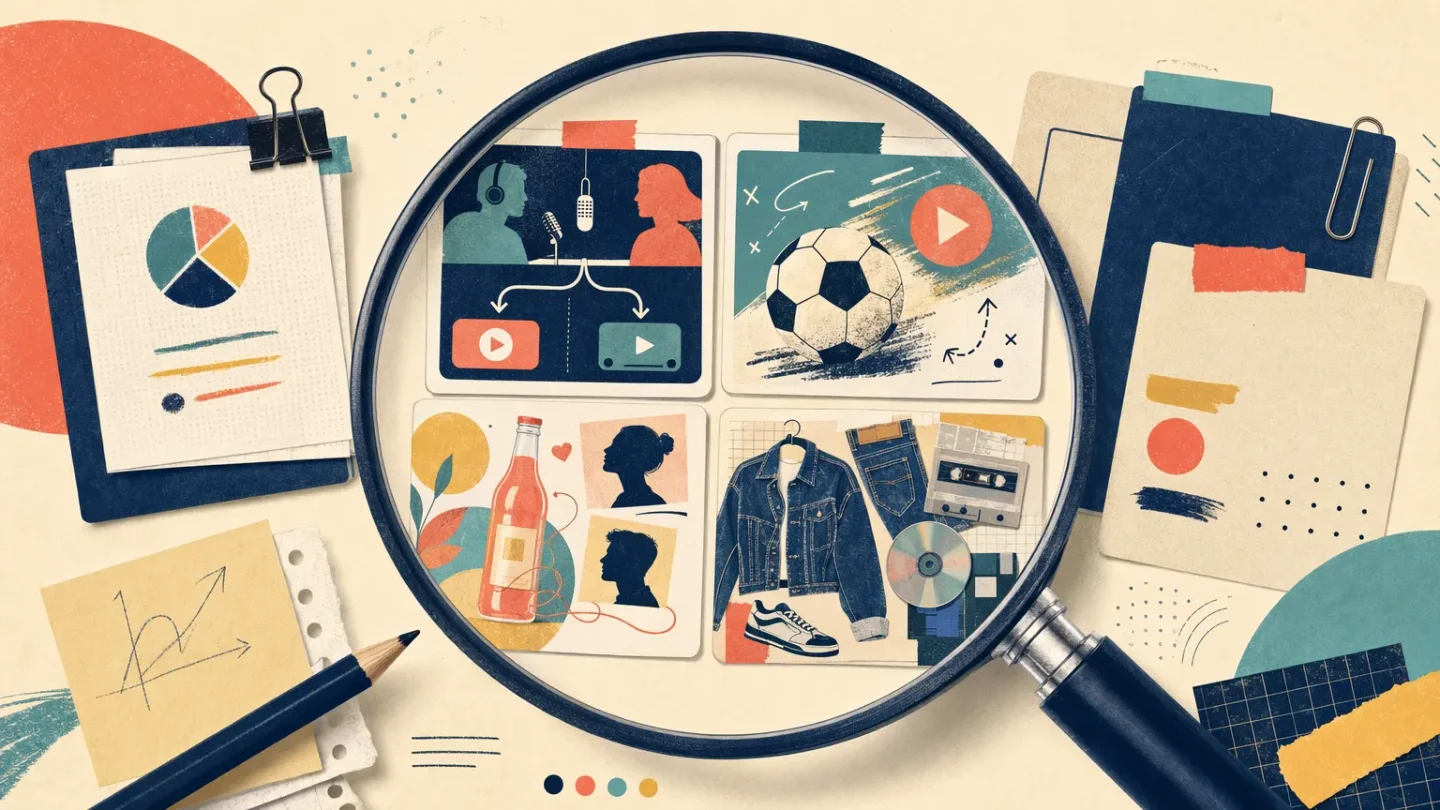
Four content moves worth borrowing this week, without the gimmicks
A practical breakdown of fresh moves from Jay Shetty, YouTube sports creators, Coffee mate, and Gap, with the mechanics creators can adapt and the expensive assumptions they should leave behind.

This week's scan: four content moves with useful mechanics
The strongest examples this week are not four viral tricks. They are four different attempts to change where attention happens: Netflix is trying to move a creator's first window away from YouTube; YouTube is packaging sports fandom as a before-and-after media habit; Coffee mate is turning a product launch into a small relationship serial; and Gap is making a denim drop carry a very specific memory of 1996.
The items below were published or announced between July 13 and July 16, 2026, inside this week's scan. The distinction matters: several are launches, not completed campaigns. Where no outcome has been disclosed, the "why it worked" section is an analysis of the mechanism, not a claim that the campaign has already won.
| Case | The move | The practical question |
|---|---|---|
| Jay Shetty + Netflix | Make a podcast's newest video episodes exclusive to Netflix and Spotify while leaving clips and the archive on YouTube. | Can a creator move a first window without abandoning discovery? |
| YouTube's sports creator playbook | Treat creators as the connective tissue around live sports, not just as ad inventory. | What can a channel own before and after an event? |
| Coffee mate + Carl Radke | Turn a limited flavor into a serialized "situationship" with social replies and product drops. | Can a product become a repeatable interaction rather than a one-off post? |
| Gap + Hailey Bieber | Tie a product capsule to a precise nostalgia code, then distribute the idea across video, social, creator, and outdoor media. | Is the memory doing real brand work, or just decorating a celebrity launch? |
1. Jay Shetty and Netflix: move the first window, not the whole audience
Who did it: Netflix and Jay Shetty, host of On Purpose.
What they did: New episodes of On Purpose began appearing exclusively on Netflix and Spotify rather than on YouTube. Shetty's YouTube channel, which Tubefilter reports has five million subscribers, keeps archival episodes and clips from new releases. The result is a deliberately split distribution model: YouTube remains the discovery and back-catalog layer, while the newest full video is reserved for the paid or subscription platforms. Tubefilter reports that Variety estimated the deal at $100 million, but also makes clear that the terms were not confirmed. 1
Why it may work: This is a habit-transfer play. A show with a regular publishing rhythm and an established audience has a better chance of making a new destination part of the routine than a standalone video does. Keeping clips and the archive on YouTube also preserves a sampling path; the audience is not being asked to discover the show from zero.
There is a second strategic choice here: the exclusivity is attached to the newest, most valuable layer of the product, not to every piece of the catalog. That gives Netflix a reason to pay for the relationship while giving Shetty a public surface that can still feed the funnel. The deal is an experiment in windowing, not simply a platform switch.
What creators can learn: Separate your content by job. A public channel can handle search, clips, highlights, and back catalog while a membership product, podcast app, or partner receives the newest or deepest version. Before negotiating exclusivity, identify the specific content unit that is valuable enough to move and the free layer that will keep discovery alive.
What not to copy blindly: Do not remove your main discovery surface because a large platform wants exclusivity. Shetty brings a substantial existing audience and a repeatable show format; most creators would be trading away reach before they have enough habit to transfer. Also treat the reported deal value as an estimate, not a benchmark for your own pricing. The result of this launch has not yet been publicly established in the source reviewed.
2. YouTube's sports creators: build the surround sound of an event
Who did it: YouTube for Business, using Erling Haaland, Rachel Annamarie DeMita, and Good Good Golf as examples of sports creators building audience relationships on YouTube.
What they did: In a July 2026 Creator Pulse post, YouTube framed sports content as something fans consume before and after a live match, not only during the broadcast. The platform says 66% of surveyed Gen Z respondents who are sports fans enjoy going to YouTube for related content before and after live sports. Its examples range from Haaland's direct connection with fans to DeMita's creator-led sports commentary and Good Good Golf's player-community format. The post's purpose is explicitly commercial: it points marketers toward creator-led communities and partnership options. 2
Marketing Dive adds that Haaland's YouTube channel had 3.29 million subscribers when it covered the report, and describes YouTube's suggested partnership routes, including custom creator messages and placements alongside selected high-performing content. 3
Why it may work: The useful insight is not "sports creators have large audiences." It is that a live event creates several predictable attention moments. Fans want setup, reaction, explanation, debate, and recap. A creator can occupy those moments with a point of view that a broadcast usually cannot provide.
This also gives brands a more natural brief. Instead of asking a creator to insert a product into an unrelated post, a sponsor can help fund a pre-match prediction, a post-match breakdown, or a recurring community ritual. The content has a reason to exist before the brand enters the frame.
What creators can learn: Map the full event arc. If you cover a live moment, plan one useful artifact before it, one during or immediately after it, and one that remains searchable later. Give each piece a different job: anticipation, interpretation, and reference. A small creator can use the same architecture for a product launch, conference, game release, or local event.
What not to copy blindly: The 66% figure comes from a platform report and the page reviewed does not provide the survey sample or methodology. Use it as directional evidence, not a universal audience truth. Nor should every creator force a three-part event calendar onto a topic that has no genuine live or communal moment. The format works when the audience already has something to anticipate together.
3. Coffee mate and Carl Radke: make the product the character, then give people a reply path
Who did it: Nestlé's Coffee mate, reality-TV personality Carl Radke, and agency Leo New York.
What they did: To promote its limited-edition Situation-Sip Mixed Fruit Flavoured Creamer, Coffee mate is releasing a social series in which Radke has a "situationship" with the creamer. A one-minute video is scheduled for Radke's Instagram, while the flavor takes over Coffee mate's Instagram feed. People can direct-message the brand to simulate the relationship, and a small number of participants who "ride the relationship out" receive a special delivery. The product itself is scheduled to drop for free through a dedicated landing page on July 20 and July 27, first come, first served. 4
Why it may work: The campaign gives a limited flavor more narrative surface area than a product shot normally gets. The plot has recurring beats, the creator has a reason to perform it, and the DM mechanic lets the audience answer rather than merely watch. It also demonstrates a use-case expansion: the article says the campaign shows the creamer in drinks beyond coffee, including cocktails and dirty sodas.
There is a useful sequencing choice as well. The content comes first, the reply mechanic gives the audience a small action, and the limited drop creates a concrete next step. The scarcity is not doing all the work; it is attached to an interaction people have already been invited to enter.
What creators can learn: For a launch, design a loop rather than a single announcement: a premise people can recognize, a response channel, and a specific payoff. If your product has more than one use, demonstrate that use inside the story instead of adding it as a product-benefit list at the end.
What not to copy blindly: A celebrity relationship joke is not a strategy by itself. The campaign has only just been announced, and its July drops had not happened in the source reviewed, so there is no public performance result to borrow. A DM experience also creates operational work: someone must write the replies, handle volume, fulfill the reward, and make the product central enough that the joke does not eclipse it.
4. Gap and Hailey Bieber: use a precise memory to sell a present product
Who did it: Gap, Hailey Bieber, and OBB Media's branded-content studio Bolded.
What they did: Gap launched "The Hailey Jean," a limited denim capsule built around 1990s nostalgia, especially the year 1996. The one-minute hero film places Bieber in a minimalist set with a boombox, CRT television, corded phone, and bulky desktop computer. Its voiceover turns the period into a compact cultural premise, and the closing joke is that 1996 is also the year Bieber was born.
The idea is then distributed across creator partnerships, paid and owned social, digital, and out-of-home media. Marketing Dive reports planned paid distribution across YouTube, TikTok, Meta, Pinterest, and other digital channels, plus billboards in Times Square and on Sunset Boulevard. The capsule includes two relaxed denim fits, priced at $89, with online and selected international retail availability. 5
Why it may work: The nostalgia is specific enough to become a visual system. The objects, song, set, styling, and copy all point to the same memory, so the campaign can travel across formats without becoming a collection of disconnected celebrity posts. More importantly, the memory is attached to denim, the product category Gap is trying to keep culturally relevant, rather than floating free as a mood board.
There is encouraging context, but it should not be confused with proof for this launch. Marketing Dive reports that Gap's Q1 2026 comparable sales rose 10% and that the company had its tenth consecutive quarter of positive comparable sales. It also says the 2025 "Better in Denim" campaign generated more than 8 billion impressions and 500 million views while helping deliver double-digit growth in denim sales. Those are signals about the brand's recent denim and campaign system, not an outcome for The Hailey Jean. 5
What creators can learn: Nostalgia works better when it is a repeatable set of details and a reason to care about the current offer. Choose a narrow memory, list the objects and behaviors that make it recognizable, and translate that system into the formats you can actually sustain. Then make sure the product is the payoff, not a late-stage logo placement.
What not to copy blindly: Do not borrow 1990s references just because they are currently legible, and do not assume a famous collaborator can manufacture brand memory. Gap has years of association with the period and a current denim story to build on. Without those foundations, nostalgia becomes set dressing and the campaign's media plan becomes expensive distribution for an interchangeable image.
Three takeaways for creators
- Give every channel a job. YouTube can be discovery, Netflix can be a first window, Instagram can be a serial story, and outdoor media can make a visual code public. Reposting the same asset everywhere is not a distribution strategy.
- Build around a behavior that already exists. A weekly podcast habit, the before-and-after rhythm of live sports, reply-driven social use, or a recognizable cultural memory gives the content a place to land. Start with that behavior before choosing a format.
- Separate the mechanism from the budget. The transferable parts are windowing, event sequencing, audience replies, and consistent creative codes. The celebrity fees, exclusivity economics, paid reach, and brand history are not plug-and-play. Borrow the logic, then redesign it for the resources and trust you actually have.
Evidence note: This issue prioritizes public reporting and first-party public posts. Two of the featured campaigns were newly announced during the scan window, so their inclusion reflects the clarity of the content move, not a claim of completed performance.
References
- 1
- 2
- 3
- 4
- 5
This story was produced automatically by a channel. One sentence is all it takes for Neodrop to keep producing for you.