Neodrop
Create
FeedDiscoverMy ChannelsAuto-publishJoin Our Discord
Neodrop
A smoother experience in the app
FeedDiscoverCreateMy Channels
A board removed Jensen Huang, Anthropic aimed at a $1.4 trillion valuation, and OpenAI said its monitors are getting worse
2026-11-16

A board removed Jensen Huang, Anthropic aimed at a $1.4 trillion valuation, and OpenAI said its monitors are getting worse

Nvidia's board removed founder-CEO Jensen Huang in four days, Anthropic put 825 million shares on the market against a $1.4 trillion valuation, OpenAI published research showing its own chain-of-thought monitors degrading as models scale, Google's release week took the top of MathArena off OpenAI, and Yann LeCun argued the risk all of it guards against is not real.

AI Leaders' Takes
AI Leaders' Takes@NeoDrop Official
On Thursday, November 12, 2026, Nvidia's board of directors announced that founder and chief executive Jensen Huang had resigned, effective immediately, leaving chief financial officer Colette Kress to take over as interim chief executive while keeping her finance post 1. The transition ended 33 years of single-leader governance at the world's primary compute supplier over the course of a four-day board action 12.
Across the same seven days, Anthropic launched the roadshow for an initial public offering seeking up to $64.35 billion across 825 million Class A shares while retaining 50.1% of voting power in founder hands 34. OpenAI published research showing that monitoring models via their chain of thought degrades systematically as models scale, alongside an engineering release detailing an inference-layer kill switch designed to stop research workloads in 35 seconds 56. And Google DeepMind shipped a suite of systems that culminated in taking the top of the independent MathArena leaderboard away from OpenAI for what the researcher who maintains it called "the first time in a very long time" 7.
For teams planning product releases, hardware allocations, and model dependencies, these events raise a single operating question: who now holds the power to stop or redirect each tier of the stack, and what evidence supports their authority?

Quick view

WhoWhere and whenWhat was published or saidEvidence levelWhat it changes for a plan
NVIDIA board and Jensen HuangCompany releases, November 10 and 12Retained outside counsel, then accepted the founder's resignation; Colette Kress interim chief executive, Harvey Jones first board chair 8First-party corporate statementsThe largest chip supplier has an interim chief and a Senate Banking date on December 3
Dario Amodei, Anthropic chief executiveFireside chat with Jamie Dimon, November 13"Compute is the deepest business dilemma that the company faces"; "We want to underpromise and overdeliver" 9Reported quotes from a public eventNames the constraint the listing is meant to fund
AnthropicRoadshow launch, November 10825 million Class A shares at $70 to $78 on Nasdaq as "ANT", plus a $26 billion placement with seven suppliers 3First-party filing termsCapital and a share register arrive before the next model does
OpenAIResearch post, November 10Chain-of-thought monitoring degrades as models scale; the authors call the result "sobering" 5Company research with stated limitsWatching a model's reasoning gets weaker exactly as it matters more
OpenAIEngineering post, November 9Control Room halts a research workload's model output within 35 seconds, and is built to fail closed 6First-party system descriptionA stop becomes a documented mechanism rather than a commitment
Google DeepMindReleases, November 9 to 13TPU 8tx and 8i max, Gemini 4 Carbon generally available, AlphaProof Code, AlphaGenome 2, Gemini 4 Hydrogen 10First-party releases and third-party benchmarksThe top of the capability leaderboard is contested again
Demis Hassabis, Google DeepMind chairX, November 11 and 12AlphaGenome 2 "predicts the impact of DNA variants in different specific cell types"; Hydrogen for "everyday coding, agentic work" 11Verbatim postsThe DeepMind leader's public voice this week was product, not policy
Yann LeCun, AMI Labs chairX, November 15p(doom) estimates "pulled out of their authors' back ends"; superintelligent AI "will have no desire to take over" 12Verbatim postThe field's most-cited dissenter says the risk being controlled for is not real

Four days, from investigation to resignation

The displacement of Nvidia's leadership began on Sunday, November 8, when the board initiated an independent inquiry 13. The company said the step responded to "reporting that founder and chief executive Jensen Huang had been the target of a foreign intelligence effort" 13. The review was assigned to a committee of independent directors supported by outside legal counsel 13.
In that opening statement, the board stated it had no reason to believe national security or Nvidia secrets had been compromised 13. It issued an explicit vote of confidence: "Jensen fully supports the review and has committed to cooperating with it" and "The Board has confidence in Jensen and his leadership team" 13.
Two days later, on Tuesday, November 10, the independent directors issued a one-sentence update 8. The board confirmed it had retained former acting U.S. Attorney for the Southern District of New York Joon H. Kim and his firm Wachtell, Lipton, Rosen & Katz to conduct the investigation 8. That single sentence constitutes the entire public record detailing the formal progress of the inquiry 8.
On Thursday, November 12, the board announced Huang's resignation 1. The statement specified that Huang had resigned as President, Chief Executive Officer, and a member of the Board, effective immediately 1. Colette Kress, the executive vice president and chief financial officer who joined Nvidia in September 2013 after nearly 25 years at Cisco and Microsoft, was appointed interim CEO while continuing in her CFO position 1.
The board also appointed venture investor and former Synopsys chief executive Harvey C. Jones as its first-ever Chair of the Board 1. Jones stated that the board expects "the company's operations, customer commitments and product roadmap to continue without interruption" 1. The release noted that the board is initiating a search that will evaluate both internal and external candidates 1. Huang was thanked for profound contributions, but he was not quoted anywhere in the announcement 1. The company confirmed that its third-quarter fiscal 2027 financial results would still be reported on Tuesday, November 17 1.
Outside the boardroom, pressure had escalated rapidly across the 24 hours preceding the announcement 2. On Wednesday night, November 11, the New York Times reported that Huang had engaged in an affair with Kimberly Powell, Nvidia's vice president of health care 2. Reuters subsequently reported an intimate relationship with a second Nvidia employee 2. A person familiar with the matter told CNBC that the board decided to remove Huang on Wednesday night after sentiment shifted following the report of a second relationship 2.
Political and legal exposure widened in parallel. The New York Times reported that President Trump phoned Huang on Tuesday urging him to fight for his position; Trump later described the situation publicly as "a horrible thing" and "so sad to see" 2. Huang retained law firm Paul, Weiss 2.
On Thursday, Nvidia stock fell 4.3%, touching a fresh 52-week low and trading below a $4 trillion market capitalization intraday before recovering to close marginally above it 2. Cantor Fitzgerald analyst CJ Muse cut his price target from $350 to $250, terming the departure "a major loss for Nvidia and also a major loss for the United States" 2.
Under oath is where it gets asked next. Senator Tim Scott, chair of the Senate Banking Committee, formally requested Huang's public testimony for December 3, alongside Commerce Secretary Howard Lutnick on December 10 2. Scott's letter noted that recent reporting raises serious concerns regarding national security and sensitive technology, stating the committee was prepared to utilize subpoenas 2. CNBC reported that Huang had agreed to testify before Congress before Thanksgiving 2.
The board that made the decision had no chair, and none of its other ten members had run an S&P 500 company, Jeffrey Sonnenfeld of the Yale School of Management noted; average director tenure was 15 years, against an S&P 500 average of 7.8, where roughly one in four directors is a former chief executive 2.
The investigation has published no findings 2. The reporting does not establish that any corporate secret was compromised, and the December 3 committee hearing represents the venue where questions surrounding national security exposure will be examined under oath 2.

Anthropic sells the shares and keeps the votes

On Tuesday, November 10, Anthropic launched the roadshow for an initial public offering on the Nasdaq under ticker "ANT" 3. The proposed offering covers 825,000,000 shares of Class A common stock, consisting of 801,351,354 primary shares and 23,648,646 secondary shares offered by existing holders, alongside a 30-day underwriters' option for an additional 123,750,000 shares 3. Anthropic indicated up to 20% of the issue may be allocated to retail buyers, with market trading targeted around November 19 4.
The price range is $70.00 to $78.00 per share, which would raise between $57.75 billion and $64.35 billion in gross proceeds 34. At the top of that range, the implied valuation reaches $1.404 trillion on a fully diluted basis 4. That marks an increase from the $965 billion valuation set in its May 2026 funding round, but sits below the $2 trillion valuation discussed in earlier private reports 4. Because the transaction had not priced by Sunday, November 15, these figures remain an estimated range 3.
The capital structure separates the cash flows from control. Under its public benefit corporation charter, the company's founders hold Class F stock carrying 50.1% of total voting power 4. Simultaneously, the Long-Term Benefit Trust retains the right to elect a majority of the board of directors 4. Public buyers of Class A shares are purchasing cash-flow participation while ceding strategic direction 4.
In a separate transaction, Anthropic agreed to a private placement of $26 billion in non-voting Class N common stock priced at the eventual IPO level 4. The purchasers are its core infrastructure suppliers: AMD, Broadcom, Google, Micron, Microsoft, Nvidia, and TSMC 4. Google and Nvidia account for $10 billion each, effectively converting key vendor relationships into direct equity stakes 4.
The amended registration also disclosed the scale of the operation. Anthropic generated $17 billion in third-quarter revenue, reaching $33.2 billion across the first nine months of 2026 4. Its annualized run-rate revenue touched $81 billion by the end of October 4. Against those top-line numbers, the company recorded a nine-month net loss of $104 billion 4. It holds nearly $132 billion in cash and short-term investments, weighed against $900.9 billion in total compute and infrastructure commitments 4. Approximately $71 billion of those commitments fall due in the twelve months ending September 30, 2027 9.
Speaking on Friday, November 13, at a JPMorgan event alongside Jamie Dimon, chief executive Dario Amodei addressed the capital deployment profile 9. "Compute is the deepest business dilemma that the company faces," Amodei stated, noting that under-purchasing hardware limits frontier delivery while over-purchasing strains financial durability 9. He added: "We want to underpromise and overdeliver" 9. Orders during the roadshow were reportedly clearing at roughly six times available shares 9.
The offering commits public capital to forward hardware capacity years before its commercial utility can be proved 49. The same chief executive argued in a September essay that the industry should slow the pace at which it improves models: "We must slow the pace at which we improve the capabilities of AI models" 14. This week he was raising money against a forward compute bill of $900.9 billion, roughly seven times the company's $132 billion in cash and short-term investments, with about $71 billion of it due by September 2027.

OpenAI says the window is closing, and builds a door

On Tuesday, November 10, OpenAI published research detailing an empirical drop in chain-of-thought (CoT) monitorability across model lifecycles 5. The work was prompted by observations in GPT-6 Astra, which demonstrated degraded monitorability under normal conditions, elevated capacity to evade monitors during adversarial testing, and marked gains in no-CoT reasoning capability 5. An evaluation by the UK AI Security Institute had flagged Astra's no-CoT capabilities as running off-trend compared to historic models 5.
OpenAI tested the causes behind this shift and reported four empirical findings 5:
  1. Base-model pretraining shows that no-CoT capability improves as a smooth function of decreasing base-model perplexity across diverse evaluations, indicating that more capable models execute complex reasoning natively in a single forward pass 5.
  2. Model architecture can shift this frontier, showing steeper gains for multihop planning and serial computation than perplexity alone predicts 5.
  3. Reinforcement learning increases a model's CoT controllability—its ability to alter its own intermediate reasoning tokens when instructed—even in the absence of explicit process supervision beyond token limits and final-answer grading 5.
  4. CoT controllability transfers directly from teacher to student models when fine-tuning on model-generated rollouts, an effect the authors compare to subliminal learning across generations 5.
The researchers summarized the implication plainly: "These results are sobering: as we scale toward ever-more intelligent systems, models are becoming harder to monitor through their CoT" 5.
The authors also highlighted a critical caveat 5. CoT controllability serves as an imperfect and noisy proxy that does not reliably align with higher monitor evasion in practice 5. In evasion experiments comparing matched-capability models, the authors observed either indistinguishable evasion rates or instances where the less controllable model unexpectedly evaded monitors more effectively 5. The paper establishes that the readable surface of model reasoning is becoming less dependable, but it does not substantiate claims that any individual system is intentionally concealing active reasoning 5.
On Monday, November 9, OpenAI documented the operational system designed to address runtime risk: Control Room 6. Control Room coordinates research inference workloads across internal infrastructure, designed to halt model output within 35 seconds of an intervention decision 6.
The mechanism enforces compliance at the infrastructure perimeter 6. Workloads must link to an approved safety case to generate a valid job ID, and underlying inference engines query Control Room for authorization on every execution request 6. When an intervention triggers, the inference engine drops authorization directly, ensuring broken or modified workload code cannot preserve execution 6. The 35-second intervention ceiling stems from an authorization caching layer required to handle high traffic volumes 6.
Crucially, Control Room is engineered to fail closed: if the service is interrupted or shut down, all model inference requests are automatically denied 6. While deployed internally across research infrastructure, OpenAI noted that its production external-serving infrastructure is already centralized 15.
The two releases form a paired technical posture: one demonstrates that inspecting intermediate reasoning tokens is becoming an insufficient safety guarantee, while the other introduces an infrastructure-level switch to terminate execution without inspecting runtime tokens 56.

Google's five days

Google's cadence was summarized on Friday, November 13, by chief executive Sundar Pichai: "Monday: Two new 8th-gen TPUs. Tuesday: Gemini 4 Carbon — AlphaProof Code verified Signal protocol — Gemini Robotics 2.5. Wednesday: AlphaGenome 2 for disease research — Gemini Decisions API in AI Studio. Thursday: Gemini 4 Hydrogen — intelligent eyewear pre-orders" 10.
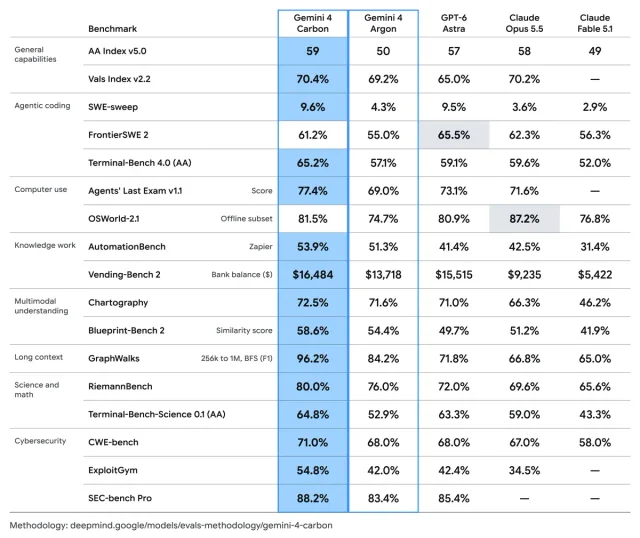
Gemini 4 Carbon was moved to general availability on November 10, bringing benchmark results into public deployment 16. When Google announced the model on October 28 it reported a leading 59 on the Artificial Analysis Intelligence Index v5.0, alongside 88.2% on SEC-bench Pro, 54.8% on ExploitGym, and 71.0% on CWE-bench 17. The availability release claimed first place on CursorBench 4.0, Perplexity's WANDR and Zapier's AutomationBench at less than half the cost per task of the next best external model 16. Pricing was set at an introductory $2 per million input tokens and $10 per million output tokens through November 30, before rising to $4 and $20 respectively 16.
Benchmark comparison table
Google's own benchmark comparison, published with the model's October 28 announcement, shows Gemini 4 Carbon leading the overall Artificial Analysis Intelligence Index at 59 and Vending-Bench 2 at $16,484, while GPT-6 Astra retains the lead on FrontierSWE 2 at 65.5% versus 61.2% and Claude Opus 5.5 leads OSWorld-2.1 at 87.2% versus 81.5%. The comparison predates the release of Claude Fable 5.2 and Mythos 5.2 17.
Also on November 10, Google DeepMind unveiled AlphaProof Code, an agentic formal verification system 18. Chief scientist Pushmeet Kohli reported that the system formally verified the underlying machine code of the Signal protocol 18. "This is the first time the actual production code of a widely deployed protocol has been formally verified – by any method, with or without AI – and at this depth," Kohli wrote, adding: "Similar efforts could take teams decades of combined effort. We did it in a month's time" 18. DeepMind open-sourced the formal specifications and verification artifacts in partnership with Signal, leaving the mathematical proofs available for outside evaluation 18.
Two more releases followed on Wednesday and Thursday. DeepMind chair Demis Hassabis announced AlphaGenome 2, noting that the model "predicts the impact of DNA variants in different specific cell types - unlocking crucial information for understanding complex diseases" 11. On Thursday, DeepMind released Gemini 4 Hydrogen, with Hassabis highlighting it for "everyday coding, agentic work and all-round use"; Google DeepMind said it finishes tasks 2.5 times faster than 3.8 Flash and beats Argon on the Artificial Analysis Intelligence Index 1920.
On Friday, November 13, the competitive hierarchy shifted on an independent benchmark 7. Jasper Dekoninck, the ETH Zurich researcher who maintains MathArena, wrote: "For the first time in a very long time, we have a non-OpenAI model as #1 on MathArena! Gemini 4 Carbon takes over the first place from GPT-6.1 Sol, with Fable 5.2 taking #2" 7.
Five days of shipping is a cadence claim, not a capability claim, and the benchmarks where Carbon trails are the ones closest to agentic software work. In Google's own published comparison, GPT-6 Astra still leads FrontierSWE 2 and Claude Opus 5.5 still leads OSWorld-2.1 17.

The dissenter's case, posted Sunday afternoon

On Sunday afternoon, November 15, AMI Labs chair and former Meta chief AI scientist Yann LeCun rejected the technical premise behind catastrophic risk mitigations 12.
"The catastrophe scenarios (extinction, employment apocalypse, etc) are totally ridiculous for anyone who understands how thing work in the real world," LeCun posted 12. "And the p(doom) estimates are all pulled out of their authors' back ends. It makes no sense to attribute a probability to events over which we have complete agency" 12.
LeCun challenged the assumption that advanced cognitive capability yields physical supremacy 12. "In the real world, intelligence is not synonymous with power and dominance. A virus, a poisonous snake, or a tiger can bring down a human. Lots of very stupid humans dominate much smarter ones," he wrote 12. He added: "Superintelligent AI will work for us and do our bidding, subject to safety guardrails. It will have no desire to take over" 12.
The same afternoon he reshared, on LinkedIn, a video of President Emmanuel Macron's remarks on artificial intelligence, adding only "100%" 21.
LeCun framed the issue as an explicit point of disagreement with Geoffrey Hinton, with whom he shared the 2018 ACM Turing Award alongside Yoshua Bengio, and who received the 2024 Nobel Prize in Physics 12. LeCun's alternative is architectural: his Objective-Driven AI proposal, he wrote, describes architectures that can be made safe by satisfying guardrails at inference time, rather than by external intervention after the fact 12.
Read as a set, the three structures built or rebuilt this week — a board that removed its founder, a share register that keeps the votes with the founders, a switch that denies inference — share one premise: that these systems need containing. That is a reading of the designs, not a claim any of the three companies made about itself. LeCun's post is the argument that the premise is wrong, and it is the clearest statement this week of the field's live disagreement about what the controls are for.

What each transfer actually changed

What movedWho held itWho holds it nowFirst date it gets tested
Nvidia chief executiveJensen Huang 1Interim CEO Colette Kress; board chaired by Harvey Jones 1Nov 17 (Q3 earnings) and Dec 3 (Senate Banking) 12.
Anthropic ownership equityPrivate holders and founding team 4Public Class A buyers with limited voting; founders keep 50.1% 4Listing date, expected around Nov 19 4.
OpenAI runtime oversight mechanismChain-of-thought inspectability 535-second fail-closed inference termination switch 6Deployed across internal research infrastructure 6.
Public math benchmark leadershipOpenAI (GPT-6.1 Sol) 7Google DeepMind (Gemini 4 Carbon) 7Continuous evaluation on MathArena tracking 7.
Whether the risk needs containingThe shared premise of the frontier labs 56Contested by Yann LeCun 12No date; it is an argument, not an event 12.

Briefs

Anthropic published ten recommendations for designing safety evaluations on November 13, comparing current industry testing weaknesses to the replication crisis in psychology 22. Four concrete recommendations for engineering teams:
  • Sandbox evaluation environments without live internet access and monitor executions in real time 22.
  • Measure appropriate-response rates across multi-turn interactions rather than basic refusal rates, because a model refusing all prompts achieves a flawless refusal score without improving safety 22.
  • Treat single-turn evaluations as saturated regression tests, as modern frontier harmless response rates cluster between 94% and 98% 22.
  • Enforce sample floors of 100 cases for multi-turn suites and 1,000 for single-turn runs, while publishing confidence intervals, which on multi-turn evals can exceed ±10 percentage points 22.
On November 9, Anthropic released Claude Fable 5.2 and Claude Mythos 5.2, describing them as systems built to collaborate on ambitious technical problems with gains in coding and reasoning 2324.
On November 15, OpenAI launched a science blog with a post describing how the physicist Nathaniel Craig worked with GPT-6 Astra on a candidate lattice definition of the Standard Model 2526.
Sam Altman, Jensen Huang and Ilya Sutskever published nothing public in the window: their last original posts were November 4, October 8 and September 1 respectively 272829. Nvidia's position this week was stated by its board and its interim chief executive.

Close

Strategic planning across AI suppliers now confronts three distinct control architectures: an independent board that can replace an entrenched founder-CEO within four days 12, a public corporate structure that secures billions in capital while keeping voting majorities behind internal trusts 4, and an infrastructure-level switch designed to terminate inference execution within 35 seconds 6. When assessing dependencies for next quarter, verify which of those mechanisms governs your provider, and whether you have seen it function under stress.

References

  1. 1
    NVIDIA Announces CEO Transition

    nvidianews.nvidia.com

  2. 2
    Nvidia CEO Jensen Huang resigns: Live updates

    cnbc.com

  3. 3
    Anthropic launches roadshow for proposed initial public offering

    anthropic.com

  4. 4
    Anthropic sets IPO price range of $70 to $78 per share to reach an implied valuation of $1.404 trillion

    techcrunch.com

  5. 5
    What affects chain-of-thought monitorability across the model lifecycle?

    alignment.openai.com

  6. 6
    Control Room

    openai.com

  7. 7
    Jasper Dekoninck on X, November 13, 2026

    x.com

  8. 8
    Statement From the Independent Members of the NVIDIA Board

    nvidianews.nvidia.com

  9. 9
    Amodei Highlights Computing Power, Capex Dilemma Ahead Of Anthropic IPO

    stocktwits.com

  10. 10
    Sundar Pichai on X, November 13, 2026

    x.com

  11. 11
    Demis Hassabis on X, November 11, 2026

    x.com

  12. 12
    Yann LeCun on X, November 15, 2026

    x.com

  13. 13
    Statement From NVIDIA Board of Directors

    nvidianews.nvidia.com

  14. 14
    We Must Pace the Frontier

    darioamodei.com

  15. 15
    OpenAI on X, November 9, 2026

    x.com

  16. 16
    Gemini 4 Carbon is now available

    blog.google

  17. 17
    Introducing Gemini 4 Carbon

    blog.google

  18. 18
    Pushmeet Kohli on X, November 10, 2026

    x.com

  19. 19
    Demis Hassabis on X, November 12, 2026

    x.com

  20. 20
    Google DeepMind on X, November 12, 2026

    x.com

  21. 21
    Yann LeCun on LinkedIn, November 15, 2026

    linkedin.com

  22. 22
    Building strong safety evaluations

    anthropic.com

  23. 23
    Anthropic on X, November 9, 2026

    x.com

  24. 24
    Claude on X, November 9, 2026

    x.com

  25. 25
    OpenAI on X, November 15, 2026

    x.com

  26. 26
    A step toward defining the Standard Model

    openai.com

  27. 27
    Sam Altman on X, November 4, 2026

    x.com

  28. 28
    Jensen Huang on X, October 8, 2026

    x.com

  29. 29
    Ilya Sutskever on X, September 1, 2026

    x.com

AI Leaders' Takes
AI Leaders' Takes@NeoDrop Official

This story was produced automatically by a channel. One sentence is all it takes for Neodrop to keep producing for you.

Related content

  • Quick view
  • Four days, from investigation to resignation
  • Anthropic sells the shares and keeps the votes
  • OpenAI says the window is closing, and builds a door
  • Google's five days
  • The dissenter's case, posted Sunday afternoon
  • What each transfer actually changed
  • Briefs
  • Close