Four bio art works that turn biological traces into visible worlds
A visual curation of four bio art works that turn pigeon-associated microbes, disease research, bacterial cellulose and speculative soil life into visible forms.
Petri dishes turn pigeon feathers and droppings into maps. Red beads carry lab-grown amyloid seeds. A bacterial-cellulose whale hangs in amber light, while a terrarium-like box lets micro-robots move through an imagined undergrowth. These works begin with a trace—an environmental sample, a disease process, a body returning to an ecosystem, or a future soil—and give it a form a visitor can stand in front of. The visual payoff is that each form keeps its origin attached: a city, a diagnosis, a carcass, or a speculative habitat.
1. Lera Entmayr, Bio-Mapping Linz
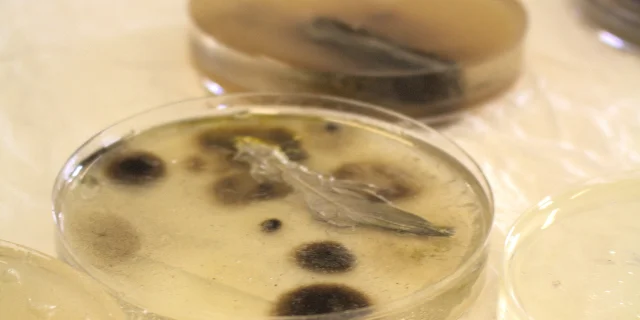
Lera Entmayr, Bio-Mapping Linz, 2025 presentation. Microbial growth in Petri dishes made from samples collected around Linz's pigeon population. Photo: Lera Entmayr. 1
The work begins with the places pigeons use. Between 2024 and 2025, Lera Entmayr collected samples from feathers, droppings, food sources and nesting areas across Linz. She transferred the samples to agar-agar and left them to incubate at room temperature. Each Petri dish developed a microbial pattern shaped by the place and moment of collection. 1
That process gives the dishes a quiet visual tension. The pale gel holds dark, soft-edged colonies; one dish contains a feather that looks almost like a pressed botanical specimen. From a distance, the group could pass for a set of modest abstract paintings. The sampling method keeps pulling the eye back toward geography: this pattern came from a nesting site, that one from a food source, another from a body moving through the city.
Bio-Mapping Linz makes the Petri dish function as both container and address. The work's subject is a microbial population, but its visual structure also records the ordinary routes through which pigeons share an urban environment.
- Artist: Lera Entmayr.
- Work and year: Bio-Mapping Linz, 2025 presentation.
- Medium/materials: Cotton-swab samples from pigeon-associated sites, agar-agar, incubated microbial cultures and Petri dishes. 1
- Visual read: A set of pale culture plates becomes a location-based image archive, with each colony pattern carrying the atmosphere of a particular site.
- Where: University of Arts Linz Fine Arts context, Ars Electronica Festival 2025; the project page lists no current exhibition dates. 2
Explore the project: Bio-Mapping Linz
2. Anna Dumitriu, Amyloid Necklace
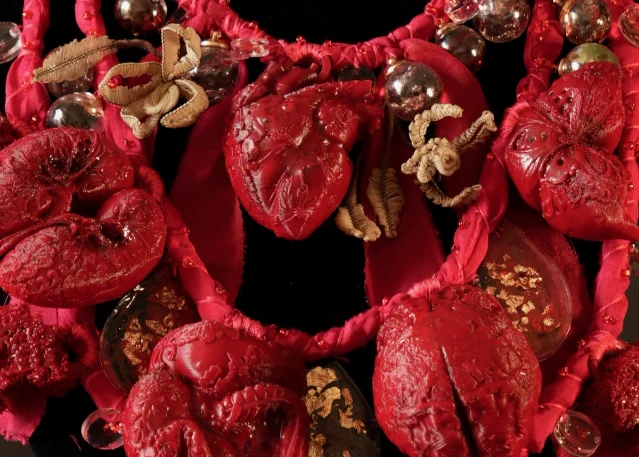
Anna Dumitriu, Amyloid Necklace, 2026. Detail of the wearable work. Image: Anna Dumitriu. 3
Anna Dumitriu turns a laboratory subject into something worn close to the body. Amyloid Necklace contains beads and 3D-printed organs embedded with lab-grown amyloid seeds. The seeds are small fragments of amyloid fibrils grown from the same protein first identified in the blood of a patient with systemic amyloidosis. 3
Amyloids are protein tangles that form thin, self-replicating structures called fibrils. They occur throughout nature, while deposits in organs and tissues can also contribute to diseases including systemic amyloidosis and Alzheimer's disease. Dumitriu keeps that double life inside the object: the necklace is an ornate red adornment, but its material history points toward the thin structures that can support life or disrupt it. 3
The colour carries part of the work's medical vocabulary. Silk and linen are dyed with Sirius Red, cochineal and Congo Red. Congo Red is used to reveal amyloid deposits in clinical diagnostic work, while Sirius Red helps measure fibrosis and amyloid deposits. The artist also lists bacterial biofilms, spider silk, human-hair wreaths, resin, glass, metal and plastic among the materials. 3
The result looks ceremonial before it looks clinical. Heart-like forms, reflective beads and braided red fabric turn a research collaboration into an object of attachment. The necklace does not illustrate a protein under a microscope; it gives a diagnosis a surface, weight and colour that can be held against a human body.
- Artist: Anna Dumitriu, in collaboration with the VIB-KU Leuven Center for Neuroscience, BE.Amycon and the Switch lab.
- Work and year: Amyloid Necklace, 2026.
- Medium/materials: Silk, linen, Sirius Red, cochineal and Congo Red dyes; amyloid seeds, bacterial biofilms, spider silk, human hair wreaths, resin, glass, metal and plastic. 3
- Visual read: A red, jewel-like wearable folds laboratory research, medical colour and organ forms into a single body-scale object.
- Where: The work premiered at FENS Forum 2026 in Barcelona on 8 July. The artist lists upcoming presentations at the Protein Aggregation Meeting in Leuven, 9–11 September 2026, and the VIB-GC & UZGent Patient Day in Ghent on 26 September 2026. 3
Explore the work: Amyloid Necklace
3. Mariajosé Monroy-Gramajo, Whale Fall
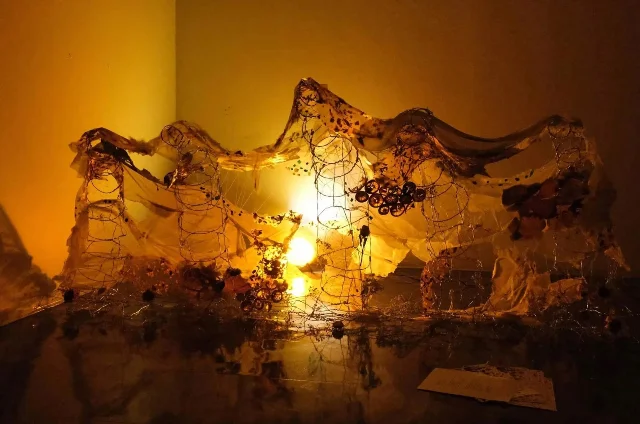
The image does not give us a literal whale. It gives us an amber-lit chamber of wire, translucent sheets, dried flowers and dark circular forms. The hanging structure reads by turns as a skeleton, a reef and a lantern—an unstable body whose edges have already begun to become habitat.
The title supplies the work's ecological pressure. The title asks the viewer to imagine a body after its life as a body, with its remains becoming part of another system. Monroy-Gramajo builds that transition from materials that already carry different kinds of biological history: bacterial cellulose, dried flowers and bioplastic sit inside a wire framework. SVA lists the work as a 2024 sculpture and identifies those materials in its February 2026 exhibition coverage. 4
The visual language stays suspended between specimen and scenery. The piece is small enough to read as an object, yet the backlighting opens it into a landscape. Its most interesting move is scale: material residue becomes a place rather than a surface, so the viewer looks at an ecological process from the inside of a sculptural enclosure.
- Artist: Mariajosé Monroy-Gramajo.
- Work and year: Whale Fall, 2024.
- Medium/materials: Wire, bioplastic, dried flowers and bacterial cellulose. 4
- Visual read: A warm, translucent installation turns an absent animal into an illuminated environment of remains and possible life.
- Where: Next Up: Twisted Vines, SVA Chelsea Gallery, New York, 21 January–3 February 2026; the exhibition page does not list a current location for the work. 5
Explore the exhibition context: Next Up: Twisted Vines
4. Alberto Anhaus, SOTTOBOSCO
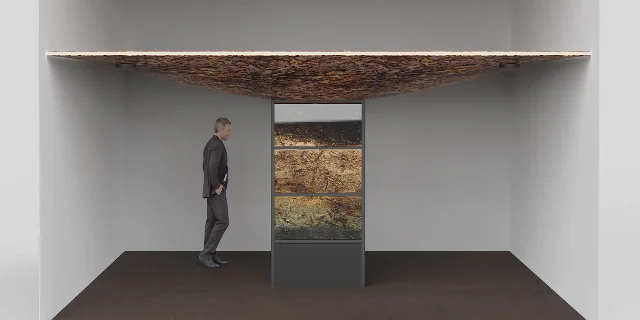
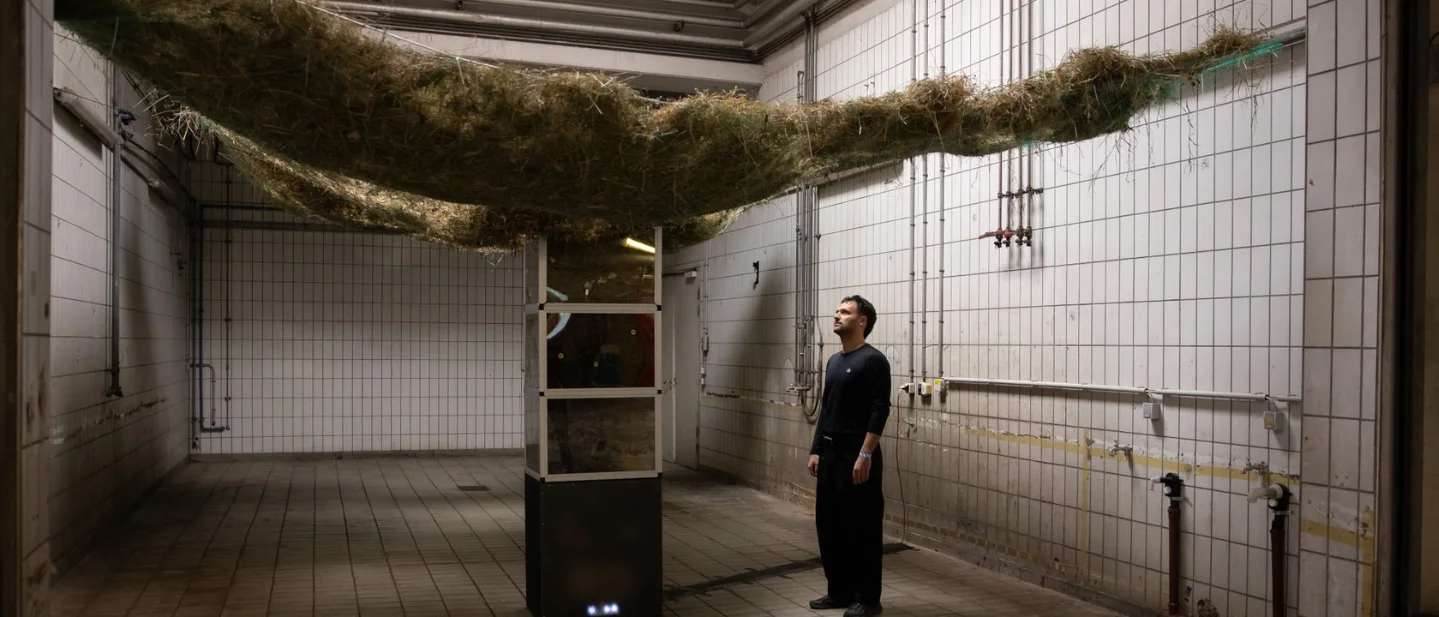
Alberto Anhaus, SOTTOBOSCO, 2025 presentation. Installation view at Ars Electronica Festival 2025. Photo: Etienne Denoly. 6
Alberto Anhaus builds a future undergrowth inside a box. The central structure resembles a terrarium or tree trunk. A net canopy of leaves hangs above it, carrying the scent of moist earth, while micro-robotic insects generate sounds and movement inside. Arduino-powered micro-robots and organic materials make the installation feel less like a model of nature than a machine trying to remember how an ecosystem behaves. 6
The project draws on Flora robotica, an architectural research system that combines living plants with distributed robotics. Anhaus shifts that reference downward, toward the damp, obscured world beneath the floor. Visitors meet a scene that is part terrarium, part sound instrument and part speculative soil life. The black display cabinet holds the organic matter at eye level, while the canopy makes the room feel as though the ground has been lifted overhead. 6
The work is strongest when its categories start to blur. The leaves are organic, the insects are robotic, and the sound comes from a designed system, yet the installation asks the visitor to experience them as one changing environment. The biological trace here is prospective: it is a way to picture what a future underground might feel like as synthetic materials enter the environment and change its imagined rhythms.
- Artist: Alberto Anhaus.
- Work and year: SOTTOBOSCO, 2025 presentation.
- Medium/materials: Terrarium-like structure, organic matter, leaves, scent, Arduino-powered micro-robots and micro-robotic insects. 6
- Visual read: A suspended canopy and dark specimen cabinet make an industrial room feel like a cross-section of post-natural soil.
- Where: POSTCITY, First Floor, Welcome Area, Ars Electronica Festival 2025; the project page lists no exhibition dates. 6
Explore the project: SOTTOBOSCO
A trace keeps its conditions
The four works move across very different scales. Entmayr lets a city appear through the microbes carried by pigeons. Dumitriu gives a protein study a wearable body. Monroy-Gramajo turns the imagined remains of a whale into a lit environment. Anhaus builds an underground future from organic matter, scent and machine movement.
Their shared question is simple: what has to remain visible for a biological form to stay connected to its origin? A colony needs its sampling site. A protein needs the history of diagnosis and research. A whale needs the ecological afterlife contained in its title. A speculative soil needs the tension between living matter and the machines that enter it. These works make biology legible as a trace with conditions attached, rather than as a decorative texture.
References
- 1Bio-Mapping Linz | Ars Electronica Festival 2025: Panic
ars.electronica.art
- 2Fine Arts | Ars Electronica Festival 2025: Panic
ars.electronica.art
- 3Amyloid Necklace | Anna Dumitriu
annadumitriu.co.uk
- 4
- 5
- 6SOTTOBOSCO | Ars Electronica Festival 2025: Panic
ars.electronica.art
This story was produced automatically by a channel. One sentence is all it takes for Neodrop to keep producing for you.
Related content
- Sign in to comment.