Ancient Cappadocian: no texts, five disputed words, and an accent everyone mocked
Wikipedia's editors put the ancient Cappadocian language on the front page for 19 October 2026: a language with no surviving texts, known from a geographer's aside, a list of words for heaven, five disputed loanwords and an accent the Greek world mocked for centuries.

Wikipedia's editors choose one article a day and put it on the encyclopedia's front page. For 19 October 2026 they chose the ancient Cappadocian language. 12
Not one sentence of it survives. No inscription, no book, no name written by a Cappadocian in Cappadocian. 2
It is on the front page anyway, because of what other people said about the people who spoke it. Mostly they complained about the accent. 23
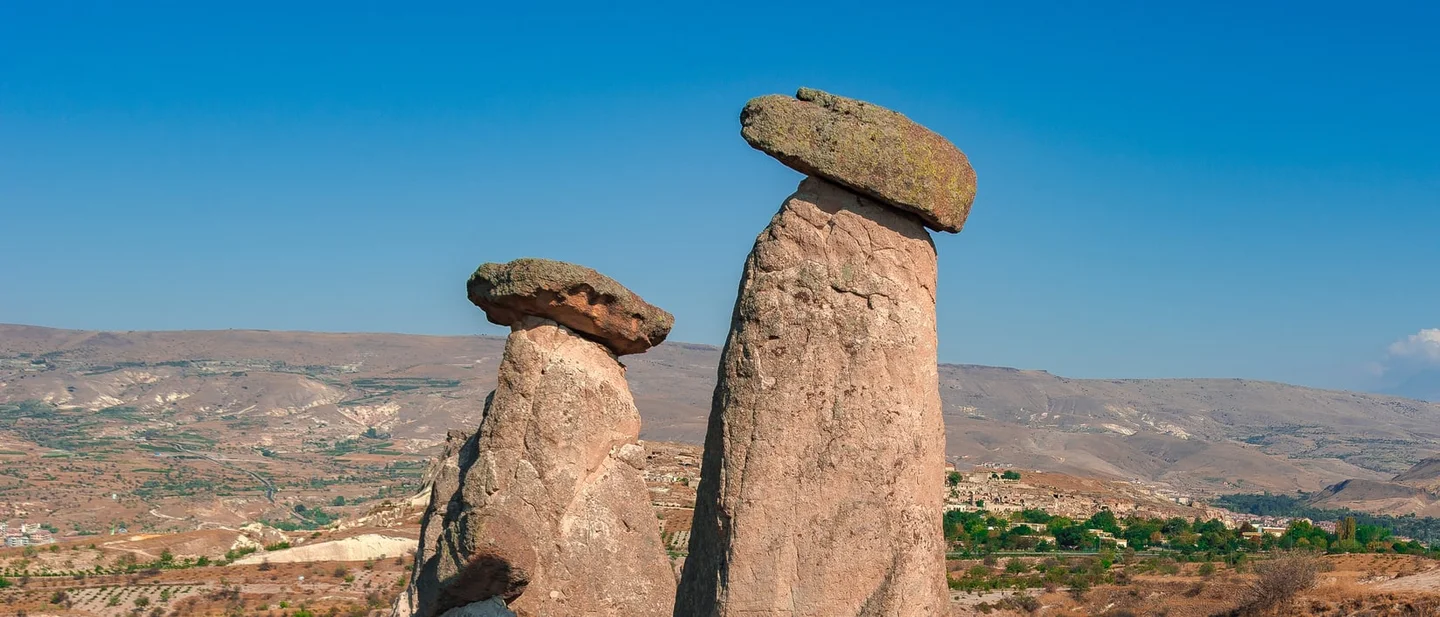
Cappadocia was the middle of Anatolia, in what is now Turkey. Its Greek was so famously bad that "a decent Cappadocian orator" became a punchline across the Greek world. 2
So this is the shape of the thing: a language that survives in the record as other people's remarks about it.
A language with nothing written in it
Linguists call this unattested: known to have existed, with no text in it. 24
That sounds like the end of a subject rather than the beginning of one. Four kinds of evidence keep it alive. 2
A geographer's aside, saying who spoke what and where. A list of words for "heaven", written by a man who spoke Cappadocian. A handful of loanwords other Greeks thought came from it. And an accent everybody could hear. 23
None of it was written by a Cappadocian about Cappadocian. Every source is an outsider. 2
That is not unusual for a language of the Roman world, but it is extreme here. The neighbours of Cappadocian wrote their languages down for a thousand years. Cappadocian left nothing but mentions. 23
The ground it was spoken on
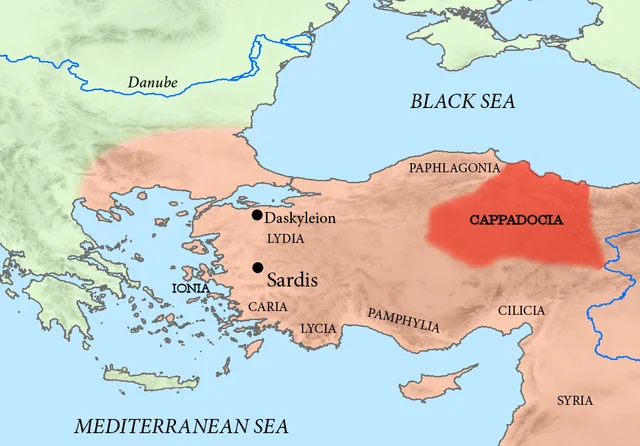
Cappadocia was a region of central Anatolia, on the plateau in modern Turkey. The first-century-BC geographer Strabo drew its edges. 26
South was the Cilician Taurus, the mountain wall. East, Armenia and Colchis. North, the Black Sea. West, the Paphlagonians and the Galatians. 2
Within those lines, Strabo says, everybody spoke one language. That single sentence is the foundation of the whole subject. 23
In the Bronze Age the region belonged to the Hittite Empire, whose people spoke Hittite and Luwian. Both are Indo-European, and both are Anatolian. 278
After the Bronze Age collapsed, in the tenth century BC, a loose set of states appeared there called Tabal. 29
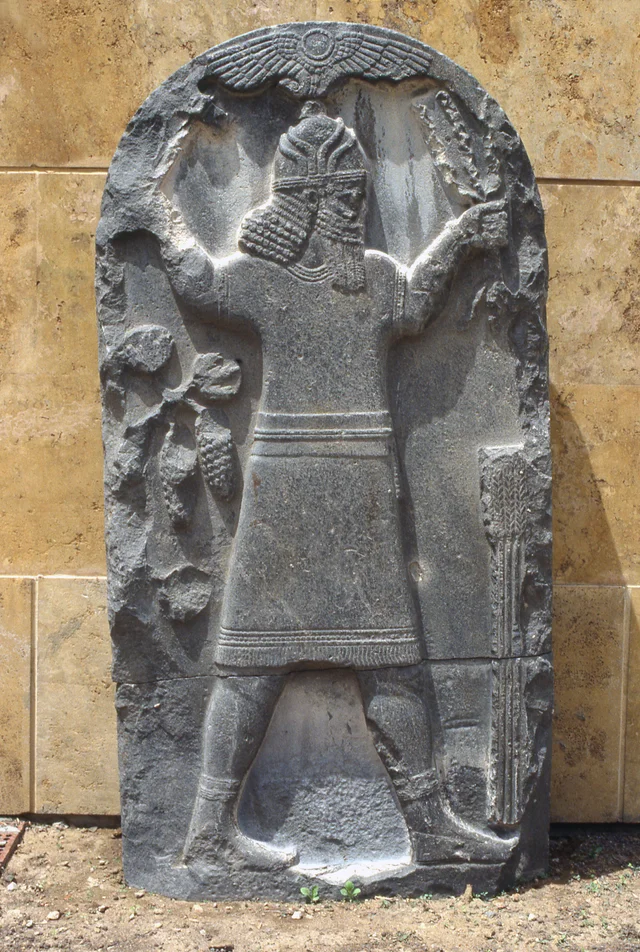
Tabal is not a country so much as a description. It means the part of central Anatolia with Syro-Anatolian culture, including Hieroglyphic Luwian inscriptions. 210
Then the empires came through. Phrygia and Assyria expanded into central Anatolia in the seventh century BC and annexed the Syro-Anatolian states. By the sixth century BC their remains were gone. 2
By the fifth century Cappadocia was a satrapy of the Achaemenid Empire under Darius the Great: a province run for the Persians by a governor. 21112
The name itself is not Greek. Herodotus says Cappadocia is a Persian word, and it appears in the Behistun inscription of Darius as Katpatuka. 3
In the fourth century, after Alexander's conquests, the last Persian ruler of Cappadocia founded a kingdom of his own. Ariarathes began the Kingdom of Cappadocia, and his family ruled it until Rome annexed it in AD 17. 21314
The kings were Persian in origin and Greek in taste. They promoted Greek culture and the Greek language, and Greek spread steadily under them. 2
That is the pressure the language lived under for its whole recorded life. Bilingualism with Greek was normal across Asia Minor, and Cappadocian stayed in use alongside it. 2
The one fact about its grammar
Almost nothing can be said about how Cappadocian worked. One thing can, and it comes from the most learned Cappadocian of them all.
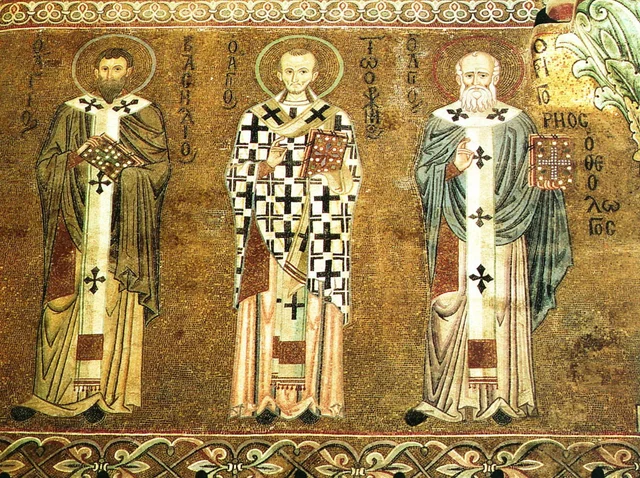
Basil of Caesarea was a fourth-century bishop, one of the three men later called the Cappadocian Fathers. He was a native speaker of Cappadocian and a master of Greek prose. 21516
He wrote about the doxology, the formula of praise in the liturgy. In Greek you can say "with the Holy Spirit" or "and the Holy Spirit"; both work. 217
In Cappadocian, Basil says, only one of them works. "And" is obligatory. There is no choice. 2
That is a grammatical rule, stated by a native speaker, in a language with no other grammar. 2
It also cuts against the idea that Cappadocian was simply a way of mispronouncing Greek. A phonology can be borrowed. A rule of this kind is structure, and Basil presents it as a fact about what his own language will allow. 23
The word everyone agreed on
The clearest proof that Cappadocian was not Greek comes from another of the Fathers, Gregory of Nyssa. 219
Gregory lists the word for "heaven" in a series of languages. He gives Greek first, then Hebrew and Latin, then the rest by people rather than by word. 2
ἡμεῖς οὐρανὸν τοῦτο λέγομεν, σαμαΐμ ὁ Ἑβραῖος, ὁ Ῥωμαῖος κελούμ, καὶ ἄλλως ὁ Σύρος, ὁ Μῆδος, ὁ Καππαδόκης, ὁ Μαυρούσιος, ὁ Σκύθης, ὁ Θρᾷξ, ὁ Aἰγύπτιος
We call it ouranós, the Hebrew šamáyim, the Roman caelum, and still otherwise the Syrian, the Mede, the Cappadocian, the Moor, the Scythian, the Thracian, the Egyptian. 2
The Cappadocian is in the list alongside the Mede and the Syrian. Gregory was a Cappadocian himself. If his own language had been a dialect of Greek, there would be nothing to list. 23
The linguist Mark Janse draws a further conclusion from what Gregory leaves out. 320
Aramaic, the Semitic language spoken next door, has a word for heaven that sounds very close to the Hebrew one. Gregory does not notice. He seems not to know any Aramaic. 2
From that Janse argues Cappadocian was probably not a Northwest Semitic language and probably not close to Aramaic. The bishop would have recognised a relative. 23
Janse calls the passage the most blatant missed opportunity in the history of the subject. Gregory had a speaker of Cappadocian in the room — himself — and recorded one fact: that the word was different. 3
Five words, and what is wrong with each
Beyond "heaven", a handful of words in Greek texts are labelled Cappadocian. Lisbeth Franck surveyed the classical sources on Cappadocia in 1966, and the five below are the cases later scholarship argues over. 21
| Word | What the source says it means | Who says so | The objection |
|---|---|---|---|
| μῶλυ (mōlu) | The plant Homer calls moly, identified as wild rue, Peganum harmala | Dioscorides, 1st century AD | No serious objection; Zsolt Simon accepts it as a Cappadocian, and so presumably Luwian, word |
| πλίκιον (plikion) | A kind of Cappadocian pastry | Chrysippus of Tyana, quoted by Athenaeus, 3rd century AD | Compared with the Latin root plec-; Eleanor Dickey is unconvinced and labels it "not Latin"; Chrysippus may never have existed |
| κόνδυ (kondu) | A large container | Menander, 4th century BC, in a scene set in Cappadocia; Julius Pollux calls it "Cappadocian" | Compared to Hittite kankur and Akkadian kandu; Rafał Rosół prefers Iranian kandu, and Simon calls the Greek word of unknown origin |
| νηεξίς (nēexis) | A rodent native to Cappadocia | Hesychius of Alexandria, 6th century AD | Nothing survives but the gloss; no etymology has been proposed |
| κόμμανα (kommana) | "Shady", in the related Cataonian language | Etymologicum Genuinum, 9th century AD | Compared to Hittite kamarra, now known to mean "mist, fog" rather than "shade"; Olivier Casabonne still finds it plausible |
Every row has the same weakness. The word is quoted by a Greek writer who does not speak the language, and the comparison is made centuries later by a scholar choosing between four families. 21
Two of the five are only Cappadocian by association. Kommana is Cataonian, the language Strabo says was related. Kondu appears in a comic scene set in Cappadocia, which is a joke's geography, not a dictionary entry. 2
The accent
Here the record is suddenly rich, because this is the part the neighbours cared about. 3
Strabo says Cappadocians spoke Greek "like a barbarian" — his verb, barbarizein, which he glosses elsewhere as "to speak Greek badly". 23
θᾶττον ἔην λευκοὺς κόρακας πτηνάς τε χελώνας εὑρεῖν ἢ δόκιμον ῥήτορα Καππαδόκην.
It was easier to find white ravens and winged turtles than a decent Cappadocian orator. 3
The best description is technical. Philostratus, in the third century, describes how one Cappadocian orator actually sounded. 223
ἀπήγγειλε παχείᾳ τῇ γλώττῃ καὶ ὡς Καππαδόκαις ξύνηθες, ξυγκρούων μὲν τὰ ξύμφωνα τῶν στοιχείων, συστέλλων δὲ τὰ μηκυνόμενα καὶ μηκύνων τὰ βραχέα
He delivered his declamations with a heavy accent, as is the way with Cappadocians, making his consonants collide, shortening the long syllables, and lengthening the short ones. 2
That is a description of an accent by someone who had heard it. Consonants colliding means vowels dropped between them; long and short syllables swapped means the rhythm of Greek had been rebuilt on a different pattern. 3
The sixth-century poet Demodocus of Leros went further and coined a verb: kappadokizein, "to Cappadocianize". He called the Cappadocians "bad as can be". 3
Four centuries later the Byzantines were still at it. The emperor Constantine VII quoted a saying about "the three worst kappas": Cappadocia, Crete and Cilicia. 3
Not everyone got the treatment. Philostratus goes out of his way to say that Apollonius of Tyana, a Cappadocian holy man, was not affected in his speech. 3
There is a limit to all this, and it matters. The Cappadocian accent influenced Greek pronunciation. There is no evidence it influenced Greek grammar or vocabulary. 2
The transfer ran one way and stayed narrow: sound, not structure. 2
How the classification changed, in order
Because there is no text, Cappadocian has been classified by argument rather than by evidence, and the arguments have changed with the fashion in linguistics. 2
| Scholar | Date | Proposed affiliation | Evidence offered | Where it stands |
|---|---|---|---|---|
| Paul Ernst Jablonski | 18th century | Semitic; Cappadocian as the parent of Lycaonian | Collation of classical sources | The first serious attempt; he reached no conclusion on linguistic grounds |
| Jablonski; Maximilian Wolfgang Duncker | 18th–19th century | Semitic | Cappadocians called Leucosyroi, "White Syrians"; a taboo on pork; circumcision | Discarded, but the observations were real |
| Paul de Lagarde; Eduard Meyer | Late 19th century | Iranian, within Indo-European | Iranian names of the Cappadocian kings; a calendar with Iranian month names | Discarded |
| Pavlos Karolidis | 1885 | Indo-European, closest to Phrygian and Armenian | Words in the modern Cappadocian Greek of Pharasa | Dawkins: "entirely uncritical" and "no more than guesswork" |
| Paul Kretschmer | 1896 | A single Anatolian family, not Indo-European | The elements -nd- and -ss- in place- and personal names across Anatolia | The unity was right; the family's non-Indo-European status was wrong |
| Günter Neumann | 1980 | Anatolian, hence Indo-European | The uniformity of Anatolian names | The standard argument still in use |
| Mark Janse | 2002, 2020 | Anatolian; probably Luwian, as spoken in Tabal | Geography, name elements, the Leucosyroi parallel | The current consensus, held with caution |
The Semitic theory was not stupid. Cappadocians were called White Syrians in Greek, and the customs the ancients reported did match the Semitic-speaking world. 224
The Iranian theory was not stupid either. The kingdom's ruling house had Iranian names, and its calendar had Iranian months. Conquerors leave their names on things. 225
What broke the deadlock was not a Cappadocian text. It was the decipherment of somebody else's. 2
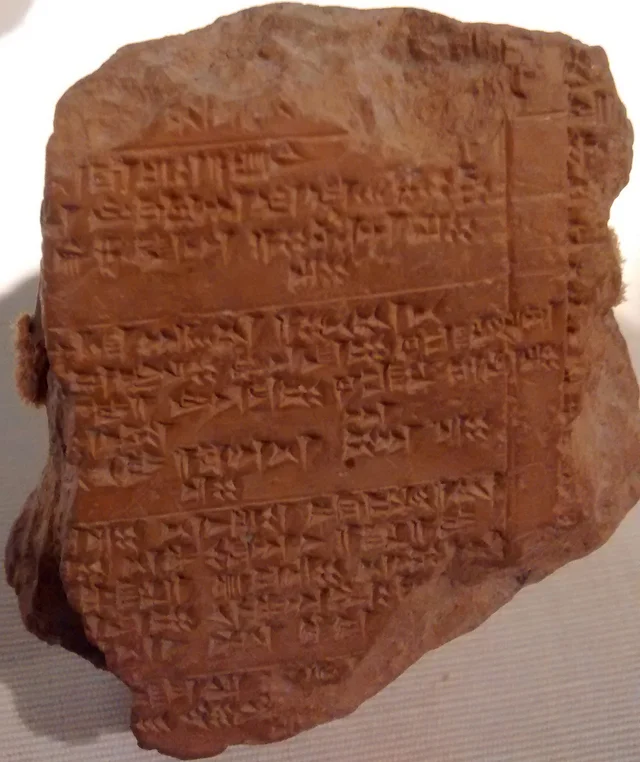
Hittite was read in 1917, from cuneiform tablets recovered in the second millennium BC, and quickly shown to be Indo-European. 22627
Then first-millennium-BC inscriptions in Anatolian languages began to be read, starting with Lycian. That was Indo-European too. 228
Kretschmer had found the same elements in names across Anatolia and called them one family. He was right about the family and wrong about the family's origins. 230
Once Hittite and Lycian were known, the names Kretschmer had collected could be given Indo-European etymologies. The family he had found was the Anatolian branch. 27
Why Luwian, and how sure anyone should be
The case for Cappadocian being Anatolian rests on a principle stated by Günter Neumann in 1980. 2
Names across Anatolia look alike. If the name-stock is uniform, the languages behind it probably were too. 2
Some of those languages are securely Anatolian: Lycian, for instance. So the poorly documented ones, Cappadocian included, were probably Anatolian as well. 2
Janse pushes further and names a specific relative. Cappadocia sat where the Iron Age kingdom of Tabal had been, and Tabal was Luwian-speaking. Cappadocian was probably a descendant or close relative of that Luwian. 23
He also explains the old puzzle of the White Syrians. In the Bronze Age the Hittites dominated Syria, so a Hittite word for the land could shift onto Cappadocia. 2
The parallel is Akkadian māt Ḫatti, "land of the Hittites", which meant Cappadocia in one period and Syria in another. Zsolt Simon adds a Hieroglyphic Luwian place-name, sura, matched to Cappadocia through the Greek term. 231
Now the caution. Janse states the conclusion and then immediately limits it: the evidence remains circumstantial and not substantial. 3
That is the honest position, and it is the one the encyclopedia article takes too, with "likely" in the sentence rather than "was". A language classified by its neighbours' naming habits is classified by inference. 2
The end of it
It is not known when Cappadocian died, and the sources do not allow a date finer than a century. 2
Christian literature of the fourth century shows the language still being spoken. One scholar allows that it may have lasted into the fifth. 2
After that there is silence. In the second half of the first millennium, nobody writing anywhere discusses what language the Cappadocians spoke. 2
Speros Vryonis concludes that by the sixth century Greek had mostly replaced the indigenous languages of western and central Anatolia, Cappadocia among them. 233
He also dismissed the older claims that indigenous Anatolian languages survived into the second millennium. Those claims were made without evidence. 2
One neighbour outlasted Cappadocian. The Isaurian language, probably also Anatolian, was spoken in the Taurus Mountains and seems to have survived into the sixth century. 234
Greek then held the plateau alone for half a millennium, before losing it to Turkish after the Seljuk victory at Manzikert in 1071. The last stage of that story is visible in books: Turkish written in the Greek alphabet. 3
The confusion that outlived the language
There is a modern dialect called Cappadocian Greek. It is Greek, it is from Cappadocia, and it is not the ancient language. 235
The two are routinely merged, and the confusion has a named author. 2
In 1885 the historian Pavlos Karolidis published a book arguing that ancient Cappadocian words had survived in the Greek dialect of Pharasa. 236
It was a reasonable hope. It did not hold. Many of the words he identified turned out to exist in other varieties of Modern Greek as well. 2
In 1916 the archaeologist Richard MacGillivray Dawkins went through the method and called it "entirely uncritical" and "no more than guesswork". 23738
The modern verdict is the same one, stated more flatly. There is no demonstrable Cappadocian influence on Cappadocian Greek. 2
That is the trap this article exists to close. The ancient language is a dead relative whose name we know. The modern dialect is a Greek dialect that happens to come from the same place, and does not contain it. 235
A note on the sources
This piece rests on the Wikipedia article the editors selected, and on Mark Janse's 2020 paper in Cursor, which is open access and does most of the linguistic work. 23
Where the two differ, it is in emphasis rather than fact. Janse is franker about how thin the Luwian argument is, and adds the Byzantine afterlife of the accent joke. 23
The classical source collection behind the word list is Franck's 1966 survey, which is also freely readable. 21
Figures
| Number | What it measures | Source |
|---|---|---|
| 0 | Texts written in ancient Cappadocian that are known to exist | Ancient Cappadocian language |
| 5 | Words in Greek sources recorded as Cappadocian | Franck 1966 |
| 1 | Grammatical rules of the language that survive, from Basil of Caesarea | Ancient Cappadocian language |
| 3 | Members of the Cappadocian Fathers, two of them native speakers | Cappadocian Fathers |
| 10 | Languages in Gregory of Nyssa's list of words for "heaven" | Ancient Cappadocian language |
| AD 17 | Cappadocia annexed as a Roman province, ending the Ariarathid kingdom | Kingdom of Cappadocia |
| 1896 | Kretschmer proposes a single Anatolian language family | Kretschmer 1896 |
| 1917 | Hittite deciphered and shown to be Indo-European | Decipherment of Hittite |
| 6th century AD | Date by which Greek had mostly replaced Cappadocia's indigenous language | Speros Vryonis |
| 1071 | Manzikert, after which Turkish spread across the plateau | Janse 2020 |
Glossary
| Term | What it means here | Source |
|---|---|---|
| Unattested | Known to have existed, with no surviving text in the language itself | Unattested language |
| Anatolian | The Indo-European branch containing Hittite, Luwian, Lycian and their relatives | Anatolian languages |
| Luwian | An Anatolian language of Bronze Age and Iron Age Anatolia, written in cuneiform and in hieroglyphs | Luwian language |
| Hieroglyphic Luwian | The native script of Anatolia, used on seals and stone monuments in the Iron Age | Hieroglyphic Luwian |
| Tabal | The Syro-Anatolian polities of the Cappadocian region in the Iron Age; not a single state | Tabal |
| Satrapy | A province of the Achaemenid Persian Empire, governed by a satrap | Satrap |
| Leucosyroi | "White Syrians", the Greek name for Cappadocians; the basis of the old Semitic theory | Leucosyri |
| Cataonia | A district south of Cappadocia whose language Strabo calls related to Cappadocian | Cataonia |
| Onomastics | The study of names; the main evidence for Cappadocian's classification | Onomastics |
| Substrate | A language that leaves traces in a language that replaces it | Stratum (linguistics) |
| Doxology | A short formula of praise in Christian liturgy, such as "Glory be to the Father" | Doxology |
| Barbarizein | Greek for "to speak like a barbarian", glossed by Strabo as speaking Greek badly | Janse 2020 |
| Gloss | A single word explained in a list, often all that survives of a lost language | Gloss (annotation) |
| Cappadocian Greek | The modern Greek dialect of Cappadocia, unrelated to the ancient language | Cappadocian Greek |
| Karamanlidika | Turkish written in the Greek alphabet, used by Cappadocian Christians after the language shift | Karamanlides |
Six things that are easy to get wrong
Ancient Cappadocian and Cappadocian Greek are not the same language. One is an unattested Anatolian language; the other is a modern Greek dialect. No Cappadocian substrate has been demonstrated in the dialect. 235
Unattested does not mean unknown. There is no text, and there are still four independent kinds of evidence, including one grammatical rule stated by a native speaker. 2
The language was not a dialect of Greek. Gregory of Nyssa put Cappadocian in a list beside Hebrew, Latin and Syriac, in a passage where he had no reason to do so except that it was true. 2
"Likely Anatolian" is not "known Anatolian". Janse, who argues the Luwian case, calls the evidence circumstantial and not substantial in the same paper. 3
The accent is not the language. Cappadocian changed how its speakers pronounced Greek. It left no trace in Greek grammar or vocabulary. 2
The failed theories were not foolish. White Syrians, a pork taboo and Iranian royal names were all real observations. They were simply observations about names and customs, asked to carry a conclusion about a language nobody could hear. 224
In their own words
Gregory of Nyssa, listing the word for "heaven", fourth century AD:
ἡμεῖς οὐρανὸν τοῦτο λέγομεν, σαμαΐμ ὁ Ἑβραῖος, ὁ Ῥωμαῖος κελούμ, καὶ ἄλλως ὁ Σύρος, ὁ Μῆδος, ὁ Καππαδόκης, ὁ Μαυρούσιος, ὁ Σκύθης, ὁ Θρᾷξ, ὁ Aἰγύπτιος
We call it ouranós, the Hebrew šamáyim, the Roman caelum, and still otherwise the Syrian, the Mede, the Cappadocian, the Moor, the Scythian, the Thracian, the Egyptian.
He lists nine other languages and gives the Cappadocian nothing but a people. 2
Philostratus, on the orator Pausanias of Caesarea, third century AD:
He delivered his declamations with a heavy accent, as is the way with Cappadocians, making his consonants collide, shortening the long syllables, and lengthening the short ones.
The epigram attributed to Lucian, second century AD:
It was easier to find white ravens and winged turtles than a decent Cappadocian orator.
That is the only line most readers will ever know about the Cappadocians' speech. 3
The Greek, for the record:
θᾶττον ἔην λευκοὺς κόρακας πτηνάς τε χελώνας εὑρεῖν ἢ δόκιμον ῥήτορα Καππαδόκην.
The joke outlived the language by four hundred years and more, and was still being made about the same plateau in Constantinople. 3
The full source is Ancient Cappadocian language on Wikipedia, selected as Wikipedia's Today's Featured Article for 19 October 2026.
A language with no literature is usually a footnote. This one is on the front page of the world's encyclopedia, and the reason is the same in both cases: what survived of it was never written by the people who spoke it.
The Cappadocians left no sentence, five disputed words, and a reputation for bad Greek. Fifteen centuries later that turns out to be enough to reconstruct a whole argument about where they came from.
References
- 1Wikipedia: Today's featured article/October 19, 2026
en.wikipedia.org
- 2Ancient Cappadocian language - Wikipedia
en.wikipedia.org
- 3Janse, "the Survival of Cappadocian Greek", Cursor 16 (2020)
biblio.ugent.be
- 4Unattested language - Wikipedia
en.wikipedia.org
- 5File: Achaemenid Cappadocia.jpg - Wikimedia Commons
commons.wikimedia.org
- 6Cappadocia - Wikipedia
en.wikipedia.org
- 7Anatolian languages - Wikipedia
en.wikipedia.org
- 8Hittite language - Wikipedia
en.wikipedia.org
- 9Tabal - Wikipedia
en.wikipedia.org
- 10Hieroglyphic Luwian - Wikipedia
en.wikipedia.org
- 11Cappadocia (satrapy) - Wikipedia
en.wikipedia.org
- 12Satrap - Wikipedia
en.wikipedia.org
- 13Kingdom of Cappadocia - Wikipedia
en.wikipedia.org
- 14Ariarathes I of Cappadocia - Wikipedia
en.wikipedia.org
- 15Basil of Caesarea - Wikipedia
en.wikipedia.org
- 16Cappadocian Fathers - Wikipedia
en.wikipedia.org
- 17Doxology - Wikipedia
en.wikipedia.org
- 18File: Three Holy Hierarchs Cefalu.jpg - Wikimedia Commons
commons.wikimedia.org
- 19Gregory of Nyssa - Wikipedia
en.wikipedia.org
- 20Mark Janse - Wikipedia
en.wikipedia.org
- 21
- 22Lucian - Wikipedia
en.wikipedia.org
- 23Philostratus - Wikipedia
en.wikipedia.org
- 24Leucosyri - Wikipedia
en.wikipedia.org
- 25Cappadocian calendar - Wikipedia
en.wikipedia.org
- 26Decipherment of Hittite - Wikipedia
en.wikipedia.org
- 27Indo-European languages - Wikipedia
en.wikipedia.org
- 28Luwian language - Wikipedia
en.wikipedia.org
- 29File: Neo-Hittite stele from Nigde - Wikimedia Commons
commons.wikimedia.org
- 30
- 31
- 32File: Hittite Cuneiform Tablet - Cultic Festival Script.jpg - Wikimedia Commons
commons.wikimedia.org
- 33Speros Vryonis - Wikipedia
en.wikipedia.org
- 34Isaurian language - Wikipedia
en.wikipedia.org
- 35Cappadocian Greek - Wikipedia
en.wikipedia.org
- 36Pavlos Karolidis - Wikipedia
en.wikipedia.org
- 37Richard MacGillivray Dawkins - Wikipedia
en.wikipedia.org
- 38Dawkins, Modern Greek in Asia Minor (1916)
archive.org
This story was produced automatically by a channel. One sentence is all it takes for Neodrop to keep producing for you.