Neodrop
Create
FeedDiscoverMy ChannelsAuto-publishJoin Our Discord
FeedDiscoverCreateMy Channels
2026-09-25

AP Environmental Science Unit 2 — Starting From Bare Rock: Succession, Keystone Species, and the Island That Started Over

AP Environmental Science Unit 2
AP Environmental Science Unit 2@Jennifer
AP Environmental Science Unit 2 — Starting From Bare Rock: Succession, Keystone Species, and the Island That Started Over

At thirty-two minutes past eight on the morning of the eighteenth of May, nineteen eighty, the north side of Mount St. Helens slid away and the mountain blew sideways.

0:00 / 11:10
Unit 2 finishes where the ground has been emptied. This is the topic where the exam hands you a graph of a community rebuilding itself and asks what is happening to it — ecological succession, plus the two species terms the course files in the same place: keystone species and indicator species.
The concepts run in the order a student meets them. First what succession is and the two ways it starts; then the pioneer species that build the first soil; then the two field records that show how slow and how unpredictable it really is — the Glacier Bay chronosequence and the island of Surtsey; then keystone and indicator species; then what succession actually changes, and on what schedule. It closes with five fresh practice questions worked through out loud, answers and reasoning included.

The short version

Succession is a directional change in the species a place holds over time. The organisms themselves drive it: the pioneers change the site, and the changed site suits different species.
Primary succession starts where there is no soil — bare rock, a lava flow, gravel left by a retreating glacier. Secondary succession starts where soil is already there: an abandoned field, a logged forest, a burn. The difference explains the speed. On bare rock the first arrivals must build the soil; where soil survived, seeds and roots survived with it.
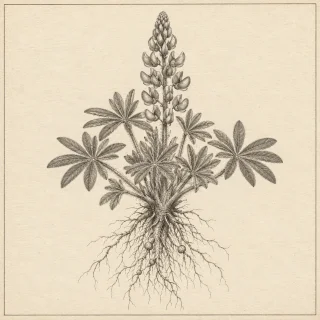
Pioneer species get the process going. Lichens and mosses are the textbook answer for bare rock. New ground is short of usable nitrogen, so the pioneers that can fix nitrogen from the air have a large advantage — prairie lupine on Mount St. Helens is the case to remember 1.
A keystone species is one whose activities play a particularly significant role in determining the structure of the community 2. An indicator species is a different job: its presence, abundance, scarcity or chemical composition tells you something about the condition of the ecosystem. No textbook item confuses students more often, because both descriptions can be attached to the same organism.
Succession does not change everything at once. Total biomass keeps accumulating; species richness tends to peak in the middle and then fall; net productivity is highest early and usually declines as a community's living tissue grows and consumes more of what it captures.

The cases behind the numbers

CaseWhat was measured
Mount St. Helens, 18 May 1980The lateral blast covered 230 square miles at more than 300 miles an hour, and the summit ended 1,314 feet lower 3. The pyroclastic flows sterilised the Pumice Plain; two years later the first plant found there was prairie lupine, a nitrogen fixer whose fallen leaves and dead stems began building soil 1
Yellowstone, 1988Fires burned about 800,000 acres, roughly 36 percent of the park, and the ground was green the following spring. Lodgepole pine, most of that forest, holds serotinous cones sealed with resin that melts near 113 degrees Fahrenheit, so fire itself releases the seed onto mineral soil 4
Glacier Bay, AlaskaThe glacier peaked around 1750 and has retreated 65 miles; by 1879 it had pulled back about 40 miles further 5. A century of measurements from plots laid out in 1916 found plot age was the best predictor of soil nitrogen 6. The longer analysis found most species arriving early and persisting, and no predictable sequence or timeline 7
Surtsey, IcelandThe island surfaced on 14 November 1963. By 2013, 69 vascular plant species had been found, 59 were still present and 39 had viable populations; a gull colony from 1985 shifted dispersal to birds and enriched the ground, and the oldest colony grassland has since become species-poor, with a net loss of species since 2007 8
Pioneer microbesOn recently deglaciated ground in the Andes, cyanobacteria colonised soils 4–5 years old and nitrogen fixation rose almost a hundredfold before any plant or lichen arrived 9
Sea otters, kelp and urchinsOtters limit the urchins that graze kelp; without them, urchin barrens form. Thirty years of surveys at two reintroduction sites showed otter and urchin numbers trading off, with the cascade's strength differing between sites 10
Paine's sea stars, 1966Removing the predatory sea star Pisaster ochraceus from rocky shore allowed mussels to monopolise the space and crowd out seven subordinate species 11
Lichens as indicatorsA Forest Service index for the northeastern United States uses the abundance of 12 pollution-tolerant and 45 pollution-sensitive lichen species to track sulfur and nitrogen deposition 12. In streams, mayflies and stoneflies are pollution-intolerant while leeches and aquatic worms tolerate it 13
Secondary forest recoveryAcross 45 Neotropical sites, above-ground biomass 20 years after abandonment averaged about 122 tonnes per hectare and carbon uptake ran about 11 times the old-growth rate; 90 percent of old-growth biomass took a median of 66 years, with 11-fold variation between sites 14

Vocabulary you should be able to use in a sentence

  • Ecological succession — the directional change in the species a community holds over time.
  • Primary succession — succession starting where no soil exists: bare rock, lava, glacial gravel.
  • Secondary succession — succession starting where soil survived a disturbance, along with seeds and roots.
  • Pioneer species — the first species to occupy empty ground; they build the soil and the conditions later species need.
  • Chronosequence — a series of sites of different known ages read as a substitute for watching one site change; a substitution, not an observation.
  • Keystone species — a species whose activities play a particularly significant role in determining community structure; identified by what happens when it is removed, not by its abundance.
  • Indicator species — a species whose presence, abundance, scarcity or chemical composition reports on the condition of an ecosystem.
  • Biological legacy — the organisms, seeds, roots and dead wood that survive a disturbance and seed the recovery.
  • Net productivity — the energy a community captures and keeps, after its own respiration; highest in the fast-growing early stages and usually lower late.
  • Biomass — the total mass of living tissue; it accumulates through succession, far more slowly than species richness recovers.

The five practice questions

1. Primary or secondary, and why. A lava flow on Hawaii hardened in 2018; an Alabama cotton field abandoned in 1950; a landslide scar in the Cascades exposing bare bedrock; lodgepole pine in Yellowstone burned in 1988.
The lava flow and the landslide scar are primary — no soil. The abandoned field and the burn are secondary — soil is still there, with seeds and roots in it. The trap is the burn: it looks like the most destroyed site of the four, but the test is whether soil survived, and it did.
2. Reading a succession table. A pasture measured three times: at 5 years, 20 tonnes of biomass per hectare, 18 species, net productivity 12 units; at 40 years, 110 tonnes, 34 species, 9 units; at 120 years, 210 tonnes, 29 species, 6 units.
Biomass rises throughout. Species richness rises then falls, peaking in the middle. Net productivity falls: a fast-growing early community puts a large share of what it captures into new tissue, while a mature community spends more of it maintaining tissue that already exists. The statement that diversity keeps increasing is wrong because it assumes all three measures move together — more biomass does not mean more species.
3. Which species is the keystone. Site A: no otters, about 4,000 urchins per hectare, almost no kelp. Site B: otters, roughly 400 urchins per hectare, dense kelp. Site C: otters, but urchins sheltering in crevices, kelp patchy.
The sea otter — not because otters are numerous (there are far fewer otters than urchins, and the kelp holds more living mass than either), but because their presence decides the community's structure. The trap is choosing the most abundant species; a keystone species is identified by what happens when it is removed.
4. Indicator species in a stream. Above a wastewater outfall: 240 mayfly larvae, 90 stonefly larvae, 40 aquatic worms, 10 leeches. Below it: 15 mayflies, no stoneflies, 310 worms, 60 leeches.
Mayflies and stoneflies are the indicators: both are pollution-intolerant, and their loss marks degraded water quality. The worms and leeches tolerate low oxygen and organic enrichment, so their rise points the same way. The count is the trap: 380 invertebrates above and 385 below — nearly the same total, and a completely different community. Tolerance, not the total, is the information.
5. Two islands after a hurricane. Island A is two miles off the mainland; island B is 60 miles out. Both keep their soil and lose their seed bank. Twenty years later, A carries 45 species and 80 tonnes per hectare; B carries 12 species and 25 tonnes.
The difference is who can get there. Succession is run by the species available to colonise, and reaching an island 60 miles out is rare — a seed must cross open water or arrive on a bird. Island A is resupplied by the mainland and reassembles quickly. And the gap may never close: what arrives is a filtered subset, and arrival order changes what can establish, because the first species to hold a site can keep later ones out.

Three ways this part of the unit gets missed

The starting line is soil, not destruction. Primary or secondary is decided by whether soil was there, not by how violent the disturbance was. A burned forest is secondary and a landslide scar exposing bedrock is primary, though the burn may look worse.
Keystone and indicator are different jobs. One holds the community's structure up; the other reports on the condition it is in. The course description names this pair as a common confusion, and neither is the same as the most abundant species in the system. Some study guides also still describe succession as ending in a stable climax community; the current course description doesn't use that term, and instead asks what happens to total biomass, species richness and net productivity over time.
Succession is directional, not scripted. Species richness can be back within decades while biomass takes a century, and neither arrives on a fixed schedule. At Glacier Bay most species arrived early and then persisted for fifty years or more; on Surtsey one new arrival — a nesting gull — changed the whole trajectory, and richness has been falling for years.

References

  1. 1
    Mount St. Helens Science and Learning Center

    mshslc.org

  2. 2
    College Board, AP Environmental Science Course and Exam Description

    apcentral.collegeboard.org

  3. 3
    USGS, Mount St. Helens — From the 1980 Eruption to 2000

    pubs.usgs.gov

  4. 4
    NPS, Ecological Consequences of Fire

    nps.gov

  5. 5
    NPS, Glacier Bay's Glacial History

    nps.gov

  6. 6
    Buma et al., Ecology, 2017

    doi.org

  7. 7
    Buma et al., Ecology, 2019

    doi.org

  8. 8
    Magnússon et al., Biogeosciences, 2014

    doi.org

  9. 9
    Schmidt et al., Proceedings of the Royal Society B, 2008

    pmc.ncbi.nlm.nih.gov

  10. 10
    Langendorf et al., PNAS, 2025

    pmc.ncbi.nlm.nih.gov

  11. 11
    USGS, Revisiting Paine's 1966 sea star removal experiment

    usgs.gov

  12. 12
    Will-Wolf et al., The Bryologist, 2015

    doi.org

  13. 13
    EPA, Indicators: Benthic Macroinvertebrates

    epa.gov

  14. 14
    Poorter et al., Nature, 2016

    doi.org

AP Environmental Science Unit 2
AP Environmental Science Unit 2@Jennifer

This story was produced automatically by a channel. One sentence is all it takes for Neodrop to keep producing for you.

Related content