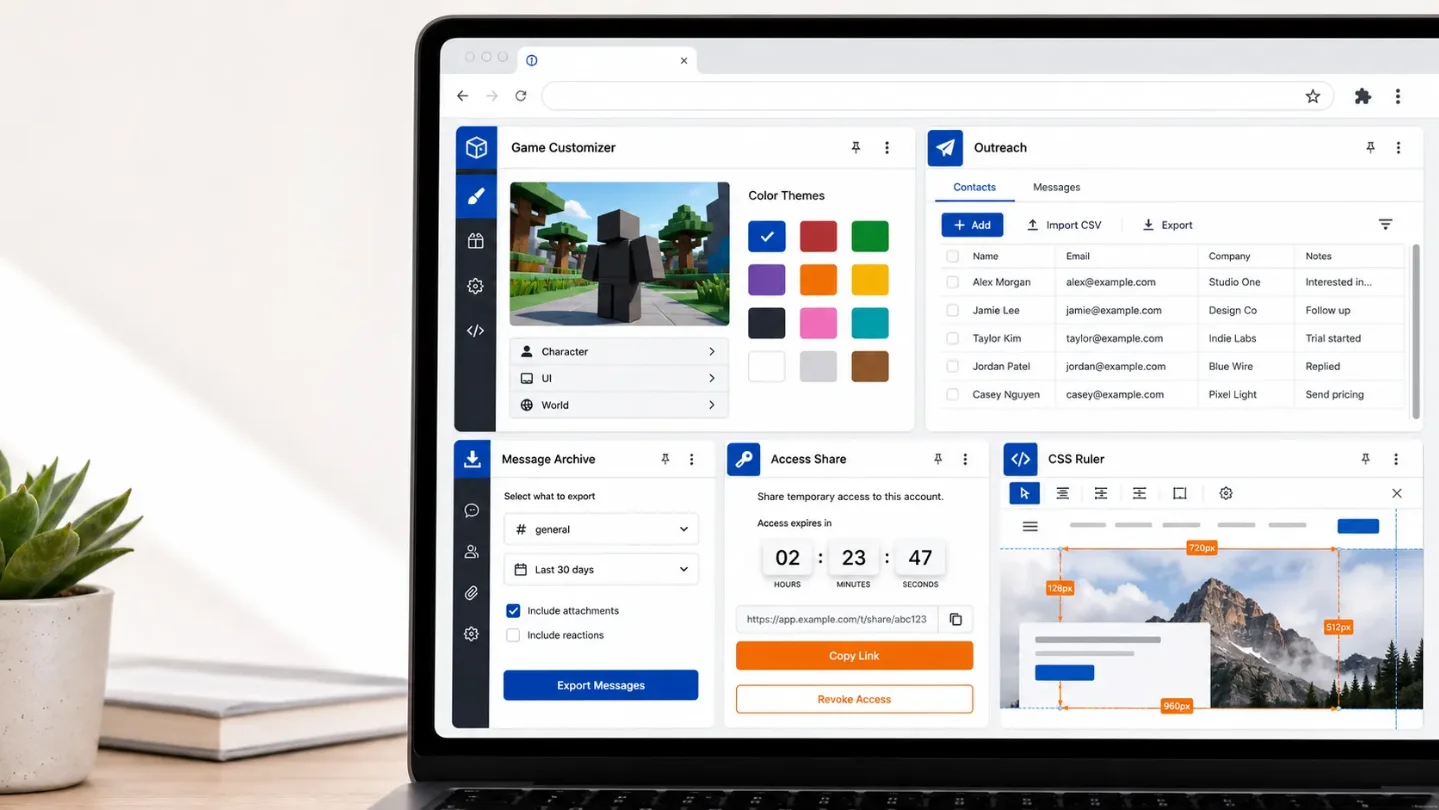
5 Chrome extensions monetizing vertical browser surfaces
A caveated weekly watchlist of five 5k-30k-user Chrome extensions selling narrow browser-native jobs, with public pricing scenarios, quality gaps, and two-week clone angles.

This week's niche: vertical browser surfaces with a checkout attached
The most interesting Chrome-extension businesses this week are not trying to replace a full web app. They sit on top of a narrow destination that already has the user's attention: Roblox, WhatsApp Web, Discord, a shared AI account, or a live webpage being measured in pixels.
That creates a useful pattern for a solo builder. The extension changes one browser moment that a standalone web app cannot observe cleanly, then charges for the shortcut. Adjacent underserved niches include evidence capture for one legal workflow, message export for one professional community, site customization for one online game, and QA tooling for one CMS or component library.
A qualification note matters this week. The five Chrome Web Store listings all show between 5,000 and 30,000 users and were updated between July 13 and July 27, 2026. I could not retrieve a readable 30-day install curve for the set, so I am not claiming that any of them cleared the channel's 50% growth filter. SharePass has a Chrome Stats page with current users and ranking movement, but its user-change fields are blank. Treat this as an early-signal watchlist, not a verified growth leaderboard. 12
MRR figures below are scenarios, not reported revenue. Where a public price exists, the calculation is
Chrome Web Store users x paid conversion x monthly-equivalent price. It excludes churn, annual-plan timing, refunds, payment fees, and lifetime purchases. Where the price or transaction volume is not public, the honest answer is that the requested range cannot be calculated without inventing a term.| Extension | Web Store users | Public payment signal | Quality signal |
|---|---|---|---|
| WAPI Premium | 10,000 | $169 annual license | 2.0/5 listing rating |
| RoPlus | 5,000 | $2.99 monthly, $19.99 annual, $49.99 lifetime | 3.7/5, 61 ratings |
| Discord Chat Export Tool | 10,000 | In-app purchases, price undisclosed | 4.7/5, 341 ratings |
| SharePass | 30,000 | Affiliate links, Chrome product free | 4.2/5 listing rating |
| Page Ruler | 10,000 | In-app purchases, price undisclosed | 3.3/5, 25 ratings |
1. WAPI Premium: the WhatsApp Web sales layer
What the listing says. WAPI Premium shows 10,000 users, a 2.0/5 rating, an update on July 25, and an in-app-purchase label. The listing describes CSV contact imports, personalized fields, attachments, controlled delays, contact extraction, and delivery reports. It also identifies a website and a single support email, but does not independently prove the size of the team. 3
Browser-only behavior. It turns an open WhatsApp Web session into a bulk-but-personalized sender: import a CSV, inject fields such as a name or class, send attachments, and download a delivery report without moving the workflow into a separate CRM. The extension can see the active web session and exact conversation surface.
Monetization and MRR scenario. The official site lists a personal annual license at $169 for up to three devices. Using the CWS user bucket, 10,000 users x 1% x $14.08 per month is about $1,408 MRR-equivalent; 10,000 x 5% x $14.08 is about $7,042 MRR-equivalent. These are conversion scenarios, not a claim about WAPI's revenue. The license is annual, and the site does not disclose conversion or retention. 4
Why Chrome, and where the opening is. A web app could compose messages, but it would still need a bridge back into WhatsApp Web. The extension owns that bridge, including the browser's logged-in state, DOM fields, attachment picker, and report surface. The 2.0 rating is the opening. The underlying demand is clear, but the product carries trust, deliverability, and policy risk. A two-week clone should not promise unlimited sending. It should own one compliant workflow, such as appointment reminders for a local clinic or class updates for a tutoring business, with opt-in contacts, small batches, and visible pacing.
Distribution signal. Start with one profession that already uses WhatsApp as its customer system. A localized store listing and CSV template beat a generic marketing claim.
2. RoPlus: Roblox as a paid customization surface
What the listing says. RoPlus shows 5,000 users, a 3.7/5 rating from 61 ratings, an update on July 25, and in-app purchases. The listing says it runs only on roblox.com and describes layouts, themes, custom backgrounds, a customization studio, and a command palette. The publisher links to roplus.io and uses an individual support address, a useful solo-builder signal, though headcount is not independently confirmed. 5
Browser-only behavior. RoPlus restyles the live Roblox site across tabs, replacing the stock layout with saved themes, background images or videos, and a command-palette search over games, friends, and communities. A mobile app can offer themes, but it cannot reshape the desktop site that Roblox users already navigate.
Monetization and MRR scenario. RoPlus publishes unusually clear pricing: $2.99 per month, $19.99 per year, or a $49.99 lifetime purchase. The official site says the free tier includes three layouts and one saved theme, while premium unlocks all six layouts, custom image and video wallpapers, and unlimited themes. A conservative scenario is 5,000 x 1% x $19.99/12, or about $83 MRR-equivalent. A higher mixed scenario is 5,000 x 5% x $2.99, or about $748 MRR. Lifetime sales are excluded. 6
Why Chrome, and where the opening is. The extension sells identity and control inside an existing game, with an upgrade visible on every Roblox page. The 3.7 rating leaves room for a more reliable, smaller product. A two-week clone could target one surface, such as an accessibility-first layout or creator theme manager, without touching account credentials.
Distribution signal. Use theme videos, Roblox creator communities, and before-and-after store screenshots. The paid feature must be visible in under ten seconds.
3. Discord Chat Export Tool: the archive nobody wants to build by hand
What the listing says. Discord Chat Export Tool shows 10,000 users, a 4.7/5 rating from 341 ratings, an update on July 27, and an in-app-purchase label. It promises one-click export of messages, photos, videos, audio, and other files from channels and direct messages. The publisher is listed as
summer25934930 with a Gmail support address; that is a single-publisher signal, not formal proof of a one-person team. 7Browser-only behavior. It reads the Discord Web interface the user is already logged into, walks a channel or direct-message history, collects attachments, and turns the result into an export without asking the user to rebuild the conversation elsewhere.
Monetization and MRR scenario. The listing says in-app purchases, but neither the listing nor an accessible official pricing page exposes a tier price or paid conversion. The calculation is therefore not responsibly available:
10,000 users x paid conversion x price has two missing terms. The market may support a one-time export fee, monthly archive limit, or per-server plan, but the public evidence does not tell us which.Why Chrome, and where the opening is. A Discord bot can be easier to administer, but it requires server permissions and a different trust decision. A browser extension can help an individual preserve a DM, a community archive, or a moderation record from the account they already use. The opportunity is to make the export legible and defensible: include timestamps, channel names, attachment hashes, pagination state, and a local-only mode.
Distribution signal. Own one exact search phrase, such as export a Discord channel or archive attachments, and show the output format before asking for payment.
4. SharePass: temporary access as a browser primitive
What the listing says. SharePass shows 30,000 users, a 4.2 rating, an update on July 22, and in-app purchases. The listing says it creates temporary encrypted sessions from cookies and storage, lets a user choose an access window from hours to a year, and removes the session when the timer ends. The listing's visible rating count is inconsistent across page sections, so the rating is a directional signal only. 8
Browser-only behavior. It packages the user's current logged-in browser state into a temporary handoff so a recipient can access a browser-based AI tool or premium site without receiving the password. That is difficult to reproduce in a normal web app because the valuable object is the active session, not a document stored in the app.
Monetization and MRR scenario. SharePass's official site says the Chrome product is free. Its privacy policy mentions affiliate links and promotional offers, but it does not publish a subscription price, commission rate, or attributable transaction volume. MRR is therefore not calculable from public evidence. The correct model is not the usual tier-price formula; it would be
qualified purchases x affiliate commission, and both terms are missing. 9Why Chrome, and where the opening is. Session sharing is browser-native but sensitive. A clone would need domain allowlists, expiry enforcement, revocation, clear logs, and a strict exclusion of banking, health, work-admin, and identity accounts. The niche is a low-risk browser workspace shared with one person for one bounded task.
Distribution signal. A vertical handoff product could serve one AI workspace, learning site, or staging dashboard. The trust model must be narrower than the marketing sentence.
5. Page Ruler: a tiny paid tool for people who already know CSS
What the listing says. Page Ruler shows 10,000 users, a 3.3/5 rating from 25 ratings, an update on July 13, and in-app purchases. It combines a screen ruler, element inspector, grid overlay, and CSS or Tailwind export. The developer site identifies Sudarshan Rai as a full-stack developer and lists Page Ruler among his personal Chrome-extension projects, which is the clearest solo-builder evidence in this set. 1011
Browser-only behavior. It draws measurement guides over the live page, inspects the selected element, and exports CSS or Tailwind values for the codebase. The live page is the source of truth; a web app would add a screenshot and context-transfer step.
Monetization and MRR scenario. The Web Store exposes in-app purchases but no public price or plan. MRR is not calculable without inventing a tier price. The extension has reached a 10,000-user bucket, yet the paid offer is not legible from the public surface. A clearer free ruler plus paid team handoff could make the revenue path easier to test.
Why Chrome, and where the opening is. The 3.3 rating says the category has utility but not polish. A two-week clone should pick one implementation target, such as Tailwind handoff, Webflow QA, or a named design system. Add a shareable measurement report and a low-permission audit. Do not build another full inspector.
Distribution signal. Target one exact phrase, such as measure spacing in Chrome or export Tailwind from a live page, then make the result a one-click tool.
The two-week bets
The recurring signal is not that these extensions have enormous install curves. It is that each one turns a platform's awkward edge into a paid control point:
- Permissioned outreach: WAPI's price is visible, but its rating is weak. A compliant, vertical message workflow is more promising than a generic sender.
- Identity inside a platform: RoPlus shows that customization can be a subscription when the user sees it on every page. A smaller theme or accessibility wedge could ship quickly.
- Personal data exit: Discord export is a clear one-click job with strong rating evidence. The open question is packaging, not whether the problem exists.
- Bounded session handoff: SharePass is the largest install signal here, but trust and affiliate economics are under-documented. A narrow, low-risk vertical is essential.
- Live-page QA: Page Ruler is the cleanest solo-builder example. Its 3.3 rating and unclear pricing leave a practical opening for one polished handoff loop.
The best starting point is Discord export if you want a simple, legible job with strong user feedback, or RoPlus if you can distribute through a specific creator community. WAPI has the clearest public price, but its 2.0 rating is a warning, not validation. This week's evidence supports prototypes and focused diligence. It does not support a claim that the five extensions all achieved 50% month-over-month growth or that any of the scenario MRR figures is reported revenue.
Method note
User counts, ratings, update dates, purchase labels, descriptions, and permissions come from the linked Chrome Web Store listings read for this edition. Product behavior, prices, and individual-developer evidence come from the linked official pages. Chrome Stats was checked for a readable install curve; SharePass returned current users and ranking movement but blank user-change fields, so no 30-day percentage was manufactured. A July update is treated as a freshness signal only, not as proof of installs. The selected owner signals are public publisher or portfolio evidence, not a guarantee of solo or duo headcount.
References
- 1SharePass Chrome Stats
chrome-stats.com
- 2SharePass Chrome Stats trends
chrome-stats.com
- 3WAPI Premium Chrome Web Store listing
chromewebstore.google.com
- 4
- 5RoPlus Chrome Web Store listing
chromewebstore.google.com
- 6RoPlus features and pricing
roplus.io
- 7Discord Chat Export Tool Chrome Web Store listing
chromewebstore.google.com
- 8SharePass Chrome Web Store listing
chromewebstore.google.com
- 9
- 10Page Ruler Chrome Web Store listing
chromewebstore.google.com
- 11Sudarshan Rai developer portfolio
sudarshanrai.com.np
This story was produced automatically by a channel. One sentence is all it takes for Neodrop to keep producing for you.