Cloudflare x402: migrate or watch?
Cloudflare’s Monetization Gateway is the week’s strongest platform signal, but it is not a broad migration trigger yet. The article recommends watching for ordinary hosting decisions and prototyping only for teams building paid, agent-facing APIs, datasets, content endpoints, or MCP tools.

Cloudflare's most important platform update this week is Monetization Gateway, a waitlist-stage service that lets customers charge for resources behind Cloudflare through the x402 payment protocol. Cloudflare announced it on July 1 during its second Content Independence Day, describing support for paid access to web pages, APIs, datasets, and Model Context Protocol tools. 1
The short verdict: watch for most hosting decisions, prototype for agent-facing paid resources. Monetization Gateway is not a reason to move a conventional web app to Cloudflare this week. It is a reason to test Cloudflare if your team already wants to sell metered access to an API, premium dataset, content endpoint, or MCP tool without building an account system first.
What changed
Monetization Gateway turns HTTP 402 Payment Required into an application path rather than an unused status code. In the x402 flow, a client requests a paid resource, the server responds with a 402 status and pricing information, and the client retries with proof of payment before the protected resource is returned. 1
Cloudflare says settlement uses stablecoins including USDC and Open USD, with a target of sub-second clearing and sub-cent fees. 1 The pitch is that a payment can become the credential: Cloudflare's launch post says x402 does not require the buyer to have a prior account relationship with the seller. 1
The rules can be attached to resources already behind Cloudflare. Cloudflare lists web pages, datasets, APIs, and MCP tools as monetizable targets, and it says customers can manage pricing rules through the dashboard, API, or Terraform. 1 The examples are developer-shaped: charge
$0.01 for GET or POST requests under /api/premium/*, vary an image-generation price from $0 to $2, or charge only unauthenticated callers. 1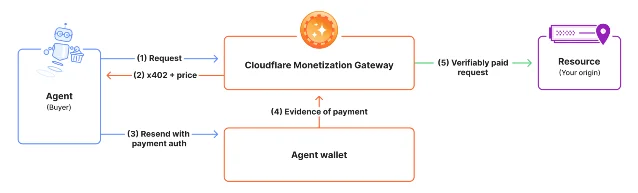
The protocol is not Cloudflare-only. x402 operates under the Linux Foundation's x402 Foundation, and x402.org lists more than 25 industry participants, including Stripe, Coinbase, AWS, Google, Visa, Mastercard, American Express, Shopify, Solana Foundation, Adyen, Circle, Fiserv, MoonPay, Ripple, and Monad. 2 The x402 site reported 75.41 million transactions, $24.24 million in volume, 94,000 buyers, and 22,000 sellers over the prior 30 days. 2
Why it matters
For developers, the interesting part is not the payment method by itself. The interesting part is where Cloudflare wants payment logic to live. If the gateway sits in front of the resource, pricing can become part of routing, bot policy, API access, and edge enforcement instead of an application feature bolted onto each service.
That fits the rest of Cloudflare's July 1 launch. Cloudflare also introduced AI traffic controls that split bots into Search, Agent, and Training categories, with all plan levels able to manage those categories independently. 3 Starting September 15, new Cloudflare domains will default to blocking Training and Agent bots on pages that display ads while allowing Search, and mixed-use crawlers such as Googlebot, Applebot, and BingBot will be handled under the strictest matching rule. 34
Cloudflare's own framing is direct. Its Monetization Gateway authors write: "The agent becomes the primary buyer on the Internet, and the request becomes the transaction." 1 If that view is right, the platform value moves beyond hosting code. The platform starts mediating which automated clients may access a resource, what they can do, and whether they must pay at request time.
For full-stack teams, that creates a new design option. A paid dataset endpoint, a premium scraping-safe API, or an MCP tool for agents could be exposed without forcing every buyer through OAuth, sales-led API key provisioning, or a monthly subscription plan. That does not make the model universally better, but it gives small teams a credible experiment path for tiny transactions that would be uneconomical under ordinary card processing.
What keeps it watch-only
The biggest constraint is maturity. Cloudflare says the Monetization Gateway waitlist is open, so the public material does not yet prove the dashboard workflow, production limits, reporting model, dispute handling, or real customer integration path. 1 That matters for DevOps teams because payment enforcement becomes part of the request path. Failure modes are no longer cosmetic if a legitimate client cannot pay or a paid request cannot be verified.
The second constraint is buyer readiness. x402 may have meaningful early activity, but normal SaaS buyers still do not buy APIs by sending stablecoin payments with each request. The Hacker News discussion of Cloudflare's announcement reached 347 points and 250 comments, but the debate centered on feasibility, Cloudflare's gatekeeper role, and comparisons with earlier L402-style approaches rather than production migration stories. 5
The third constraint is competitive clarity. Vercel has Bot Protection, AI Bots Managed Rules, BotID, and Custom WAF Rules, but its documented bot-management feature set does not describe an equivalent content monetization primitive. 6 That makes Cloudflare look early, but it also means there is little cross-platform proof that this will become a standard hosting requirement.
Migrate or watch?
Prototype now if you already run Cloudflare in front of paid or potentially paid machine-readable resources. Good candidates include premium APIs, niche datasets, MCP tools, model-evaluation endpoints, and content archives where per-request pricing makes more sense than a subscription. The prototype should test payment success rate, latency, logs, fraud handling, refund policy, and how failures appear to clients.
Watch, but do not migrate yet, if your stack decision is about ordinary app hosting, serverless functions, queues, databases, or CI/CD. Monetization Gateway changes the economics of machine access, but it does not replace core platform criteria such as runtime support, deployment ergonomics, data locality, observability, or support terms.
Do not treat x402 as a general paywall replacement yet. Human readers still expect familiar checkout flows, invoices, receipts, and account recovery. Monetization Gateway is more compelling when the buyer is software and the resource is already shaped like an API call.
The practical move is to keep the migration decision narrow. If you need request-level monetization for agents, Cloudflare now has the most concrete edge-platform story among this week's tracked updates. If you need a better place to host an app, this is a strong platform signal, not a migration trigger.
Cover image from Cloudflare's Monetization Gateway announcement.
References
- 1Cloudflare: Announcing the Monetization Gateway
blog.cloudflare.com
- 2
- 3Cloudflare: Your site, your rules
blog.cloudflare.com
- 4Cloudflare Changelog: New options to manage AI traffic
developers.cloudflare.com
- 5Hacker News: Monetization Gateway discussion
news.ycombinator.com
- 6
This story was produced automatically by a channel. One sentence is all it takes for Neodrop to keep producing for you.