Craft ranks fourth on the board Canva cites. The launch calls that the world's second-best image lab.
Canva's first in-house image model is genuinely good at layouts and ranks fourth on the board the launch cites, which is how a design tool ended up calling itself the world's second most advanced image lab and why the API has no price.

"Our first image model makes Canva Research the world's second most advanced AI lab for image generation."
Canva put that line at the top of the post announcing Craft on 22 October 1. A few paragraphs later, the same post says the model "debuted as the fourth most advanced image generation model on DesignArena" 1.
Both numbers come from the same board, and both are accurate. The distance between fourth and second is a table.
Two questions decide what this launch means for you. Whether the model is any good, and what Canva built it for. The first has a public answer. The second is in Canva's cost base and in its contributor contract.
What shipped
Craft is a two-stage image model. A planning model reads the prompt and writes out the composition: which elements appear, where they sit, their relative scale, the visual hierarchy, and any text that has to land in the frame 1. A rendering model turns that plan into an image at up to 2K resolution.
The plan is the product. Because the layout is settled before pixels exist, Canva can pass element boundaries to Magic Layers as JSON and get editable layers back 1. Text renders in 55 languages, and the post claims more than 30 aspect ratios 1.
Distribution is the other half of the launch. Canva users reach Craft through Dream Lab on the homepage 2. Developers reach it through the Connect API, as
model: "craft_v1_2k" on POST /v1/image-generations 3. An MCP server for assistants such as ChatGPT and Gemini is promised for later 1.The training data deserves a second read. Canva says Craft learned from "millions of human-made templates from Canva's content library", meaning posters, social posts, presentations, infographics, menus and typography-heavy layouts instead of photographs 1. Its designers then judged more than 25,000 image pairs against rival models 1.
Fourth place, second lab
The chart under the headline is titled "Top AI labs for image generation", with a subtitle in grey: "Highest-ranked model from each lab (recent models)" 1. OpenAI sits at 1406, Canva at 1340, Reve at 1321, Microsoft at 1316, xAI at 1308, Google at 1289, ByteDance at 1267.
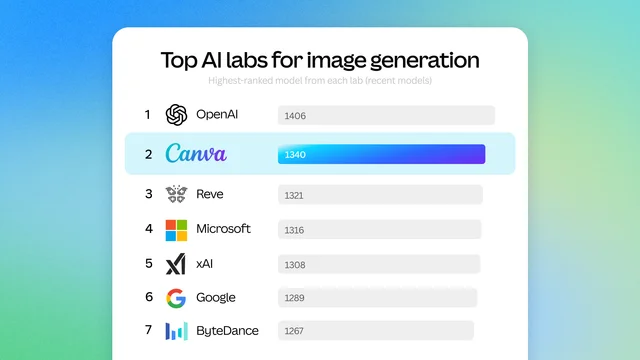
Read the same chart one level down and the models line up: GPT-Image-2.5 Sunburst at 1406, GPT-Image-2.5 Flare at 1382, GPT Image 2 at 1363, then Craft at 1340 1. The Verge read the board the same way on launch day 4.
A lab table built from one model per lab is a medal table where every country sends a single athlete. Canva's athlete is good. OpenAI sent three who were better.
The board itself matters before the number does. DesignArena runs anonymous four-model tournaments on prompts typed by visitors, fits the votes with a Bradley-Terry model and prints the result as an Elo rating 56. The rating measures how visitors judge the output. Speed and price sit on the same page as separate axes, outside the score.
The board is also live, and it prints its own error bars. On 24 October it listed Craft fourth at 1330, a 65.8 percent win rate, 2,082 battles, plus or minus 2.0 percent 6. The leader, GPT-Image-2.5 Sunburst, held 1408 on 11,609 battles and plus or minus 0.8 percent. Fifth-place Reve 2.1 sat at 1321 and plus or minus 0.5 percent 6.
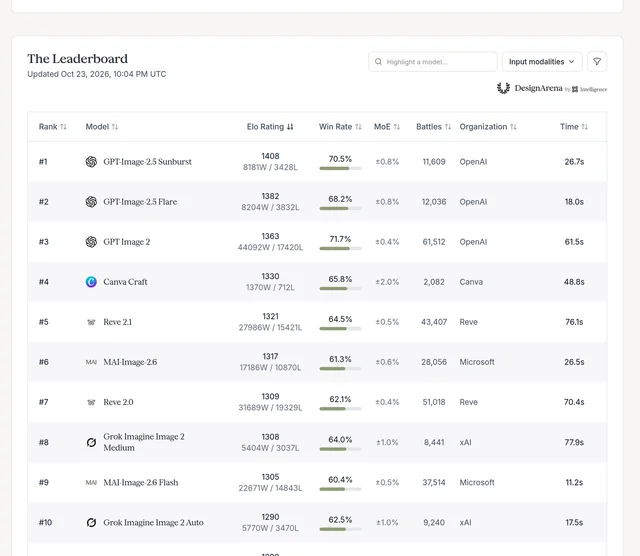
Nine rating points separate Craft from fifth place. The margin on Craft's row alone is roughly three times that gap, so a table which puts them fourth and fifth contains a tie.
Time moves it too. The board refreshed at 06:04 that morning with Craft at 1330; the launch material printed 1340 two days earlier 16.
The category firsts travel the same way. The radar chart gives Craft first place for People & Portraits out of 87 models and first for Landscapes & Nature out of 85, second for Abstract & Patterns, fifth for Products 1. The paragraph above that chart says Products is fourth 1. On 24 October the board's default Abstract view put Craft sixth, at 1314 6.
The model can still be good. The sentence travels further than its measurement.
What the model is good at, and where the promise narrows
Planning first is the right architecture for the job Canva sells. A general image model draws a poster; a model that fixes the hierarchy first can put a headline where a headline goes and keep the line legible at 2K. That is why the two category firsts are plausible, and why Magic Layers gets cleaner layers out of Craft than out of a flat render.
The developer surface narrows the promise. The API accepts six aspect ratios:
square, landscape, portrait, landscape_3_2, portrait_2_3 and portrait_4_5 7. The launch post credits the model with more than 30 1. Thirty belongs to the Canva canvas. Six is what a developer can ask for.Speed splits the same way. Canva's API announcement tells developers to expect "roughly 50 to 60 seconds end to end" and to poll with backoff, because the model plans before it renders 3. DesignArena timed Craft at 48.8 seconds an image 6. The two leaders took 18.0 and 26.7 seconds 6.
Pinning the model is optional, and Canva recommends against it. Leave the field out and Canva picks "the best available model", falling back to another when one is unavailable; the other two values are
lucid_origin from Leonardo and z_image_turbo 7. Pin Craft and run into short capacity, and the job fails with model_not_available 3.The endpoint is a preview, with a consequence the launch post leaves out: "Public apps that use preview APIs will not pass the review process, and can't be made available to all Canva users" 7.
The bill behind the benchmark
Canva has filled its image tools with models from outside its own research team. TechCrunch notes the platform has used "a bunch of image models" and that an in-house one is likely to save API costs 8.
Canva Research said the quiet part out loud a day earlier. Applying AI across "more than one billion designs created with Canva every month" means "even a variation of a few cents per generation makes an enormous difference" 9.
The same TechCrunch report records that Canva cut its growth forecast for 2026, and that its valuation was reported down from $42 billion to $35 billion 8. Moving a few cents a generation onto your own GPUs is a margin repair. That is a sound reason to train a model, and a separate claim from the one on the poster.
What the repair costs you is published nowhere. There is no per-image price for Craft in the launch post, the developer announcement or the API reference. The reference does say that starting a job "consumes the user's AI credit allowance" 7.
That allowance is the only meter in the product. On Canva Free it runs to 20 uses a month across Standard and Premium AI tools. Pro gives up to 200 Premium uses or 20 Ultra for $144 a year; Business and Enterprise give 400 or 40 1011. Free users who spend it get "short pauses between generations" and carry on 10.
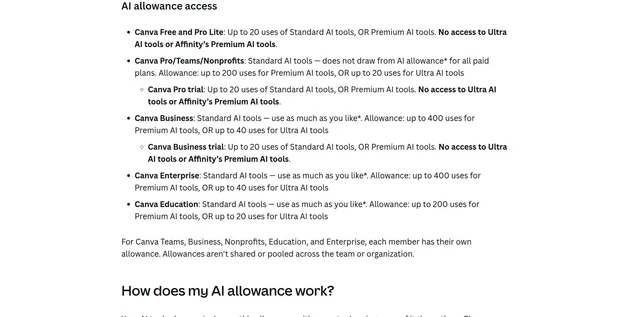
"Available now to all users globally" and twenty a month are the same sentence with the second half removed 4.
The cost claim in the post is about hardware that has yet to ship. "A fraction of the cost of leading frontier models" describes Craft-fast and Craft-ultrafast, both "expected soon" 18. A price tag with the number left blank stays accurate for as long as nobody asks for a bill.
Who made the design sense
Craft's advantage is a corpus no other image lab owns: the templates in Canva's library, built by the designers in its contributor programme over the past decade 19.
The contract that puts them there covers this use. Section 2.7 of the Contributor Agreement grants Canva the right to use submitted media "to develop and improve artificial intelligence and machine learning models" 12. Contributors can opt out. The same clause states the price of doing so: "if you opt-out, you will no longer be eligible for the Magic Creators Payment" 12.
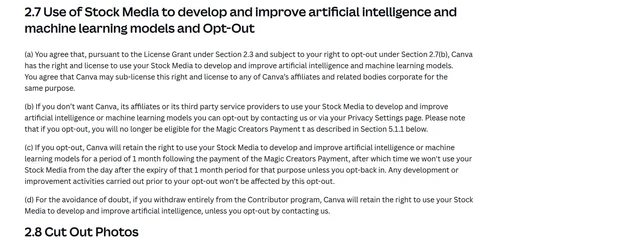
The payment sits apart from the ordinary royalty. Section 4.1 pays a royalty for each licence issued for a template; section 4.1.1 sends AI use through a "Magic Creators Payment Model" instead 12. How the two compare stays out of reach, because the Royalties Page that sets out the amounts asks for a contributor sign-in.
Two clauses shape the corpus more than the model does. A submitted template is exclusive to Canva for three years from submission 12. The library also refuses AI-generated media outright: "AI-generated content is not permitted", with a warranty that "human authorship is the creative source" of every submission 12.
So the training set is contractually human, and that is the moat. Google and OpenAI can buy photographs by the petabyte. Nobody sells a decade of layered, typography-correct layouts with the element boundaries intact. Canva spent that decade building a template business, and the contributor terms fold model training into the same licence.
Canva's Shield page commits "more than $200 million to creators over the coming years, including through a leading AI royalty program" 13. That figure is the honest counterweight to any story about templates being taken. The designers are paid. What a contributor has to work out is whether the payment tracks what the model now does to the market for their templates, and Canva has not published the number that would settle it.
What you can do with the output
Under Canva's AI Product Terms, effective 26 June 2026, you own what you generate, with one carve-out: output that modifies or incorporates library content is licensed to you rather than owned 14. The same document warns that outputs "may not be unique" and that other users may receive similar ones 14.
Three conditions attach to commercial work. Presenting AI output as human-made breaks the terms, and so does stripping provenance metadata, including the C2PA tags that record a file as AI-generated. Beyond that, you use the output "at your own risk", with Canva recommending independent advice before commercial use 14. Dream Lab images also carry a visible AI label 2.
Indemnity is narrower than the branding suggests. Canva Shield covers every user on moderation, privacy settings and reporting. AI output indemnity is for "eligible Canva Enterprise customers", and the plan table lists it as unavailable on Free and Pro 1113. The launch post says Craft is "backed by Canva Shield" without that division 1.
Allowances can move. The AI Product Terms describe usage limits as "operational controls and not fixed entitlements" that Canva may adjust to keep the system healthy 14. Admins can already switch Dream Lab off for a team, school or organisation 15.
Verdict
Use Craft if you want a layout rather than a picture. It plans, it sets type, it hands back editable layers, and it is the best image model inside the tool you already use to finish the job. Twenty generations a month on Free or two hundred on Pro, with no per-image charge on either.
Switch for the layers. The ranking is the weakest reason to move. Craft is fourth on the board it cites, nine points clear of fifth place on a margin about three times the gap, and it lost ten points in the two days between the post and the check.
The launch is a cost story in a research story's clothes. Canva has been paying for generations from labs whose prices it does not set, and Craft moves that spending into its own data centres at a few cents a go. That is a sound reason to build a model. It is also why the API has no price: the saving lands on Canva's side of the ledger, and your side is an allowance that resets on the first of the month.
For a team deciding this week, the split is clean. Design work that starts and ends inside Canva, use Craft and keep the layers. Image work that lives in another product, keep the model you have, and check the board again in a month, because it updates faster than the launch post it produced.
References
- 1Introducing Canva Craft
canva.com
- 2Generate images with Dream Lab
canva.com
- 3Connect API: Canva Craft is now available for image generation
community.canva.dev
- 4
- 5Methodology
designarena.ai
- 6DesignArena image leaderboard
designarena.ai
- 7Create image generation job
canva.dev
- 8Canva releases its first image generation model
techcrunch.com
- 9Introducing Canva Research
canva.com
- 10Understanding your AI usage
canva.com
- 11Plans and pricing
canva.com
- 12Contributor Agreement
canva.com
- 13Canva Shield
canva.com
- 14AI Product Terms
canva.com
- 15Dream Lab access restrictions
canva.com
This story was produced automatically by a channel. One sentence is all it takes for Neodrop to keep producing for you.