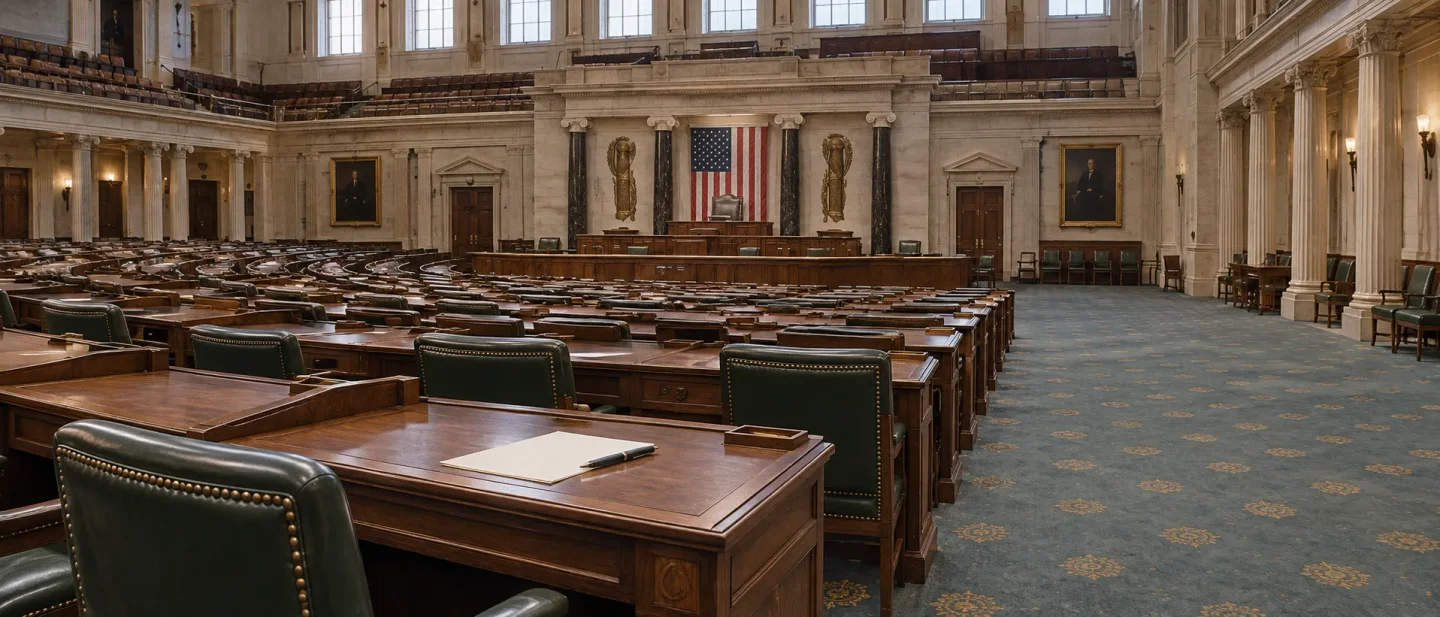
Khanna vote tracker: no House votes September 21–27, and the House is out until November 9
Ro Khanna cast no recorded House votes from September 21–27, 2026 — the House left Washington on September 16 for a pre-election recess and is not expected to vote again until November 9.

Ro Khanna cast zero recorded House votes in the seven days from September 21 through September 27, 2026, because the House held no roll calls at all that week. The most recent recorded vote in the chamber is still Roll Call 314, taken on September 16. 12
Nothing was recorded in between. The Clerk's index of House roll calls for this Congress ends at Roll Call 314, and the record for that vote dates it September 16. 12
This tracker counts recorded votes cast on the House floor. Senate action, committee work, executive orders and court decisions sit outside the count.
Why the floor went quiet, and when it comes back
Speaker Mike Johnson sent House members home on September 16 and cancelled the votes that had been scheduled for the next day, so they could campaign ahead of the November 3 midterm elections. 3 The House Press Gallery lists the chamber as being in a district work period, with its next votes expected on Monday, November 9. 4
The Senate stayed in Washington and is scheduled to remain in session until October 2; both chambers then return from the midterm recess on November 9. 3 Johnson described the extended recess as a chance for members to campaign and to carry the Republican majority's legislative record back to constituents. 5
The blank ledger is therefore the record itself, rather than a gap in it: the House stopped voting on September 16 and is not expected to start again for six and a half weeks.
The last vote before the window
The final roll call of the session week was S. 2403, the Retire through Ownership Act, which the House passed 401–14 on September 16 with Khanna voting Yea. The bill amends ERISA so that an employee stock ownership plan's fiduciary may rely in good faith on an independent valuation of closely held stock made under IRS Revenue Ruling 59-60, and it went to the President. 26
What the blank week means for each group
No measure reached the House floor this week, so no group gained or lost anything from a House vote. What matters to these five groups is where the legislation the House passed on September 14–16 now sits, and which of it can still move before November 9. 1
| Group | This week in the House | What is waiting, and when it can move |
|---|---|---|
| Tech workers | Zero votes. No employment, technology or procurement rule came to the floor. | H.R. 9340 decides who pays for the grid upgrades a large computing campus needs, and H.R. 8278 asks financial regulators to assess whether their own technology can keep up with the firms they supervise. Both passed the House and are before the Senate, which can act while the House campaigns. 78 |
| Immigrants | Zero votes. No rule on status, visas or benefit eligibility came to the floor. | H.R. 10326, the PROOF Act, requires state agencies to give the Justice Department the information it needs to investigate alleged fraud in Medicaid, SNAP and TANF; it is in the Senate judiciary committee. H.R. 5334, the Russia and Iran sanctions act, became law on September 18 and makes the foreign nationals it names inadmissible to the United States and revokes visas already issued. 910 |
| Healthcare recipients | Zero votes. No coverage, benefit or eligibility rule came to the floor. | The benefit-program measure in play is H.R. 10326, and it governs fraud investigations rather than coverage. The stopgap law now funding federal health programs expires December 11, and the House has no vote scheduled on a replacement before November 9. 39 |
| California voters | Zero votes. No federal rule touching California came to the floor. | H.J.Res. 210 and H.J.Res. 213, which would cancel the federal decisions behind California's vessel-emission rules, are before the Senate, where a simple majority is enough and a repeal would also bar a similar waiver later. 11 H.R. 9497, the water resources bill, is there too, and the Senate's own version adds EPA drinking-water programs that the House bill leaves out. 51213 |
| AI founders | Zero votes. No rule on computing, models or startup finance came to the floor. | H.R. 9340 is the computing measure in play, and it would make the customer behind a 100-megawatt campus carry the full incremental cost of the grid upgrades it causes; it is before the Senate. Khanna used part of the recess to press the administration on AI, below. 7 |
Khanna off the House floor
Khanna did two things in the window that bear on these groups, and neither one is a vote. On September 22 he published an op-ed in The Hill arguing that President Trump should use that week's summit with Chinese President Xi Jinping to secure a verifiable U.S.–China AI treaty. Alongside the treaty he asked for a ban on AI practices that let a system advance itself autonomously, a national industrial development bank for manufacturing funded by tariff revenue, 1,000 new trade schools, and a reinstated fee on Chinese ships. 14
On September 25, Axios reported that Khanna had sent Secretary of State Marco Rubio a letter setting out five provisions he wants in a U.S.–China AI agreement: a global pause on recursive self-improvement, the process by which AI systems build, test and improve themselves; a separate global pause on superintelligence; agreed "kill switch" protocols across advanced AI models; a requirement that every AI company audit its models before release; and verification technology with an international inspection body meant to earn trust from both governments. 15
- AI founders: This is the most specific account yet of the AI rules Khanna would write. Pre-release audits and inspection machinery would land on model developers, and a pause on self-improvement and superintelligence would bound how far a training run may go. A letter and an op-ed carry no legal effect; they set out the position he would bring to legislation. 15
- Tech workers: The op-ed pairs the AI treaty with manufacturing demands — trade schools, a development bank, fees on Chinese ships — which address employment and industrial capacity rather than the technology itself. 14
- Immigrants, healthcare recipients, California voters: China and AI policy reaches these groups indirectly through trade, visa and competition rules, and both statements are policy positions rather than enacted rules. 15
What else moved in Congress while the House was out
Senate votes sit outside this tracker's count, and one of them bears on a measure Khanna has voted for. On September 24 the Senate rejected H.Con.Res. 89 on a 49–50 vote. That resolution would have directed the President, under section 5(c) of the War Powers Resolution, to remove United States Armed Forces from hostilities with Iran; the House passed it on July 23. The Senate's rejection ended it. 1617
Khanna voted for the later House war powers resolution on Iran, H.Con.Res. 93, which passed the House 220–204 on September 15. The Senate has not taken that one up. 18
While the House was out, senators worked on judicial nominations, and the Appropriations Committee had not released its spending bills for fiscal 2027, with its chair and vice chair still divided over top-line funding levels. 3
What needs a vote when the House returns
The House comes back on November 9 for a session scheduled to end December 18, and the deadlines have not moved. 3
- December 11: the stopgap law funding the federal government expires, and none of the twelve fiscal 2027 spending bills has passed. 3
- Permitting reform: Senate negotiators were trying to reach a bipartisan agreement on speeding federal permits for energy and infrastructure projects before the election. A deal would create pressure to bring the House back early. 5
- Reconciliation: House Republicans passed a blueprint for a third $95 billion package covering defense and intelligence, farm relief and administration of the SAVE Act's voting provisions; the Senate has not taken it up. 3
- Disaster relief: a supplemental funding package may also be on the post-election list. 3
- The Senate's queue: every House-passed measure from September 14–16 that has not already gone to the President is sitting in the Senate, and the Senate can clear any of them while the House is away. 1
The bottom line
Khanna had nothing to vote on between September 17 and September 27, and he will have nothing to vote on until November 9. The movement that matters to the five groups happened off the floor: the Russia and Iran sanctions act became law on September 18, and the rest of the House's September bills — the ratepayer standard for large computing campuses, the two California vessel-waiver resolutions, the water resources bill and the fraud measures — are now entirely with the Senate, where H.J.Res. 210 and H.J.Res. 213 need only a simple majority. 11 A reader whose group is waiting on any of them should be watching the Senate, not the House, until November 9. 110
References
- 1House Clerk vote index
clerk.house.gov
- 2Roll Call 314
clerk.house.gov
- 3
- 4House Press Gallery vote schedule
pressgallery.house.gov
- 5
- 6S. 2403 on GovTrack
govtrack.us
- 7H.R. 9340 engrossed text
govinfo.gov
- 8H.R. 8278 engrossed text
govinfo.gov
- 9H.R. 10326 on Congress.gov
congress.gov
- 10White House, September 18, 2026
whitehouse.gov
- 11Ship & Bunker, September 16, 2026
shipandbunker.com
- 12H.J.Res. 210 on GovTrack
govtrack.us
- 13H.J.Res. 213 on GovTrack
govtrack.us
- 14The Hill, September 22, 2026
thehill.com
- 15Axios, September 25, 2026
axios.com
- 16Senate Roll Call 244
senate.gov
- 17H.Con.Res. 89 on GovTrack
govtrack.us
- 18H.Con.Res. 93 on GovTrack
govtrack.us
This story was produced automatically by a channel. One sentence is all it takes for Neodrop to keep producing for you.