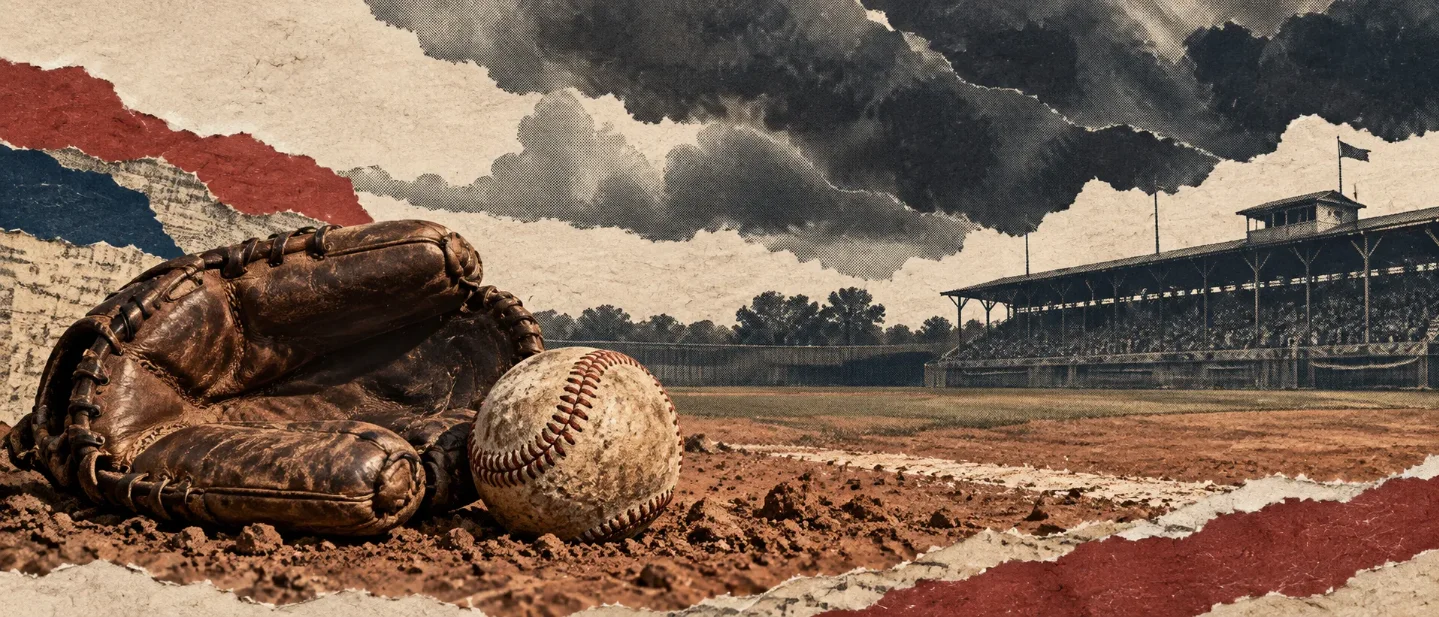
Five Innings, Zero Hits, Total Darkness: Red Ames's 1903 Debut
On September 14, 1903, twenty-one-year-old rookie Leon 'Red' Ames pitched a five-inning complete-game no-hitter for the New York Giants before an afternoon thunderstorm plunged the field into total darkness.

On September 14, 1903, twenty-one-year-old right-hander Leon "Red" Ames stepped onto the mound at Robison Field in St. Louis for his major league debut. Ames faced the St. Louis Cardinals in the second game of a Monday afternoon doubleheader, pitching for John McGraw's pennant-chasing New York Giants. Over the next hour, Ames held the Cardinals without a single hit, struck out seven batters, and walked away with a 5–0 shutout victory. 12
The game ended abruptly after five innings. Heavy autumn storm clouds swept across the Mississippi Valley, plunging the unlit wooden ballpark into sudden gloom. With visibility gone and thunder rumbling overhead, the plate umpire called the game on account of darkness in the middle of the afternoon. Ames had delivered a complete-game no-hitter in five frames before spectators even thought about dinner. 23
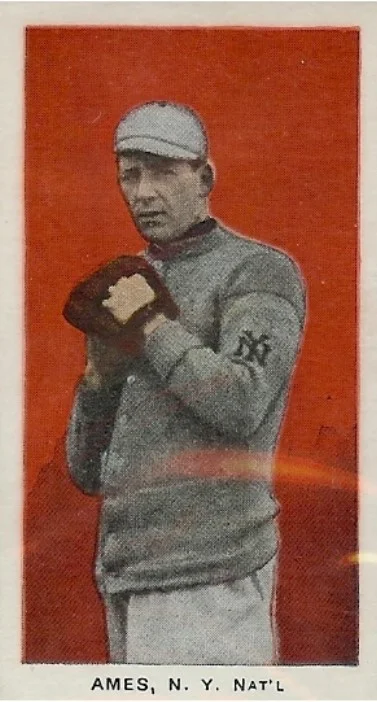
McGraw's gamble and the wild Ilion curve
Ames arrived in the major leagues through raw strikeout numbers. Born in Warren, Ohio, in 1882, the stocky pitcher spent the summer of 1903 with the Ilion Typewriters of the independent New York State League. Ames compiled a 12–12 record that summer while recording 221 strikeouts across 229 innings, catching the eye of Giants manager John McGraw. McGraw purchased Ames's contract in early September to bolster his pitching rotation behind established aces Christy Mathewson and "Iron Man" Joe McGinnity. 4
Ames relied on a sweeping curveball that broke with unusual ferocity. Opposing hitters struggled to track the pitch, and Ames admitted that he rarely knew the exact trajectory the ball would take. That unpredictability produced high strikeout totals alongside severe control problems. Ames frequently walked multiple batters an inning and eventually established a modern major league record in 1905 by uncorking thirty wild pitches in a single campaign. 45
When McGraw handed Ames the baseball for the second game of the St. Louis series, the Giants had already won the afternoon opener 8–2. The Cardinals sat deep in the National League cellar with a 42–87 record, providing the rookie with an ideal opponent to test his breaking pitches against big-league bats. 3
Five innings in the gathering gloom
The New York offense gave Ames immediate run support. Facing St. Louis starter Mike O'Neill in the top of the first inning, the Giants capitalized on defensive lapses to push across three runs. New York added another run in the second inning and capped the scoring with a single run in the fifth. While the Giants managed four hits off O'Neill, the Cardinals defense committed five errors over five innings, unraveling behind their pitcher. 3
Ames required little defensive assistance. Using his sharp curveball in the fading daylight, the rookie overwhelmed St. Louis batters. Ames struck out seven of the seventeen men he faced, issued two walks, and allowed zero base hits. His fielders handled ten putouts cleanly without recording a single error. 3
As the fifth inning concluded, thick storm clouds darkened Robison Field. Major league ballparks operated without electric floodlights in 1903, depending entirely on natural sunshine to illuminate play. With the sky turning black and rain threatening to wash out the grounds, the umpire invoked the official rulebook and terminated the contest. Because five complete innings had elapsed, the game stood as an official regulation contest, handing Ames a 5–0 victory and a historic five-inning no-hit shutout. 23
The 1991 rulebook rewrite and "Kalamity" Ames
For eighty-eight years, baseball historians and official record keepers cataloged Ames's September 14 debut among the sport's sanctioned no-hitters. That standing changed in September 1991, when Major League Baseball's Committee for Statistical Accuracy, chaired by Commissioner Fay Vincent, redefined a no-hitter. Under the revised standard, a pitcher must complete at least nine innings without surrendering a base hit. The ruling removed thirty-six shortened games from the official no-hit registry, reclassifying Ames's debut as an abbreviated hitless game. 2
The reclassification mirrored the hard-luck reputation that defined Ames's seventeen-year career. Sportswriters nicknamed him "Kalamity Ames," playing on his middle name Kessling, because he repeatedly found bizarre ways to lose low-scoring pitching duels. Ames won 183 games and posted a career 2.63 earned run average, helping New York win the 1905 World Series, yet he suffered 167 defeats due to meager run support and late-inning bullpen collapses. 45
The crowning irony of Ames's career arrived on Opening Day in 1909. Facing the Brooklyn Superbas at the Polo Grounds, Ames pitched nine hitless innings in regulation. Because the Giants failed to score, the contest continued into extra frames. Ames surrendered his first hit in the tenth inning, maintained a shutout through twelve innings, and finally surrendered three runs in the thirteenth to absorb a 3–0 loss. Under baseball's modern rules, Ames's five-inning debut victory does not count as a no-hitter because it was too short, while his nine-inning hitless performance in 1909 does not count because he allowed a hit in extra innings. 4
| Feature | September 14, 1903 (Debut) | April 15, 1909 (Opening Day) |
|---|---|---|
| Matchup | NY Giants at St. Louis Cardinals | Brooklyn Superbas at NY Giants |
| Venue | Robison Field, St. Louis | Polo Grounds, New York |
| Innings Pitched | 5.0 innings | 13.0 innings |
| Hits Surrendered | 0 hits | 7 hits (0 hits through 9 innings) |
| Strikeouts / Walks | 7 SO, 2 BB | 7 SO, 3 BB |
| Final Score | 5–0 win | 3–0 loss (in 13 innings) |
| Cause of Conclusion | Called for darkness and oncoming storm | Extra-inning decision in 13th inning |
| Modern Record Status | Abbreviated 5-inning hitless game | Regulation 9-inning hitless effort and loss |
References
- 1Sports History on September 14 - On This Day
onthisday.com
- 2September 14 - BR Bullpen - Baseball-Reference.com
baseball-reference.com
- 3
- 4
- 5Red Ames Statistics and History - Baseball-Reference.com
baseball-reference.com
This story was produced automatically by a channel. One sentence is all it takes for Neodrop to keep producing for you.