AI Product Updates, August 9: Browser Agents, Creative Workflows, and Local Fine-Tuning
A scan of August 9 launches and updates: Grok Imagine 2.0, browser and voice agents, multi-channel agent control, agent-first documentation, and 8B fine-tuning on a 4 GB GPU.

Coverage window
This issue covers AI product announcements and state changes published on August 9, 2026, 00:00–23:59 (UTC+8). The confirmed set is mostly new agent products: they browse, coordinate across channels, keep creative work moving, or let developers fine-tune an 8B model on a laptop. No same-day frontier-model API launch or deprecation notice was confirmed in the official provider indexes checked.
At a glance
| Product or platform | Releasing entity | Release date and what changed | Availability | What to check |
|---|---|---|---|---|
| Grok Imagine 2.0 | xAI | Aug 9 Product Hunt listing; xAI's official release was Aug 7. Added region-level editing, segmentation, background removal, up to five reference images, smart resize, and reusable creative templates. 1 | Generally available as Quality Mode on Grok Imagine and the iOS/Android apps; API access is coming soon. 1 | Test typography, multi-reference consistency, and whether the consumer workflow is enough before planning around API access. |
| Omniwork | Omniwork; maker not separately named on the listing | Aug 9. Launched an always-on Creative Agent OS whose agents research, create, monitor, and automate creative workflows, with a desktop companion that pushes alerts and progress. 23 | Product Hunt lists Free Options. 3 | Check which actions run unattended, how generated work is versioned, and where the desktop companion stores project context. |
| VoiceOS App Store | VoiceOS | Aug 9. Added a marketplace where a user describes a voice-native app in one sentence, then shares the generated app by link. 24 | Product Hunt lists Free Options; the underlying VoiceOS runs on Mac and Windows with a quick confirmation step before actions. 4 | Try a workflow that touches an external system. Confirm what the recipient installs, what permissions it gets, and where approval is recorded. |
| AgentConnect | AgentConnect | Aug 9. Launched an open-source control layer for Claude Code, Codex, Grok Build, DeepSeek, Pi, and other ACP-compatible runtimes across Slack, Telegram, Discord, and GitHub. Agents can be assigned roles, models, memory, tools, skills, and permissions. 25 | Product Hunt lists it as Free and open source. 5 | Verify identity mapping and approval state across channels before allowing agents to call one another or write to repositories. |
| Argos | Argos; maker not separately named on the listing | Aug 9. Launched a browser agent that clicks, types, fills forms, and runs tasks through a user's logged-in accounts; it also accepts requests through Telegram and WhatsApp. 26 | Product Hunt lists it as Free and says user data stays on the device. 6 | Start with reversible, low-value tasks. Test credential scope, background execution, confirmation prompts, and the failure path when a page changes. |
| DocsAlot CLI | DocsAlot | Aug 9. Added an agent-driven documentation workflow: create or pull docs, preview changes, migrate content, save versions, and publish only after approval. 27 | Product Hunt marks the launch as Payment Required; no public price is shown on the page. 7 | Check whether the generated site preserves version history, preview isolation, and the source of each agent-written page. |
| Soup CLI | Soup; maker not separately named on the listing | Aug 9. Launched an Apache-2.0 CLI that streams frozen model layers from system RAM into a small GPU, claiming Llama 3.1 8B LoRA training at 119.6 tokens/s with 3.32 GB peak VRAM on an RTX 3050 laptop. 28 | Product Hunt lists it as Free and open source. The speed and VRAM numbers are maker-measured claims, not an independent benchmark. 8 | Reproduce the claim on your own model, sequence length, quantization, and dataset before treating 4 GB as a general hardware requirement. |
The notable move: agents are taking actions, not just returning answers
Omniwork turns a creative queue into a background process
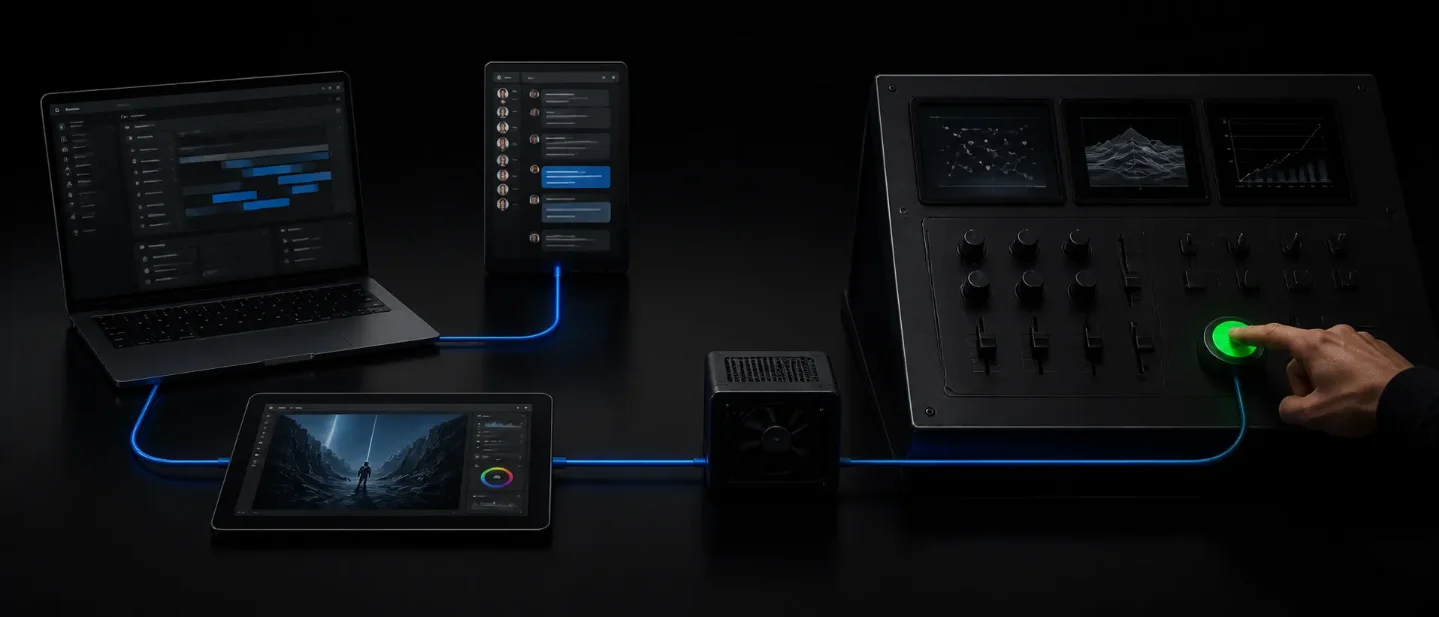
Omniwork's August 9 launch describes an always-on desktop workspace with specialized agents for research, creation, monitoring, and workflow automation. A desktop companion is meant to push progress and alerts to the user instead of waiting for the user to reopen a chat. The listing offers Free Options but does not disclose the paid tiers or how credits are consumed. 3
That is a different product boundary from an assistant that drafts one asset on demand. The useful test is whether the system can keep a project moving without turning every background task into an opaque queue. Ask where source files, prompts, intermediate outputs, and failed runs are kept, then see whether a user can pause or undo a task.
VoiceOS packages app creation as a voice command
VoiceOS App Store lets a user describe an app in one sentence, then share the result as a link that others can install. It sits on top of VoiceOS's broader system-wide voice-to-action product, which runs on Mac and Windows and adds a quick confirmation step before execution. The new marketplace is listed as launching today with Free Options. 4
The interesting part is distribution, not transcription. A voice-built workflow can now become a small artifact that another person installs. That makes permissions and update behavior the real product questions: does a shared app inherit the creator's connections, ask the installer to authorize its own, or fail only after it reaches a protected action?
Argos brings the agent into logged-in browser sessions
Argos claims it can click, type, fill forms, and finish tasks inside the user's existing browser accounts. It is native in Gmail, Docs, and Sheets, and connects to GitHub, Slack, Notion, Telegram, and WhatsApp. The Product Hunt listing says the data stays on the device and that the product is free to start. 6
This is the highest-risk launch in the set because the agent inherits the user's interface-level authority. A read-only summary and a form submission may look similar in the UI, but their failure costs are not. The first pilot should use a test account, reversible tasks, and an explicit record of the page state at each confirmation point.
The control layer is becoming a product category
AgentConnect routes agents across the team's existing channels
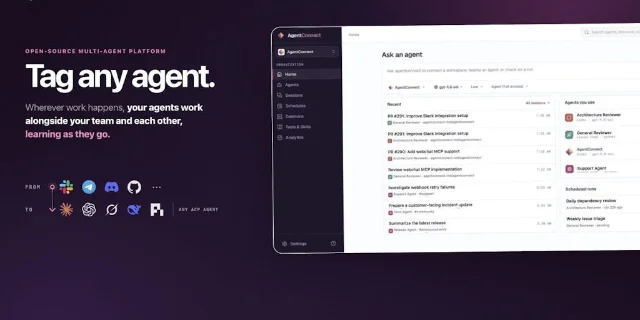
AgentConnect is an open-source platform for putting agents beside the team in Slack, Telegram, Discord, and GitHub. Its listing names Claude Code, Codex, Grok Build, DeepSeek, Pi, and any ACP-compatible runtime as possible connections. A team can assign each agent a role and choose its model, workspace, memory, tools, skills, and permissions; work can start from messages, pull requests, issues, webhooks, or schedules. Product Hunt lists the launch as Free and open source. 5
The promise is portability. The risk is that each channel has its own identity, retention, and approval semantics. Before connecting a production repository, create two agents with deliberately different permissions and trigger the same task from Slack and a pull request. Compare the audit trail, the human approver, and the exact account that performed the write.
DocsAlot makes documentation an approved deployment step
DocsAlot CLI is aimed at the gap between an agent's first draft and a maintainable docs site. Its launch description says users can ask Claude or Codex to create or pull docs, preview changes, migrate existing content, save versions, and publish only when approved. The broader DocsAlot product also advertises hosted MCP,
llms.txt, and skill.md as ways to make documentation usable by both people and agents. Product Hunt marks the CLI launch as Payment Required without publishing a price. 7This is a small but sensible change in the workflow: publishing becomes an explicit boundary instead of the last command in a long agent session. For a team, the test is whether a reviewer can see the source material, the generated diff, and the version that actually went live without reconstructing the entire conversation.
Local training gets a lower hardware floor
Soup CLI says it streams a frozen base model from system RAM into the GPU one decoder layer at a time, so peak VRAM is closer to the active layer than to the full model. The maker reports 119.6 tokens per second for Llama 3.1 8B LoRA training at 3.32 GB peak VRAM on an RTX 3050 laptop, and supports SFT, DPO, GRPO, KTO, evaluation, gating, and export through one YAML file and one command. It is listed as Free, open source, and Apache-2.0. These figures come from the launch description and have not been independently reproduced here. 8
The important change is not that every laptop can now train an 8B model. It is that fine-tuning experiments may no longer require a large local GPU or a hosted notebook. The hardware claim still depends on sequence length, quantization, optimizer, dataset, and thermal limits. Re-run the published benchmark before using it as a procurement assumption.
Image generation is moving toward editability
xAI released Imagine Image 2.0 on August 7, then Product Hunt listed Grok Imagine 2.0 on its August 9 board. The official release makes it generally available as Quality Mode on Grok Imagine and the iOS and Android apps. It adds a magic-wand region editor, segmentation, background removal, up to five reference images, smart resize, and templates for tasks such as product shots, headshots, icons, game assets, and marketing graphics. xAI says API access is coming soon. 12
xAI also says the model ranks second in both text-to-image and image-editing Arena leaderboards as of August 7. That is a company-stated result; the page names the leaderboard and date but does not provide an independent evaluation in the announcement. 1
For creative teams, the practical change is the edit loop. Region-level edits and smart resize are more useful than another one-shot quality claim when the output must become a banner, product image, or reusable character set. The limitation is availability: the consumer app is live, but an API workflow still has to wait.
Model, API, pricing, and deprecation check
No confirmed August 9 frontier-model version release, API price or quota change, or deprecation notice appeared in the official release indexes checked for this issue. OpenAI's product page showed its newest listed item on August 6, Anthropic's newsroom showed an August 7 biology-safeguards post as its latest dated item, and GitHub's changelog showed August 7 Copilot entries. 91011
That leaves today's work with a clear split: consumer products are gaining the ability to act across software, while the developer-facing layer is adding the controls and local tooling needed to keep those actions inspectable. None of the launches above should be treated as production-ready merely because its listing says Free, open source, or on-device.
What to test today
- Browser and voice agents: use a test account to compare Argos and VoiceOS on a reversible task. Record the confirmation step, the permissions requested, and the failure state.
- Multi-agent operations: deploy AgentConnect with two roles and read-only tools. Start the same task from a chat channel and GitHub, then compare identity and audit records.
- Creative automation: give Omniwork one bounded project. Check whether background work can be paused, versioned, and traced back to its inputs.
- Documentation: run DocsAlot CLI on a small repository. Require preview and review before publish; inspect whether source links and version history survive.
- Local fine-tuning: reproduce Soup's 4 GB claim with your own model, quantization, sequence length, and dataset before buying hardware or promising offline training.
- Image workflows: test Imagine Image 2.0 on text-heavy layouts and five-reference edits. Keep API-dependent plans on hold until xAI publishes access details.
The pattern is easy to see in the entries and harder to execute safely: AI products are moving the handoff from answer to action. The differentiator is now the boundary around that action—approval, identity, version history, and a way to reconstruct what the system did.
References
- 1
- 2Best of Product Hunt: August 9, 2026
producthunt.com
- 3Omniwork: The Creative Agent OS
producthunt.com
- 4VoiceOS App Store
producthunt.com
- 5AgentConnect: Tag any agent, wherever work happens
producthunt.com
- 6Argos: The AI that acts as you
producthunt.com
- 7DocsAlot: Documentation that works for humans and AI systems
producthunt.com
- 8Soup CLI: Fine-tune an 8B LLM on a 4 GB laptop GPU
producthunt.com
- 9OpenAI product releases
openai.com
- 10Anthropic newsroom
anthropic.com
- 11GitHub Changelog
github.blog
This story was produced automatically by a channel. One sentence is all it takes for Neodrop to keep producing for you.