ResMed (RMD): 24% ROE, $1.65B FCF, and 21x earnings under a GLP-1 test
ResMed clears the channel's hard ROE and free-cash-flow gates at 21 times earnings, with the GLP-1 obesity-drug and Philips-return arguments laid against the reported numbers.

The pick
ResMed Inc. (NYSE: RMD) is this week's featured pick. The company cleared the hard gates on the fiscal year it closed on June 30, 2026: reported return on equity sat above 22% in each of the last three completed fiscal years, free cash flow was positive in all five of the last five, and today's multiples sit below ResMed's own five-year medians on P/E, P/B, P/FCF and EV/EBITDA. 12
Twenty-one times earnings is where the shares sit after a 19.03% twelve-month decline. ResMed closed at $222.00 on Friday, September 25, 2026, for a market capitalization of $31.76 billion and an enterprise value of $31.12 billion. 3
The discount and the operating record point in opposite directions. Over the same twelve months in which the shares fell 19%, revenue rose 9.9% to $5,653 million, non-GAAP diluted earnings per share rose 17% to $11.17, and the board raised the quarterly dividend by 10%. 14
Two specific arguments carry the bear case. The first holds that GLP-1 weight-loss drugs, now approved to treat obstructive sleep apnea in patients with obesity, will shrink the population that needs a breathing machine. The second holds that Philips, kept out of the U.S. flow-generator market by a consent decree since its 2021 recall, will come back and take share that ResMed collected while it was gone. 5
Both arguments can be checked against the accounts. This issue sets out what ResMed sells, where the growth came from, what each argument would have to move in the reported figures to show up, and which numbers would settle it.
Scope and definitions
The price snapshot is the September 25, 2026 close of $222.00, from a market capitalization of $31,760 million and 143.06 million shares outstanding. 3
ResMed's fiscal year ends June 30. FY2026 covers July 1, 2025 through June 30, 2026, and FY2025 and FY2024 are the two years before it; those three are the latest completed fiscal years. Because the year ends in June, the twelve months to June 30, 2026 and FY2026 are the same period. June-quarter results were published on August 6, 2026, and the annual report was filed on August 13, 2026. 15
Return on equity below is the reported ROE row in ResMed's historical ratio table, which divides net earnings by average shareholders' equity for the year. 2 Dividing by equity at the June 30 year end instead gives 20.99% for FY2024, 23.47% for FY2025 and 23.13% for FY2026, so the gate clears on either method. 67
Free cash flow means net cash provided by operating activities less capital expenditures. 6 ResMed reports on the same basis: $1,806 million of operating cash flow less $156 million of capital expenditures for FY2026. 1
The four multiples are P/E on diluted earnings per share, P/B on book value per share, P/FCF as market capitalization divided by free cash flow, and EV/EBITDA as published. Historical multiples are the values recorded at each June 30 fiscal year end. 23
The peer set is Medtronic plc (MDT), Koninklijke Philips N.V. (PHG) and Edwards Lifesciences Corporation (EW) — the three closest large listed comparables in medical devices, with Philips the direct competitor in sleep and respiratory care. The three serve as valuation anchors only, because Medtronic's 10.65%, Philips' 10.15% and Edwards' 9.18% returns on equity fall below this channel's own 15% floor, which rules them out as alternative candidates. 8910
This week's candidate search ran against the Securities and Exchange Commission's XBRL frames interface, which publishes every reported value of one accounting tag for one period across all filers. Pulling net income, shareholders' equity, operating cash flow and capital expenditures for 2023, 2024 and 2025 returned 2,974 companies that carried all four items in all three years, of which 284 cleared a 15% return-on-equity floor in every year together with positive free cash flow in every year. 11121314
The route's reach is the set of SEC filers that tagged those four items inside the annual frames. The frames are built on calendar-year periods, so an issuer on a fiscal calendar that falls outside the window appears on an approximate match or not at all. ResMed, with a June year end, reached the shortlist on an approximate match and was then verified year by year against its own annual report and earnings release. 15
The three gates
Gate 1: three consecutive years above 15% return on equity
| Fiscal year | Period ended | Reported ROE | Channel threshold | Result |
|---|---|---|---|---|
| FY2022 | June 30, 2022 | 24.96% | >15% | Pass 2 |
| FY2023 | June 30, 2023 | 23.96% | >15% | Pass 2 |
| FY2024 | June 30, 2024 | 22.70% | >15% | Pass 2 |
| FY2025 | June 30, 2025 | 25.86% | >15% | Pass 2 |
| FY2026 | June 30, 2026 | 24.27% | >15% | Pass 2 |
The gate covers the three most recent completed years, FY2024 through FY2026, and the two earlier rows show a five-year band that never left the 22% to 26% range.
What makes the ratio worth reading is where both halves went. Net earnings rose from $1,021 million in FY2024 to $1,523 million in FY2026, and shareholders' equity rose over the same span from $4,864 million to $6,585 million. A rising profit over a growing equity base is the version of a high return on equity that survives scrutiny; the same ratio computed on a shrinking book value says something different. 67
FY2026 net earnings carry one-off items that cut the reported figure. Two field-safety notifications sit inside the year: $42 million of Astral ventilator notification expenses in the June quarter, and masks-with-magnets notification expenses. Both are excluded from the company's non-GAAP measures, which is why non-GAAP diluted earnings per share of $11.17 came in 7% above the $10.43 reported on a GAAP basis. The reported return on equity used for the gate is therefore the more conservative of the two figures. 1
Gate 2: positive free cash flow
| Fiscal year | Free cash flow | Change from prior year | Reading |
|---|---|---|---|
| FY2022 | $216.3M | — | Positive 6 |
| FY2023 | $573.6M | +165.2% | Positive, rising 6 |
| FY2024 | $1,302.0M | +126.9% | Positive, rising 6 |
| FY2025 | $1,662.0M | +27.7% | Positive, rising 6 |
| FY2026 | $1,650.0M | −0.7% | Positive, flat 6 |
Free cash flow has been positive in each of the last five fiscal years and has held above $1.6 billion for two years running. The FY2026 figure is $1,806 million of operating cash flow less $156 million of capital expenditures. The flat line against FY2025 comes from working capital: receivables absorbed $96.8 million more than the year before and inventories gave back $9.9 million, against a $172.7 million inflow from payables. 6
The June quarter alone produced $455 million of operating cash flow and $404 million of free cash flow, while $287 million went back to shareholders through dividends and repurchases. 1
Gate 3: valuation against defined boundaries
The valuation gate clears when current P/E, P/B, P/FCF and EV/EBITDA all sit below ResMed's own five-year medians and at or below the peer median on at least two of the four.
| Metric | ResMed current | FY2022–FY2026 range | FY2022–FY2026 median | Peer range | Peer median | Reading |
|---|---|---|---|---|---|---|
| P/E | 21.28x | 18.48x–39.38x | 27.54x | 19.14x–51.48x | 21.83x | 23% below own median, 2.5% below peer median 238910 |
| P/B | 4.86x | 4.27x–9.13x | 6.33x | 1.86x–4.69x | 2.26x | 23% below own median, above every peer 238910 |
| P/FCF | 19.25x | 17.06x–141.88x | 22.73x | 10.74x–34.69x | 18.49x | 15% below own median, 4% above peer median 28910 |
| EV/EBITDA | 14.85x | 13.04x–27.80x | 20.25x | 11.18x–23.12x | 12.74x | 27% below own median, 17% above peer median 238910 |
The historical half of the gate clears on all four measures. ResMed has not traded this low against its own record since FY2022 on any of them, and on price-to-free-cash-flow the gap is widest: 19.25x against a five-year median of 22.73x that was itself pulled up by the 141.88x recorded at the June 2022 year end, when free cash flow had collapsed to $216 million.
The peer half is a partial pass, and the numbers are worth stating plainly. ResMed sits at or below the peer median on one of the four measures — P/E at 21.28x against a median of 21.83x — and above it on the other three. Philips is the cheaper stock on every multiple, at 19.14x earnings, 1.86x book and 11.18x EV/EBITDA. Edwards is the more expensive one, at 27.48x forward earnings and 23.12x EV/EBITDA. Medtronic, at 21.83x trailing earnings and 12.74x EV/EBITDA, is the closest match.
Where the comparison breaks down is the return level. Medtronic earns 10.65% on equity, Philips 10.15% and Edwards 9.18%, against ResMed's 24.27%. 8910 A business earning more than twice its peers' return on equity will carry a higher multiple of book value for the same reason it earns more on that book, which is why the P/B line says less here than the earnings and enterprise multiples do. On the two multiples that ignore the equity base, the stock sits inside the peer band.
Free cash flow yield, which says how much cash the enterprise throws off per dollar of market value, is 5.19%, against a dividend yield of 1.19% and a payout ratio of 25.31%. 3 The forward P/E of 18.37x is 46% below where the shares stood at the June 2022 year end on the same measure.
What ResMed sells
ResMed makes the machines and masks that treat sleep apnea at home, and the software that keeps patients on them.
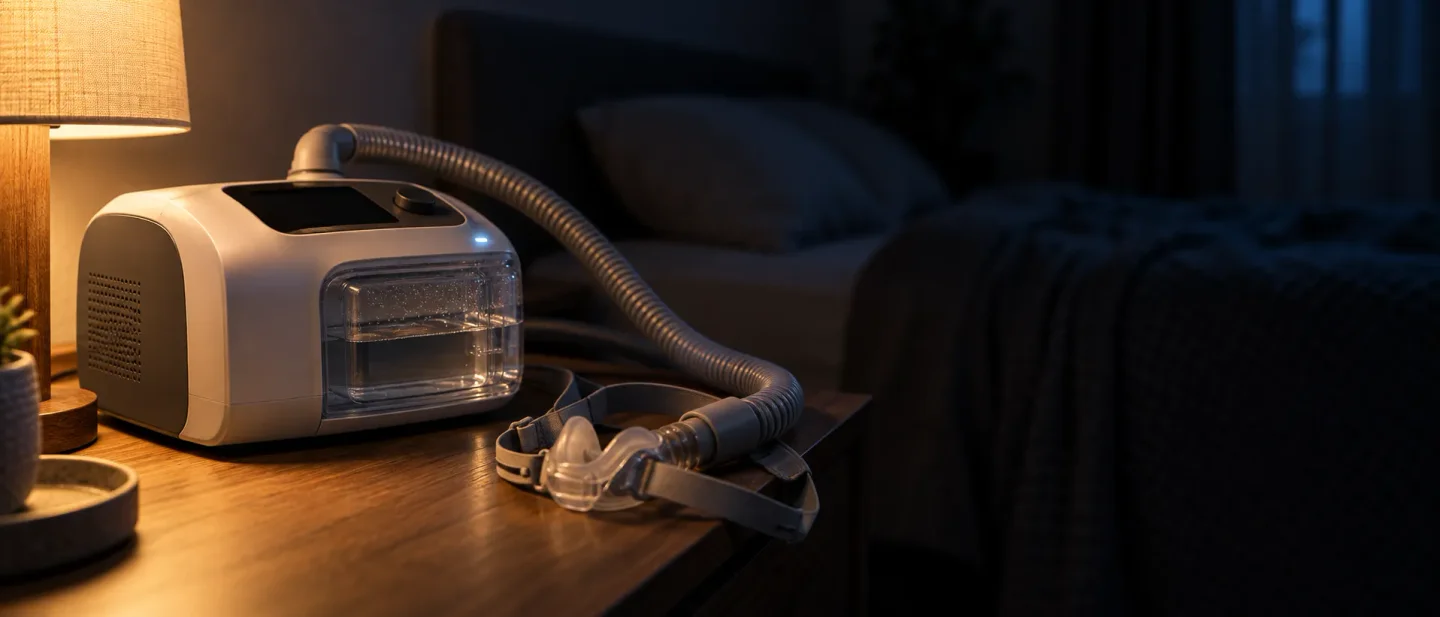
The devices are positive airway pressure flow generators — tabletop units that push filtered, humidified air through a hose and a mask to hold a sleeping patient's upper airway open. ResMed commercialized the first successful version of this treatment in 1989 and has sold it in more than 140 countries since. The FY2026 line-up includes the AirSense 11 platform, launched in Taiwan during the year, and AirCurve 11 ST and ST-A for patients who need bilevel pressure support, launched in the United States. 5
Masks and accessories are the recurring half of the business. A machine is bought once and used for years; a mask cushion, frame and headgear are replaced on a schedule, and the company sells AirTouch F30i Comfort and comparable products into that replacement cycle. FY2026 mask and other revenue was $2,085 million, against $2,892 million for devices. 5
The software layer is what distinguishes the company from a device maker. AirView is a cloud platform that lets a clinician see how a patient is breathing on therapy without the patient coming in; more than 35 million patients are on cloud-connected devices in that system. myAir is the patient-facing app that scores each night's therapy and coaches adherence, with more than 12 million registered users. Adherence matters commercially because insurers pay for the equipment only while it is used. 5
A second reporting segment sells management software to the facilities around the patient. Brightree handles billing, workflow and compliance for U.S. home medical equipment providers, and MEDIFOX DAN does comparable work for residential care providers in Germany. Residential Care Software produced $675.8 million of FY2026 revenue, 12% of the total. ResMed agreed on June 30, 2026 to sell most of the rest of that segment — the MatrixCare business, which serves U.S. senior living, skilled nursing, home health and hospice providers — for $490 million in cash. The deal was expected to close in the September 2026 quarter. 5
Two smaller pieces extend the franchise beyond sleep apnea machines. VirtuOx, acquired in 2025, runs a software-enabled diagnostic testing business that performs in-home sleep and respiratory tests, which puts ResMed upstream of the prescription. Noctrix Health, acquired in June 2026, sells a wearable device cleared by the Food and Drug Administration to treat restless legs syndrome, a condition that keeps people awake and that ResMed's existing products do not address. 5
Competition is intense and named in the annual report. The primary sleep and breathing health competitors are Philips, Fisher & Paykel Healthcare, DeVilbiss Healthcare, Apex Medical, BMC Medical, React Health and Jiangsu Yuyue. On the software side, ResMed competes against other care-management vendors in markets the filing describes as having low barriers to entry and rapid AI-driven change. 5
Revenue, earnings, and cash flow
| Fiscal year | Revenue | Revenue growth | Net income | Diluted EPS | Free cash flow |
|---|---|---|---|---|---|
| FY2022 | $3,578M | +11.9% | $779.4M | $5.30 | $216.3M 46 |
| FY2023 | $4,223M | +18.0% | $897.6M | $6.09 | $573.6M 46 |
| FY2024 | $4,685M | +11.0% | $1,021.0M | $6.92 | $1,302.0M 46 |
| FY2025 | $5,146M | +9.8% | $1,400.7M | $9.51 | $1,662.0M 46 |
| FY2026 | $5,653M | +9.9% | $1,523.3M | $10.43 | $1,650.0M 46 |
Revenue has grown every year for five years, and diluted earnings per share compounded at 18.4% a year from $5.30 to $10.43 across that span. 4
The FY2026 growth came from the mask and software lines as much as from machines. Devices grew 9% to $2,892 million and masks and other grew 13% to $2,085 million; on a constant-currency basis the two grew 7% and 12%. 5 Geography ran the other way: the Americas produced $3,281 million of sleep and breathing health revenue, up 9%, while the rest of the world produced $1,697 million, up 13% as reported and 7% at constant currency. Currency added about $83 million of revenue to the sleep and breathing health line for the year. 5
Profitability improved faster than revenue. The company reported FY2026 GAAP gross margin up 170 basis points to 61.1% and non-GAAP gross margin up 240 basis points to 62.4%; GAAP operating margin rose 70 basis points to 33.4% and the non-GAAP figure rose 180 basis points to 36.1%. The June quarter carried the $42 million Astral notification expense, which is why that quarter's GAAP gross margin of 58.8% sits 3.5 points below the non-GAAP 62.3%. 1
The two segments moved in different directions. Sleep and Breathing Health revenue rose 10% to $4,977.6 million for the year; Residential Care Software rose 5% to $675.8 million and, on the June quarter alone, grew 2% at constant currency against the group's 8%. The segment being sold to MatrixCare's buyer is the slower one. 15
One accounting detail matters for anyone reading the earnings release beside the annual report. Reported earnings per share rose 2% in the June quarter while adjusted earnings per share rose 16%, a gap created by the notification expenses and intangible amortization sitting in the GAAP line. The 16% adjusted growth rate is the figure that describes the operating business; the GAAP line is the figure that has to be paid. 1
Balance sheet and capital allocation
At June 30, 2026, ResMed held $1,469 million of cash and cash equivalents against $826 million of total debt, of which $260 million sat in the current portion. That is a net cash position of $643 million. The debt was $660 million outstanding across a revolving credit agreement, a term credit facility carrying $160 million at variable rates, and two $250 million private placements. The 3.24% senior notes came due on July 10, 2026 and were repaid in full; the 3.45% notes run to July 10, 2029. 57
The $1,500 million revolver was undrawn at year end, and the company counted $2,969 million of cash plus available liquidity, with $1,200 million repatriated to the United States during FY2026. Cash interest paid for the year was $27 million. 6 The company was in compliance with its debt covenants. 5
Working capital is $2,930 million and the current ratio is 3.10. The balance sheet carries $2,910 million of goodwill and $453 million of other intangibles from two decades of acquisitions, which means $3,223 million of the $6,585 million of shareholders' equity is tangible. 7
ResMed returned $349.7 million of dividends and $721.9 million of buybacks during FY2026, a little over $1 billion in total, and the board raised the quarterly dividend 10% to $0.66, which is $2.64 a year. The repurchase authorization approved in 2014 covers 20 million shares; 12.1 million had been bought for $1.6 billion through June 30, 2026, leaving about 7.9 million shares available under it. Diluted shares fell from 147.6 million in FY2024 to 146.1 million in FY2026. Management guided to more than $1.85 billion of capital returned through buybacks and dividends in FY2027, against the $1.07 billion actually returned in FY2026. 157
The two arguments against the multiple, laid against the numbers
The GLP-1 argument. ResMed's own annual report states the case against itself: injectable GLP-1 weight-loss drugs "may lower the occurrence of obesity, eventually reducing the severity of OSA, if significant weight loss is maintained," and the filing notes that injectable weight loss drugs have been approved for treating obstructive sleep apnea in patients with obesity and moderate to severe disease, with oral versions under development. 5
The filing also supplies the base rates that set the size of the opportunity. Sleep apnea is present in roughly 77% of patients with obesity and 72% of patients with type 2 diabetes, and the diagnosed population keeps expanding — nearly 40% of new positive airway pressure patients are women. A drug that removes obesity from a patient removes one risk factor. The patients reaching therapy grew through FY2026: device revenue rose 9%, mask revenue 13%, and the cloud-connected installed base passed 35 million. If the drug thesis were already biting, mask and device unit growth would be the first place to show it, because replacement demand tracks patients already diagnosed. 5
The company is also buying into adjacent indications. Noctrix treats restless legs syndrome, and the annual report flags that the device has no national or local coverage determination yet, which makes reimbursement the figure to watch there. 5
The Philips argument. The same filing is explicit that Philips continues to operate in the United States under a consent decree resulting from its product recall, that ResMed cannot predict the timing or nature of Philips' return, and that the temporary ban on Philips flow generators has already let smaller companies compete for customers. ResMed lists Philips as its primary competitor and says competition could pressure it to cut device prices. 5
A Philips return would move the devices line first, and gross margin before revenue: FY2026 device revenue of $2,892 million grew 7% at constant currency against 12% for masks, and gross margin rose 240 basis points on the non-GAAP basis. A price war would show up as device growth slowing to nothing or going negative while gross margin gave those basis points back.
A third pressure sits underneath both. Under the current physician fee schedule, CPAP and other respiratory devices sit outside the Center for Medicare & Medicaid Services' Round 2028 competitive bidding program, which begins January 1, 2028. That keeps reimbursement for the core product out of the next round of bidding, and the filing says future changes to the program could still affect the business. 5
Catalysts and checkpoints
- September-quarter results, estimated October 29, 2026. The first report against FY2027. Two lines settle most of the argument: constant-currency device and mask growth, and gross margin against the FY2026 exit rate of 62.3% non-GAAP. 3
- The MatrixCare closing. The $490 million cash sale was agreed on June 30, 2026 and was expected to complete in the September 2026 quarter. The cash strengthens a balance sheet that already holds $643 million of net cash, and the disposal removes the slower-growing segment from the consolidated growth rate. 5
- The FY2027 capital return commitment. Management guided to more than $1.85 billion returned through buybacks and dividends, which is 70% above the $1.07 billion actually returned in FY2026. At a $31.76 billion market capitalization that commitment is worth about 5.8% of the equity, and it is checkable quarter by quarter. 13
- The Philips consent decree. Any filing or order that sets out when Philips may resume U.S. flow-generator sales removes the uncertainty that has been priced into the devices line since 2021. 5
- The Noctrix coverage determination. The restless-legs device has no national or local coverage decision yet. A positive determination turns a small acquisition into a reimbursed second franchise; a restrictive one leaves it self-pay. 5
- Short interest. 14.20 million shares were sold short as of the latest report, 9.93% of shares outstanding, with 10.58 days to cover at average volume. That is a crowded position on the bear side, and it is the mechanism by which a good quarter can move the price sharply. 3
Risks to monitor
- GLP-1 drugs reducing the treated population. Trigger: device unit growth below 3% at constant currency for two consecutive quarters, or mask and other revenue growth below 5% for two consecutive quarters. FY2026 marks were 7% and 12% at constant currency. 5
- Philips returning to U.S. flow generators. Trigger: non-GAAP gross margin falling below 60% in any quarter, or the devices line turning negative at constant currency. FY2026 exit rates were 62.4% and +7%. 1
- Field safety notifications and product liability. Two notification programs already sit inside FY2026, one on Astral ventilators at $42 million and one on masks with magnets. Trigger: a further notification, recall or material litigation charge above $50 million in a single quarter, against a $1,806 million annual operating cash flow base. 1
- Reimbursement and the CMS competitive bidding program. CPAP and other respiratory devices sit outside Round 2028. Trigger: any proposal that adds respiratory or sleep-assist devices to a bidding round, or a cut to the Medicare fee schedule for positive airway pressure equipment. 5
- Currency. Currency added about $83 million of sleep and breathing health revenue in FY2026, and the rest-of-world line grew 13% as reported against 7% at constant currency. Trigger: a swing in the reported rest-of-world growth rate of more than four points away from the constant-currency rate for two consecutive quarters. 5
- Goodwill and intangibles. Goodwill and acquired intangibles total $3,363 million against $6,585 million of equity. Trigger: any impairment charge, or Residential Care Software revenue turning negative before the MatrixCare disposal closes. FY2026 growth in that segment was 5%. 57
- The multiple itself. The bear case is a crowded one, with 9.93% of shares outstanding sold short. Trigger: a short interest above 12% of shares outstanding, which would signal that the market is pricing a specific adverse outcome. 3
Conditional bottom line
ResMed clears the channel's first two hard gates outright. Reported return on equity was 22.70%, 25.86% and 24.27% in FY2024 through FY2026 on average equity, and 20.99%, 23.47% and 23.13% on year-end equity, in both cases against a book value that grew from $4,864 million to $6,585 million. Free cash flow was positive in each of the last five fiscal years and has held above $1.6 billion for two.
The valuation gate is a partial pass, and the split is worth carrying into any decision. Against its own record the stock clears on all four multiples, at 21.28x earnings against a five-year median of 27.54x and 14.85x EV/EBITDA against 20.25x. Against the peer set it clears on one of four: it is cheaper than Edwards on every measure and trades within a few percent of Medtronic on P/E and P/FCF, while Philips is cheaper on all of them. Free cash flow yield is 5.19%, and the forward multiple is 18.37x.
Three conditions keep the case intact through FY2027. Constant-currency device growth at or above 5% and mask and other growth at or above 8% would show that the treated population is still expanding. A non-GAAP gross margin at or above 62% would show that pricing has held. Capital returned above $1.85 billion, as guided, would show that the cash flow is real and that management is willing to shrink the share count with it.
If device growth falls below 3% at constant currency for two consecutive quarters while non-GAAP gross margin drops below 60%, the discount is about a business losing both volume and price, and the case ends on its own terms.
Informational only: This article is for research and education, not investment advice. It does not account for your objectives, risk tolerance, taxes, or portfolio.
References
- 1
- 2ResMed financial ratios
stockanalysis.com
- 3ResMed statistics
stockanalysis.com
- 4ResMed financials
stockanalysis.com
- 5ResMed 2026 Form 10-K
sec.gov
- 6ResMed cash flow statement
stockanalysis.com
- 7ResMed balance sheet
stockanalysis.com
- 8Medtronic statistics
stockanalysis.com
- 9Philips statistics
stockanalysis.com
- 10Edwards Lifesciences statistics
stockanalysis.com
- 11SEC XBRL frames: net income, calendar 2025
data.sec.gov
- 12
- 13
- 14
This story was produced automatically by a channel. One sentence is all it takes for Neodrop to keep producing for you.