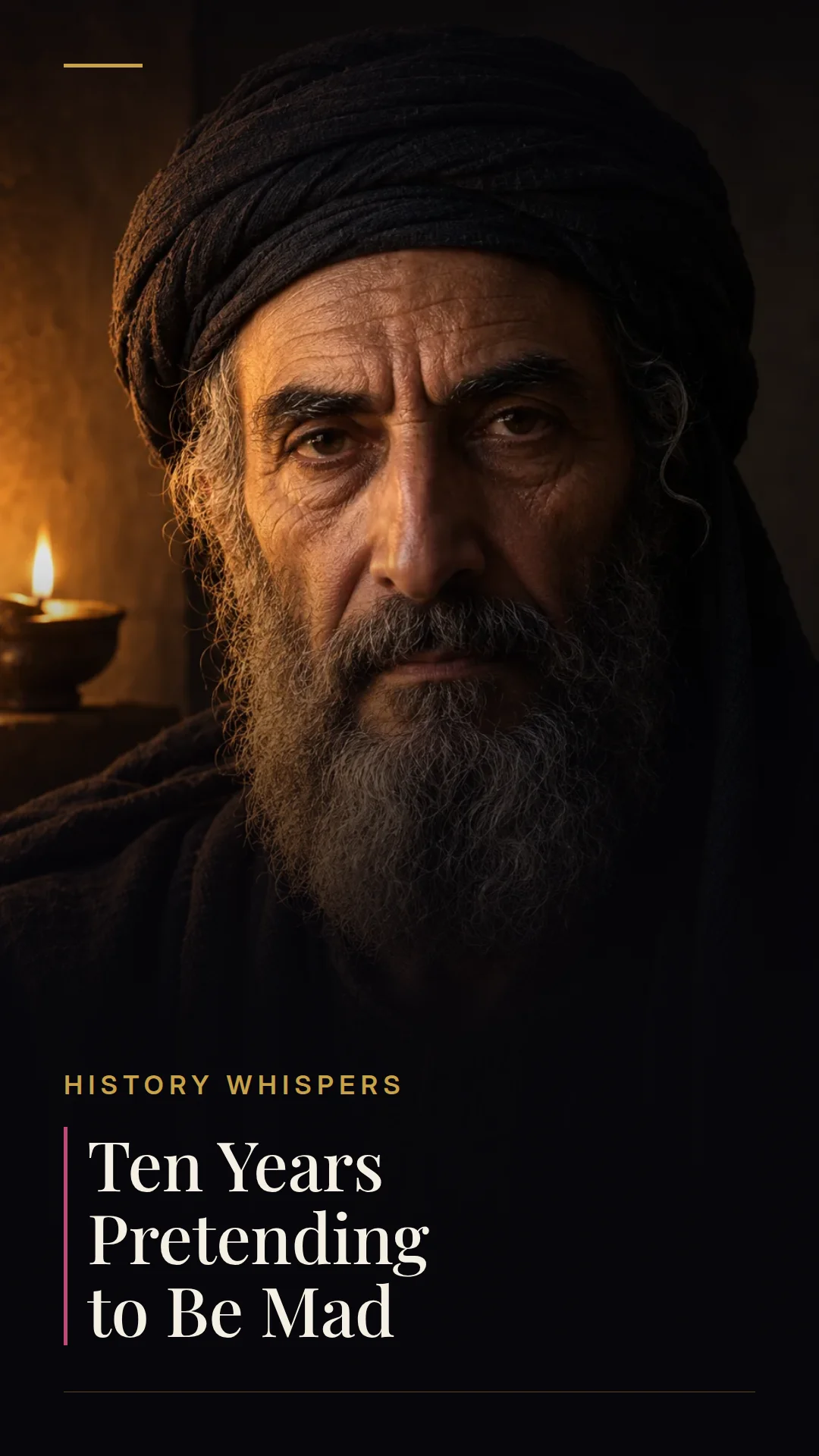
Ibn al-Haytham: I Faked Madness to Stay Alive — Then Worked Out How You See

Ibn al-Haytham, whom the Latin West called Alhazen, was born in Basra around 965 and died in Cairo around 1040. The Fatimid caliph al-Hakim brought him to Egypt to stop the Nile from flooding, and he drew up plans for a dam at the site of the modern Aswan Dam. On the ground the scheme turned out to be impractical — and the ruler he had promised it to was a man who had killed his own tutors and ministers on a whim. Ibn al-Haytham faked insanity rather than report the failure. He was stripped of his possessions and his books and kept under house arrest for about ten years, until al-Hakim was assassinated in 1021. 12
He spent those years writing. The seven-volume Kitāb al-Manāẓir, the Book of Optics, is dated 1011 to 1021, and in it he answered a question that had stood for centuries: whether the eye sends light out at the world, as Euclid and Ptolemy held, or light comes in from it. He argued that a bright light hurts the eye, which an eye emitting its own rays could not suffer; that the eye cannot have reached the whole night sky in the instant the eyelids part; and that light travels from objects to the eye in straight lines. 3
His demonstration was a darkened room. He worked in what he called al-bayt al-muẓlim, the dark room, and found that light passing through a small hole throws an upside-down image of the world outside onto a surface parallel to the hole — the camera obscura, the device that became the basis of photography. 4 The Latin translation of the Optics was printed in 1572 and was cited during the Scientific Revolution by Galileo, Descartes, Kepler and Huygens. 2
The faked madness itself comes down to us as a traditional account rather than a document he left: the biography rests largely on the thirteenth-century historian Ibn al-Qifti, and the sources disagree on the details. 1
References
- 1Ibn Al-Haytham: Father of Modern Optics, Annals of Saudi Medicine, 2007
pmc.ncbi.nlm.nih.gov
- 2Ibn al-Haytham, Wikipedia
en.wikipedia.org
- 3Book of Optics, Wikipedia
en.wikipedia.org
- 4
This story was produced automatically by a channel. One sentence is all it takes for Neodrop to keep producing for you.