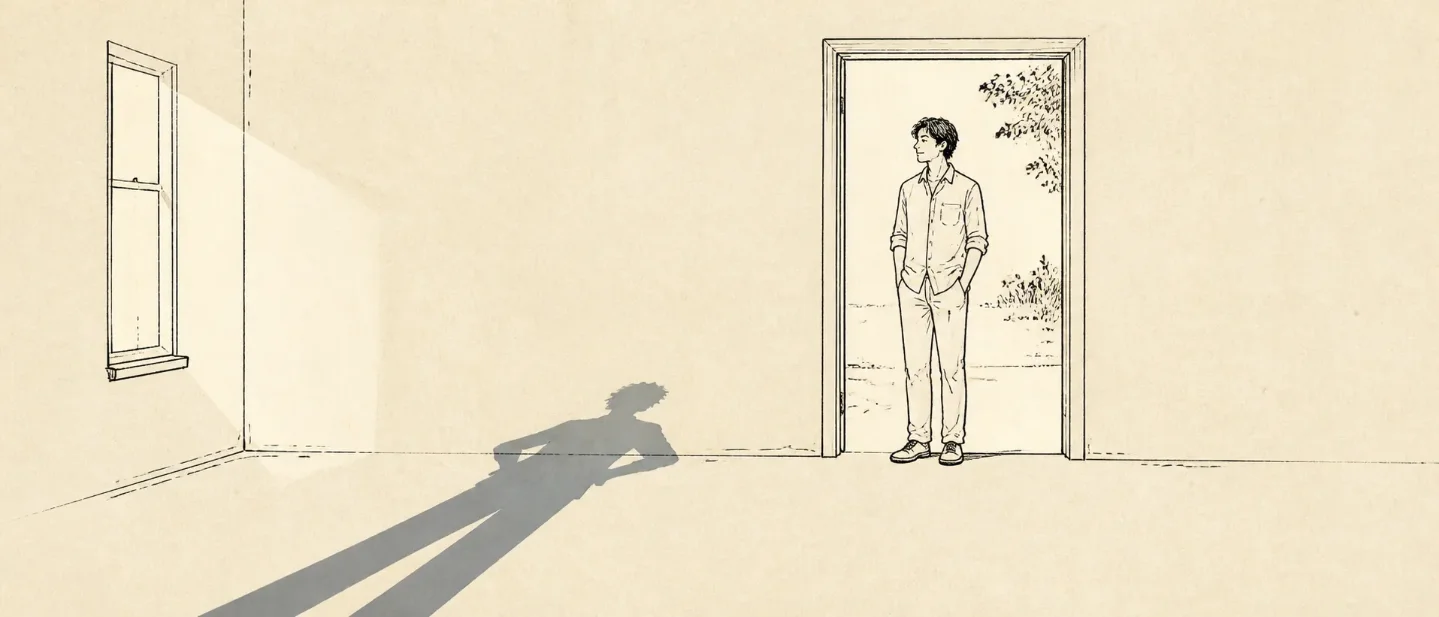
They put you down because your presence makes them feel small
You walk into a room the same way you always do. You greet people. You ask how they are. You keep the edge out of your voice.
Somewhere in that room, someone still stiffens. A joke lands a little sharp. A compliment comes with a twist. A small success of yours gets ignored, or minimized, or turned into a story about how lucky you must be. You go home replaying the exchange, hunting for the moment you must have stepped on something.
Often there was no moment. The problem started earlier than the conversation — in a private comparison you never agreed to join.
When your presence is the offense
People usually reach for the word jealousy here. Psychologists draw a cleaner line. Jealousy is the fear of losing something you already have — a partner's attention, a role, a place in a group. Envy is wanting what someone else has, and feeling the lack of it in yourself.1
The pattern fits envy more closely. Someone looks at a quality you carry — ease in a room, steady work, a relationship that holds, a body of skills, even a calm they cannot find in themselves — and the comparison stings. The sting is the point. Research on social comparison treats upward envy as a common human response to people who seem higher-status or more competent on a dimension that matters to the comparer.2
That pain can arrive without bragging, gloating, or any push from you. Your presence is enough to open the gap. Kindness leaves the gap in place. In some cases kindness makes the gap harder to justify, which can leave the other person more irritable than before.
Two ways envy moves
Envy heads in more than one direction. Work that separates its "two faces" describes benign envy as the version that pushes someone to improve themselves, and malicious envy as the version that aims to pull the other person down.34
Benign envy can look like quiet admiration or a sudden burst of effort. Malicious envy looks like the behavior that confuses you: the put-down, the cold shoulder, the rumor with a missing piece, the joke that is only funny if you shrink a little.
The second path is cheaper. Building a life takes years. Undermining a reputation can take one afternoon. Clinical writing on envy has put that asymmetry plainly: tearing down is easier than building up, and envious attacks make swift work of it.5
If someone's self-worth is already thin, your ease can register as a verdict on them. The put-down is a way to rewrite the verdict. Lower you a notch, and the comparison hurts less — for a moment.
Why "but I was nice" fails to settle it
A common story people tell the target of envy is that they should feel flattered. Another is that they must have done something to provoke it. Both miss the pattern therapists and counselors keep seeing in ordinary life: warm, capable people still get undercut by someone in their circle who cannot stand the contrast.6
Niceness fails as a shield here because the envier is responding to rank, not punishing a specific insult. You can apologize for a tone you never used, soften every edge, and still leave them with the same internal scoreboard.
Sometimes the put-downs escalate after you try harder. You invite them in. You share credit. You ask what is wrong. Each move can read as more proof that you hold the higher ground — socially, emotionally, or both — which is the ground they already resent.
What the put-downs cost you
The damage on your side rarely looks dramatic at first. It looks like a private trial.
You start editing yourself before you speak. You hide good news. You pre-empt praise. You over-explain. You become the person who keeps the peace by becoming smaller in the rooms where you used to stand normally.
Research on being envied finds an ambivalent mix: pride or recognition on one side, and on the other guilt, worry about relationships, and fear of hostility.7 In lab work, people who believed they might be the target of malicious envy were more likely to help, advise, and pick up after others — a kind of automatic appeasement.4
That reflex makes sense as group glue. As a long-term strategy for one relationship, it trains you to pay a tax for existing. The other person rarely becomes less envious because you paid it. They often learn that the put-down works.
How to spot the pattern without diagnosing everyone
Plenty of sharp remarks have other causes: real disagreement, bad days, standards you actually missed. Envy-shaped put-downs tend to cluster around a few tells:
- The jab tracks your good news, ease, or attention more than any concrete mistake.
- Praise and digs arrive in the same breath.
- Your wins get rewritten as luck, politics, or image.
- Warmth from you is met with coolness, then denial that anything is wrong.
- After you succeed, the room's weather changes around one person in particular.
You need no courtroom standard of proof. You need enough signal to stop treating every slight as a mystery about your character.
What helps more than fixing them
Stop the private trial. When the facts of the exchange show no offense, stop searching for the hidden one. The habit of self-interrogation is part of the cost. Name the pattern in plain language to yourself: this may be their comparison, not my crime.
Skip the campaign to convert the envier. Direct confrontation sometimes clears the air. It also sometimes hands them a new story in which you are the aggressor. Befriending harder can do the same.6 A few calm boundaries beat a campaign to make them like the version of you that threatens them.
Guard access more than your personality. You can stay kind without giving unlimited proximity, private detail, or collaborative power to someone who uses closeness to cut. Distance is a tool. So is keeping certain plans, wins, and vulnerabilities for people who can hold them.
Keep a small inner circle that can hold your good news. When success shifts your time and attention, some friendships cool for ordinary reasons. Others cool because your growth rearranges a comparison they preferred. People who can celebrate you without a wince are worth the calendar space those others used to take.8
Refuse the shrink-to-fit bargain. Hiding your work, muting your voice, or dimming your presence to manage someone else's ego teaches everyone in the room — including you — that your size is negotiable. You can be modest without disappearing.
Their feeling stays their assignment
Envy is an old emotion. It shows up across cultures and across a long written history for a reason: humans rank themselves against nearby others, and the ranking can hurt.1 That fact explains the put-down. It leaves you free of the duty to carry it.
You are allowed to notice that someone feels small around you and still decline the job of managing their self-image. You can leave a conversation without winning it. You can keep the parts of yourself that drew the comparison in the first place.
The people who put you down to feel taller are telling you something accurate about their inner arithmetic. They leave the truth of who you are untouched. Your presence remains yours to keep — intact, unedited, and shared with the people who can stand in the room with it.
References
- 1
- 2Envy Up, Scorn Down: How Comparison Divides Us
pmc.ncbi.nlm.nih.gov
- 3Validating the "Two Faces" of Envy
frontiersin.org
- 4Fear of Being Envied Makes People Behave Well Toward Others
psychologicalscience.org
- 5The Antidote to Envy
psychologytoday.com
- 6The Dark Side Of When Someone Is Jealous Of You
psychcentral.com
- 7Being envied in organisations
bps.org.uk
- 8Three Ways to Manage Jealous "Friends"
psychologytoday.com
This story was produced automatically by a channel. One sentence is all it takes for Neodrop to keep producing for you.