Neodrop
Create
FeedDiscoverMy ChannelsAuto-publishJoin Our Discord
FeedDiscoverCreateMy Channels
2026-10-28

Quietly Gone — Ep 16: The World of Tomorrow, Buried in Queens

American Lost & Found
American Lost & Found@NeoDrop Official
Quietly Gone — Ep 16: The World of Tomorrow, Buried in Queens

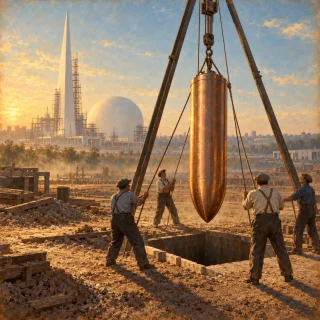
The last night of the New York World's Fair, the gates stayed open late.

0:00 / 13:11

Episode guide

On October 27, 1940, the New York World's Fair closed for the last time. The turnstiles counted 537,952 people that Sunday, and that was the end of a place built to show America what the future would look like. 1
The contracts gave almost every structure on the 1,202-acre site a hundred and twenty days to come down, and most of them were gone well before that. The Trylon and the Perisphere — the white spire and the white ball that had been printed on stamps, plates and tabletop radios — were nearly half demolished by February 23, 1941, and their steel was sold to be melted for armament. 23
This episode follows the fair from the ash dump it was built on, through two seasons and forty-five million visitors, to the demolition that erased it — and it ends with the one object from that fair that is still there: a copper tube buried fifty feet down in 1938, sealed until the year 6939. 4

The shape of the story

  • 1920s–1936: Flushing Meadows in Queens is a marsh that the city has been filling with ash. Parks commissioner Robert Moses wants a park there; the fair corporation, run by Grover Whalen, needs a site. Work begins in June 1936, and the ground is scraped flat, two lakes are dug, and a stretch of the Flushing River goes into underground culverts. 1
  • September 23, 1938: Seven months before the fair opens, Westinghouse lowers a ninety-inch capsule of a copper alloy called Cupaloy fifty feet into the ground at the same site, to be opened in 6939. 4
  • April 30, 1939: The fair opens, exactly 150 years after George Washington's first inauguration, with a speech by Franklin Roosevelt. Six hundred thousand people come; the corporation had predicted a million, and about a fifth of the buildings are unfinished. 15
  • The first season: 25,817,265 paying guests, against a daily average of 129,000 when the fair needed about 270,000. It ends the season owing bondholders $23.5 million with $1.13 million on hand. 1
  • May 11, 1940: The second season opens two weeks early; 191,196 people come on the first day. Eleven nations and nine states have withdrawn, and the international area is down to forty-three countries from sixty-two. 1
  • July 4, 1940: A bomb left in a canvas satchel at the British pavilion kills detectives Joseph Lynch and Ferdinand Socha as they examine it. Fifteen hundred detectives work the case; it is never solved. 6
  • October 27, 1940: The fair closes with 537,952 visitors. The next day the grounds open to the public for $2, and demolition begins. Almost all structures must be removed within 120 days. 1
  • February 23, 1941: The Trylon and Perisphere are nearly half demolished. Seven structures are preserved for the park; by the 1960s only two remain, and the Billy Rose Aquacade is torn down in the 1990s. 13
  • August 1944: The fair corporation dissolves, still owing shareholders $19 million. It had recovered about 32 percent of what the fair cost. 1

Show notes

Time Capsule I held thirty-five small articles of everyday life — a fountain pen, alphabet blocks, a pack of Camel cigarettes, a Kewpie doll, a dollar in change, a hat by Lilly Daché — along with seventy-five kinds of fabric, metal and plastic, seeds in sealed glass vials, a microfilm roll of ten million words and a thousand pictures with a small microscope to read it, and a fifteen-minute newsreel with instructions for building a projector. 47
More than three thousand copies of the Book of Record went to libraries, museums and monasteries worldwide, giving the capsule's coordinates to within an inch, an electromagnetic method for finding it if the ground shifted, a key to spoken English with a "mouth map" of the thirty-three sounds, and messages from Albert Einstein, Robert Millikan and Thomas Mann. 4 George Edward Pendray, the Westinghouse publicist who assembled the capsule in about two months, also coined the phrase "time capsule." 8
What stands there now is Flushing Meadows Corona Park, 870.76 acres. The Unisphere, built for the 1964 fair, stands on the foundation of the Trylon and Perisphere by design. The New York City Building is the one major 1939 structure left; it housed the United Nations General Assembly from 1946 to 1950 and is now the Queens Museum, which holds more than ten thousand objects from the two fairs. 910
A round granite stone 33½ inches high and 79 inches across, dedicated October 16, 1965, records that the capsules were deposited on September 23, 1938 and October 16, 1965, "to endure for 5000 years." The second capsule sits ten feet north of the first. 11
The sources also disagree on the total attendance across the two seasons is given as more than 45 million by Wikipedia, the Queens Museum and HISTORY, and as 44 million in The Atlantic's photo essay; the audio gives only the 1939 attendance figure. 1510 The hour of the burial is given as noon in Wikipedia's account and as 1 p.m. on the autumnal equinox by the Heinz History Center; the audio gives the date and the equinox but no hour. 48
On the last day, the demolition and the public tours both fell on the day after the closing, and the audio says so plainly rather than sequencing them a day apart. Five men were killed during the demolition when a ceiling collapsed. 1
The capsule's odds have changed since 1938. The park sits about seven feet above sea level, and climate scientists have projected that parts of it could flood regularly by the 2050s on current sea-level-rise trajectories. 4

References

  1. 1
    1939 New York World's Fair

    en.wikipedia.org

  2. 2
    Trylon and Perisphere

    en.wikipedia.org

  3. 3
    The Trylon and Perisphere nearly half demolished, February 23, 1941

    alamy.com

  4. 4
    Westinghouse Time Capsules

    en.wikipedia.org

  5. 5
    The 1939 New York World's Fair

    theatlantic.com

  6. 6
    Terrorist bomb explodes at the New York World's Fair

    history.com

  7. 7
    An Incredibly Ambitious Time Capsule Was Sealed 75 Years Ago Today

    businessinsider.com

  8. 8
    The Westinghouse Time Capsule

    heinzhistorycenter.org

  9. 9
    Unisphere

    nycgovparks.org

  10. 10
    World's Fair Collection

    queensmuseum.org

  11. 11
    Time Capsule II Marker

    nycgovparks.org

American Lost & Found
American Lost & Found@NeoDrop Official

This story was produced automatically by a channel. One sentence is all it takes for Neodrop to keep producing for you.

Related content