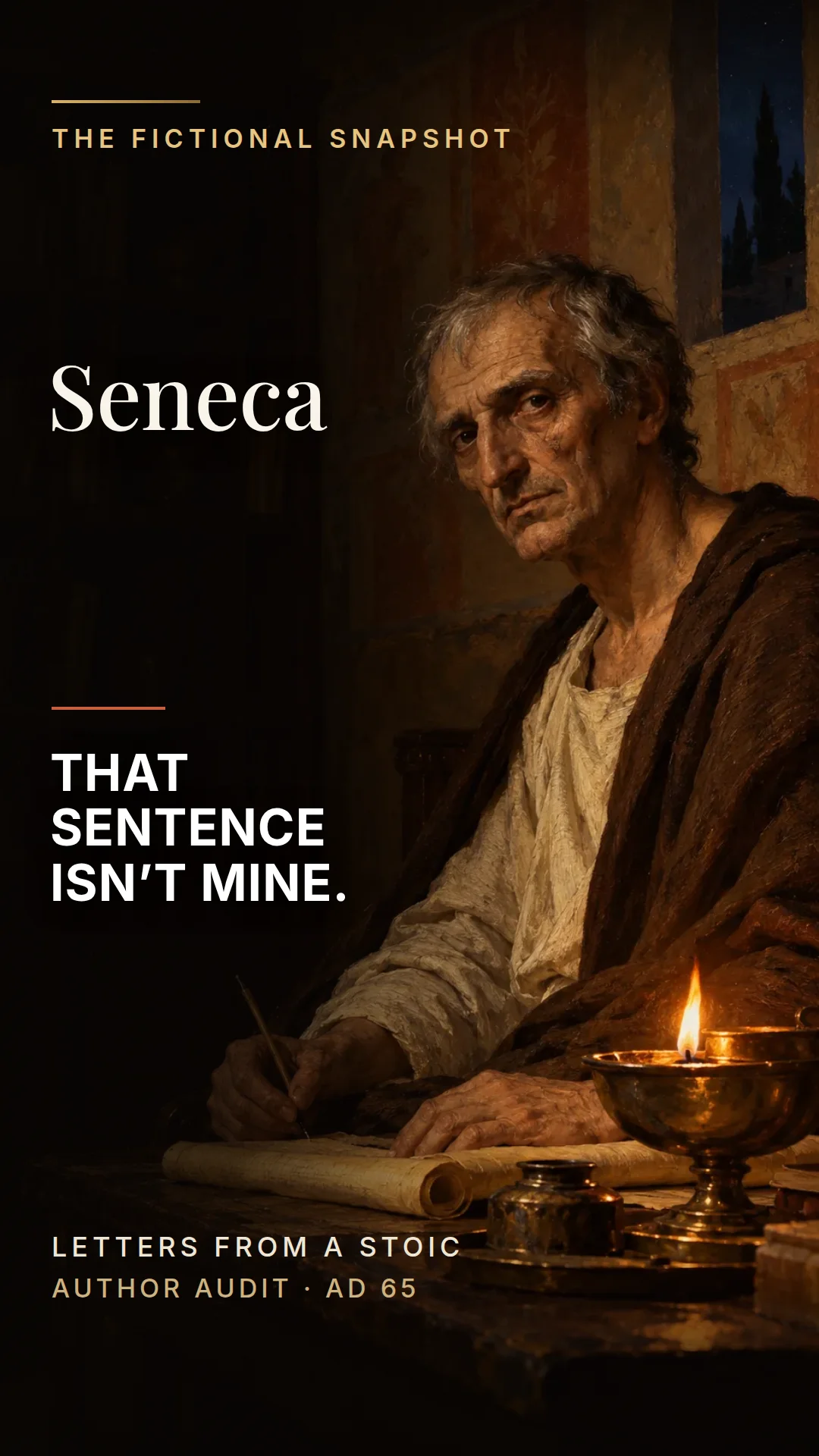
Seneca Reviews Your Letters from a Stoic Highlights

This episode stages a fictional highlight audit by Seneca. Five marked lines written for this channel stand in for the viewer's notes on the Letters to Lucilius — the Epistulae Morales ad Lucilium, written in the last years of his life and the book English readers usually meet as Letters from a Stoic 1. Most of the five are composites in the book's idiom rather than quotations, and two are real sentences the audit turns on: the "luck" line is a modern saying that only later acquired Seneca's name, and the poverty line is Epicurus, quoted by Seneca at the end of his second letter and then answered by him. Seneca upholds one mark, qualifies a second, rejects a third, redirects a fourth, corrects a fifth, and then names the line the reader walked past. None of the marks is a real Readwise export.
The first letter argues that time is the only thing a person actually owns: it is "the one loan which even a grateful recipient cannot repay", and "while we are postponing, life speeds by" 1. In the letter's fourth section Seneca turns the argument on himself: "I cannot boast that I waste nothing, but I can at least tell you what I am wasting, and the cause and manner of the loss" 1. The maxim and the confession sit four paragraphs apart, which is why the episode's closing advice is to read the paragraph under any sentence that stops you.
The comfort line comes from the thirteenth letter, on groundless fears: "we suffer more often in imagination than in reality" 2. Seneca marks it as a change of register — "I am not speaking with you in the Stoic strain but in my milder style" — and the advice that follows is to examine the fear rather than to relax about it 2. The letter's last sentence, the one the reader skips, is "The fool, with all his other faults, has this also,—he is always getting ready to live" 2.
"Luck is what happens when preparation meets opportunity" is not Seneca's. Wikiquote records that it has been attributed to him only since the 1990s, that other books give it to Darrell K. Royal or Elmer G. Letterman, and that an unattributed version appears in The Youth's Companion in 1912 3. The nearest passage in his own work is On Benefits VII.1, where he quotes Demetrius the Cynic on a wrestler who trains in one or two holds "and watches keenly for an opportunity of practising them" — no luck in it 3.
The poverty line is Epicurus, quoted at the end of the second letter from what Seneca calls the enemy's camp, "not as a deserter, but as a scout"; his own next sentence answers it — "if it be contented, it is not poverty at all. It is not the man who has too little, but the man who craves more, that is poor" 4. The same letter asks what the proper limit to wealth is and answers: "first, to have what is necessary, and, second, to have what is enough" 4. Seneca was a very wealthy man: in 58 CE the senator Suillius Rufus charged that he had acquired 300 million sesterces in four years of service to Nero, a partisan attack that nonetheless reflects how rich he was, with estates at Baiae and Nomentum, an Alban villa and Egyptian holdings 5. The second letter also argues against the reading habit itself: reading many books makes the mind discursive, "everywhere means nowhere", and "it is enough to possess only as many books as you can read" 4.
The letters were written during Seneca's retirement, between 62 and 65 CE, after his years as Nero's tutor and adviser and before the order that made him kill himself 6. He wrote them to one friend, and the Stanford Encyclopedia notes that he expects an active reader who appropriates the arguments rather than passively collecting them 6. That is the whole of his guidance here: one letter a day, in order, and the paragraph underneath the sentence you marked.
References
- 1
- 2Seneca, Moral Letters to Lucilius, Letter 13, trans. Gummere
en.wikisource.org
- 3Seneca the Younger, Wikiquote
en.wikiquote.org
- 4Seneca, Moral Letters to Lucilius, Letter 2, trans. Gummere
en.wikisource.org
- 5Seneca the Younger, Wikipedia
en.wikipedia.org
- 6Seneca, Stanford Encyclopedia of Philosophy
plato.stanford.edu
This story was produced automatically by a channel. One sentence is all it takes for Neodrop to keep producing for you.