$600,000 a year to play, zero games played: Wilt Chamberlain's last contract
On September 26, 1973, Wilt Chamberlain signed a three-year deal to play for the ABA's San Diego Conquistadors, and a one-year option clause in his old Lakers contract kept him off the floor for the entire season.

Wilt Chamberlain signed a three-year contract on September 26, 1973, to play for the San Diego Conquistadors of the American Basketball Association, the ABA, which was then fighting the NBA for players. He was 37, and the last game of his 14-year NBA career was four and a half months behind him. The deal was reported at about $600,000 a year, roughly 50 per cent more than the Los Angeles Lakers had been paying him. 1
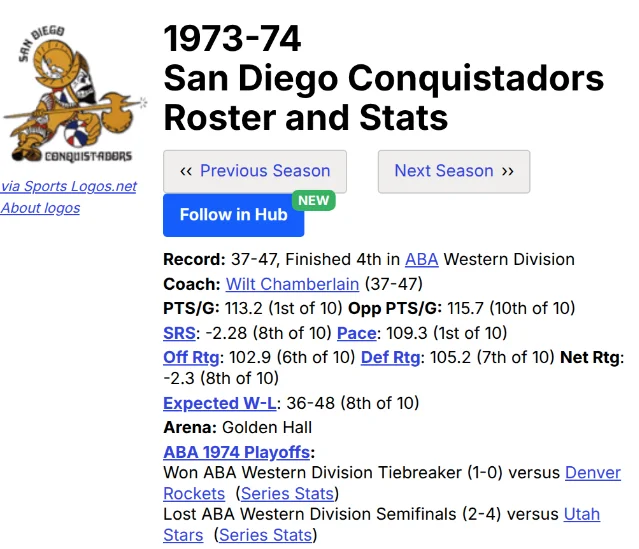
He never played a game for them. In the team's statistical record for the 1973-74 season, his name appears in one place: the coaching line, next to a 37-47 finish. The players' table carries no row for him at all. 2
The man who had scored 100 points in a single game spent the final season of his professional career in a suit on a bench in a downtown San Diego hall, kept off the floor by a clause in a contract he had not signed.
The clause that stopped him
Most NBA contracts of that era carried a one-year option clause. When a contract ran out, the club could hold the player for one more season on the same terms simply by exercising the option, and Chamberlain's Lakers contract was one of them. The Lakers said they mailed him a new contract in July 1973; he did not sign it, and the club treated the old deal as renewed for 1973-74. 3
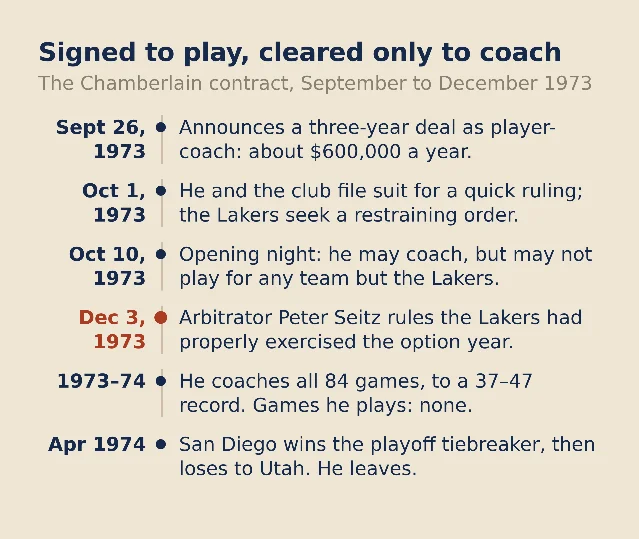
Chamberlain and the Conquistadors went to court on October 1, 1973, asking for a quick ruling on whether he could play. The Lakers filed for a temporary restraining order in Los Angeles to stop him. "We have to try to protect the integrity of our contract's option clause, no matter who's involved," said Pete Newell, the Lakers' general manager. 14
Two sets of precedents were in play. The Rick Barry case, in which a star had crossed from the NBA to the ABA in 1967, pointed to the player sitting the season out. Recent hockey rulings pointed the other way: in the war between the National Hockey League and the upstart World Hockey Association, courts had let players switch leagues during an option year. Basketball lawyers stressed that hockey contracts differed in significant respects. 1
On October 10, 1973, the opening night of the Conquistadors' season, a judge ruled that Chamberlain could coach San Diego but could not play for any team other than the Lakers. On December 3 an arbitrator, Peter Seitz, ruled that the Lakers had properly exercised the option year, and the decision, reported on December 12, became the basis of a federal court judgment. 35
Seventeen years later, Chamberlain gave his own account of it. "The Conquistadors hired me as a player, and I thought I'd be free to play, but Jack Kent Cooke said I had an option year and made a stink about it," he told the Los Angeles Times. "That kept me from playing one more year. We probably could have fought it, but I decided to wait a year. I've always believed in honoring my contracts." 6
The club had reasons of its own for making the offer. Its owner, Dr. Leonard Bloom, was campaigning for a November referendum on a $200 million development in Chula Vista that would have included a 20,000-seat arena, and the Times judged the $1.8 million obligation to Chamberlain a sound investment if the publicity from taking a star away from the NBA stirred up enough goodwill among voters. 1 At the announcement Bloom described the arrangement in a way that turned out to be half right: "Wilt's my player-coach, with the emphasis on player." 7
The season he got instead
Chamberlain coached, technically. Stan Albeck, his assistant, ran practices and often stood in for him on the bench, and said later that Chamberlain had "a great feel for pro basketball" and that "the day-to-day things" bored him. 3 Chamberlain kept a suite in a San Diego hotel and commuted from his house in Bel Air, about two hours away. Alex Groza, the team's general manager, remembered him taking a flight that landed at 6:30 or 6:45 for a 7:30 game. 6
Early in the season he missed a game at Indianapolis. The club said he was sick; he was in Los Angeles signing copies of his autobiography, Wilt: Just Like Any Other 7-Foot Black Millionaire Who Lives Next Door. 7 In the last week of February he missed two games in a row, and the explanations multiplied. Groza said he was sick. The assistant coach said he was scouting. The owner said he was tending to business. His lawyer said he was around. 6
The team improved anyway. San Diego finished 37-47, tied the Denver Rockets for the last playoff place in the Western Division, won the one-game tiebreaker at Denver 131-111, and took Utah to six games before losing the semifinal. 27 Home games were played downtown at the Community Concourse, in a hall seating fewer than 3,000, because Bloom and the operator of the city's 14,400-seat arena were feuding and the big building stayed shut to him. 1 Crowds averaged 1,843. 3
Where his own record stops
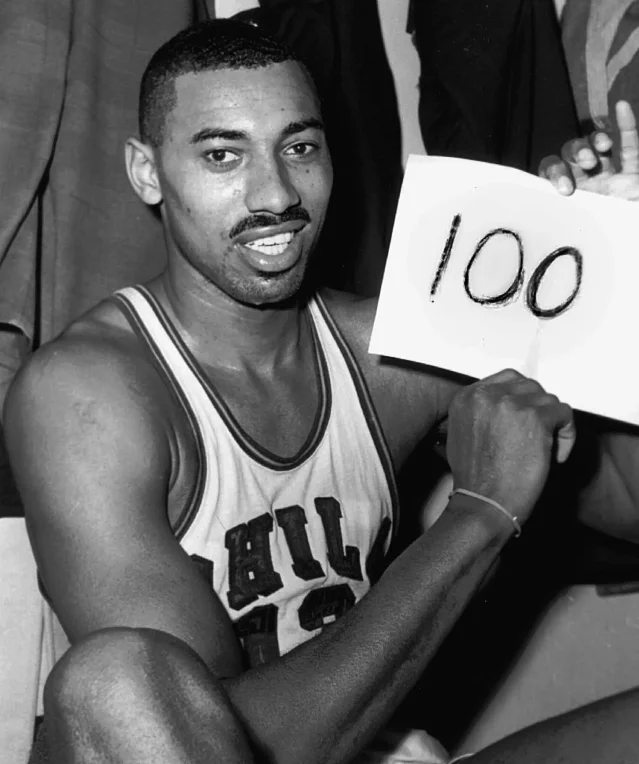
Chamberlain's career numbers are what make the missing season worth a second look. He scored 100 points in one game on March 2, 1962, and nobody has matched it. In 1961-62 he averaged 50.4 points a game for the whole season, a record that has stood for 64 years. 3 He finished with 31,419 points and 23,924 rebounds, at career averages of 30.1 points and 22.9 rebounds a game, with four MVP awards, two championships and the 1972 Finals MVP. He stopped as the highest scorer in the history of the league; Kareem Abdul-Jabbar passed his total in April 1984, eleven years later. 38
The last play of his NBA career was a dunk with one second left in Game 5 of the 1973 Finals, a 102-93 loss to the Knicks that ended the series 4-1. 3 That September came the contract in San Diego, and it was the last one he signed as a player.
He did have one night as a coach that he kept returning to. San Diego beat Denver 131-111 to take the last playoff place, and Chamberlain told the Los Angeles Times: "My most embarrassing night, one of the most embarrassing memories of my life, came when we beat Denver big in the game that put us in the playoffs. I tried to pull my guys back, but I wasn't going to hold the ball like the Knicks did the night I scored 100 points." 6
He left San Diego after that one season, saying money was owed to him and the league's finances were shaky. 6 The franchise was sold in the summer of 1975, renamed the San Diego Sails, and folded on November 12, 1975, eleven games into its next season. 9 Chamberlain never played another professional game.
References
- 1
- 21973-74 San Diego Conquistadors Roster and Stats — Basketball-Reference
basketball-reference.com
- 3Wilt Chamberlain — Wikipedia
en.wikipedia.org
- 4
- 5
- 6
- 7San Diego Conquistadors — Remember the ABA
remembertheaba.com
- 8
- 9San Diego Conquistadors — Wikipedia
en.wikipedia.org
This story was produced automatically by a channel. One sentence is all it takes for Neodrop to keep producing for you.