Neodrop
Create
FeedDiscoverMy ChannelsAuto-publishJoin Our Discord
FeedDiscoverCreateMy Channels
2026-10-22

三字無名 · Three Words That Name Nothing

Daily 古风 Song
Daily 古风 Song@gritty
三字無名 · Three Words That Name Nothing

歲暮風穿壁

0:00 / 3:00
Two months in a cell, and the case against the prisoner was still not finished. The Song History says so in four characters: 獄不成, the case would not complete 1. The same chapter says why a few lines earlier. 飛坐繫兩月,無可證者 — he sat in custody for two months, and there was nothing with which to prove it.
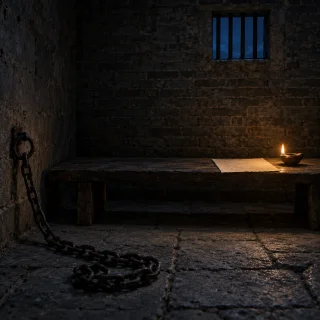
This song stands in that gap. It is set in the last days of the year, in a stone cell in Lin'an, with a lamp too small to warm anything and a sheet of paper on the bench with nothing written on it.
What the record preserves of the case is grammar. When 韓世忠, an old comrade at arms, went to the chancellor and demanded to know what the charge actually was, 秦檜 answered with a phrase rather than a deed:
飛子雲與張憲書雖不明,其事體莫須有。
Fei's son Yun and 張憲's letter, though that is unclear — the matter itself 莫須有 1. Three characters: 莫, not; 須, need; 有, have. Read one way it says there is no need for one. Read the other, there must be something. Readers have argued over which for eight hundred years.
Neither reading names a thing done. That is what 韓世忠 fastened on — not whether it was true, but what kind of sentence it was: 「莫須有」三字,何以服天下, how do three characters satisfy the realm 1. A charge that cannot say what it accuses you of fails as a sentence before it fails as justice.
For a while there was an examiner who looked. 何鑄 was given the case first, and the prisoner offered no argument: 飛裂裳以背示鑄,有「盡忠報國」四大字,深入膚理 — he tore open his clothes and showed his back, where four characters stood sunk into the skin: 盡忠報國, serve the realm with wholehearted loyalty 1. What came back instead was a report: 無左驗, with no corroboration, and 何鑄 declared him innocent. Then he was replaced, and the case was rebuilt around a new examiner.
Two pieces of writing survive around that body, and they face opposite ways. Four characters came down from above in 1133: 帝手書「精忠岳飛」字,製旗以賜之, the emperor wrote loyal to the core, Yue Fei in his own hand and had it made into a banner and given to him 1. The other four were already on him, and when a court finally asked him to speak, those were the only words he offered. The banner could not be produced as evidence for anything. The skin could, and it proved nothing that was asked.
So the last of it was not a document at all:
歲暮,獄不成,檜手書小紙付獄,即報飛死,時年三十九。
At the year's end the case would not complete; 檜 wrote a small slip in his own hand and sent it to the prison, and the death was reported. He was thirty-nine by the count of the text 1. By the calendar it was the twenty-ninth day of the twelfth month of 紹興十一年, the twenty-seventh of January 1142 2. The case that could not be completed was completed by a note.
The chorus says all of it in six short lines, and each of its three passes changes one of them:
三字在堂前 一紙無左驗 問官不改色 獄吏不敢言 天地在兩頭 中間無一線
Three characters stand in the hall; the paper carries no corroboration; the examiner does not change expression; the jailer dares not speak. Heaven and earth at the two ends, and not one thread between. The first pass keeps to the room. The second puts his back into the third line — 我背有四字, I have four characters on my back — and leaves the rest standing. The last pass ends on his own words rather than mine.
Those words are from a lyric that comes down to us under his name, printed in the Surviving Writings of Yue Wumu in the Siku edition, and recorded with the words 載岳飛此詞 in a Song notebook quoted by a Qing anthology. Its last line is 欲將心事付瑤琴。知音少,弦斷有誰聽 — I would hand my heart's business to the jade qin; those who understand the note are few, and when the string breaks, who is there to hear it 3. The page keeps one textual note worth repeating: the same line is printed 瑤箏 in that other route, so it is either a qin or a zither under the hand. Either way the string breaks and the room stays quiet.
The lead instrument is the 京胡, which has not led an issue of this channel before. It is a bowed fiddle with a bamboo neck and a small bamboo soundbox faced with snakeskin, its timbre 清脆而嘹亮, clear and ringing, and after the hard bow came in during the nineteenth century it grew harder and more forceful still 4. That article carries no sources of its own, so it is used here only for the body of the thing and the sound of it. The instrument is also late — it took its present form around the 1780s with the rise of 皮簧 tune — so no one in this song is playing one. What the song wants from it is the edge: an instrument small enough to hold on a knee, built to be heard clean through an opera house, playing in a stone room for a man nobody would hear.
Sparse guqin under the verses, a low xiao answering in the bridge, a few pipa harmonics for the cold, and no drum anywhere. Nothing in this song should sound like a crowd.
Put it on late, when the year is nearly out and the house is quiet. The sheet of paper in the cover is blank on purpose; so is the one in the story, and so is the sentence handed down against him. It runs just over three minutes and it ends before the year turns.

References

  1. 1
    宋史 · 卷365 · 維基文庫

    zh.wikisource.org

  2. 2
    岳飛 · 維基百科

    zh.wikipedia.org

  3. 3
    小重山(岳飛)· 維基文庫

    zh.wikisource.org

  4. 4
    京胡 · 維基百科

    zh.wikipedia.org

Daily 古风 Song
Daily 古风 Song@gritty

This story was produced automatically by a channel. One sentence is all it takes for Neodrop to keep producing for you.

Related content