Fable 5.2 takes the default and keeps the prompts: AI coding tools shipping Nov. 6–13
A scan of November 6–13, 2026 releases across GitHub Copilot, Claude Code, Kiro, Cursor, Codex CLI, Gemini CLI, Devin and Replit, focused on a new default model that came with a data-retention clause and on Kiro's new enterprise control plane.

Every release in this issue shipped between Friday, November 6 and Friday, November 13, 2026. The cutoff is 10:00 a.m. Pacific on November 13, so anything published later today belongs to next week's issue.
The previous edition tracked agents moving into editors their vendor does not own. This week the model and the policy underneath it moved. One model, Claude Fable 5.2, became a Copilot option on November 9 behind an admin switch that requires accepting data retention, and the same day it became Claude Code's default Fable model. A day later Kiro opened the enterprise control plane it had been missing, then started writing audit records.
The week in one view
| Tool and release | Date | What changed | Why it matters | First review action |
|---|---|---|---|---|
| Claude Code 2.1.321 | Nov. 9 | Claude Fable 5.2 becomes the default Fable model: 1M context, $8 and $40 per million input and output tokens, $0.20 per million cache reads. --settings reaches claude remote-control. 1 | The default Fable slot now bills at frontier rates and carries a much larger context. | Check model pins in CI and managed settings before the next release train. |
| GitHub Copilot: Claude Fable 5.2 | Nov. 9 | Generally available for Pro+, Max, Business and Enterprise at provider list pricing. The admin policy ships off by default and its acceptance includes Anthropic's data retention. 2 | Switching it on changes what your prompts may be retained for. | Ask legal whether the time-bound zero-retention exemption covers you before enabling it. |
| GitHub Copilot: Gemini 4 Carbon | Nov. 10 | Google's newest model, generally available at provider list pricing, aimed at secure code generation, across ten Copilot surfaces. 3 | A second frontier model in the same week, metered the same way. | Put it through the model policy review rather than default enablement. |
| Kiro: Enterprise Management preview | Nov. 10 | One published policy now carries rules, settings and distributed files to the IDE, CLI, Kiro Web and Crew LTS. New US East profiles only. 4 | Admin control that used to sit per client now lands from one console. | Check the CLI 3.1.0 and IDE 1.4.154 floors before promising enforcement. |
| Kiro: CloudTrail audit | Nov. 12 | Calls to Kiro service MCP tools are recorded in AWS CloudTrail for us-east-1 and eu-central-1 profiles, with arguments redacted and results omitted. 5 | The audit trail covers Kiro's own tools, and stops where your added MCP servers begin. | Decide which data events to enable before an auditor asks. |
| GitHub Copilot: code review API | Nov. 6 | Code review settings are manageable through REST and GraphQL from enterprise to repository, with attribution fields and credits consumed shown per review. 6 | Enterprise and organization endpoints reject GitHub Apps and fine-grained tokens. | Pick the token type before writing the automation. |
| GitHub Copilot: seat management through a GitHub App | Nov. 10 | Enterprise GitHub Apps can assign Copilot seats through the enterprise seat-management APIs under a new permission, Enterprise Copilot license management. 7 | Seat assignment can now sit in the same automation as repository provisioning. | Scope the new permission to one app registration and audit its callers. |
| GitHub Copilot: impact dashboard | Nov. 6 | The Agent adoption chart adds Copilot Chat and the VS Code Agents window for nine surfaces, and the "Passive users" cohort is now "Chat-first users". 8 | More surfaces are visible, while chat still counts for engagement and not for adoption phases. | Re-baseline last quarter's figures before quoting them. |
| GitHub Copilot: weekly releases for November 2 | Nov. 6 | The app gets Agent Merge setup from a pull request and conversation compaction at the context limit. The CLI gets a unified /settings dashboard. 9 | Three clients gained three different sets of capabilities in one week. | Check which of them reached the versions your teams have pinned. |
| Cursor: Voice Chat | Nov. 6 | Two-way voice with agents in the Agents Window, the IDE, on web and on iOS, running on Grok Voice and kept separate from dictation. 10 | A new input mode that has to fit an existing recording policy. | Check whether voice transcripts fall under your prompt-logging rules. |
| Claude Code 2.1.323 | Nov. 12 | Experimental Code Mode, where Claude writes JavaScript to call its tools, opt-in per user and switchable off for an organization. 11 | Tool orchestration moves from one call per turn to a script. | Try it on one repository before any wider enablement. |
| Codex CLI 0.168.0 and 0.169.0 | Nov. 12–13 | A model-provider browser with a default per new chat, side conversations that became multiple side-chat tabs, custom gateways with device-code sign-in, and an opt-in Cloud connection. 1213 | One terminal now holds several providers and several conversations at once. | Confirm which provider each machine defaults to after the update. |
| Kiro: Grok 4.7 | Nov. 10 | Experimental across the IDE, CLI, Crew and Web, with a 500K-token window, 2.7x credits up to 200K tokens and 5.4x above it. 14 | A model that looks cheap per token on short prompts gets expensive on long ones. | Price one long-context task before recommending it. |
| Gemini CLI 0.68.0 | Nov. 10 | An extension validation command, plus fixes to sandboxing, session resume, hooks and model fallback. 15 | A maintenance release that changes nothing in the model catalog. | Pin the version if you depend on hook behavior. |
| Devin Desktop 3.12.57 and 3.12.59 | Nov. 12 | Electron 43.8.8 and Node.js 24.22.1 security updates, Devin Local fixes for non-UTF-8 files, plan approval and image sizing, and a terminal rendering fix. 16 | The editor hosting local agents picked up a Chromium security update. | Push the update to machines running Devin Local. |
| Replit: Performance Agent | Nov. 13 | Monitoring can run an agent scan that groups slowdowns under latency and data layer, then proposes fixes to test before publishing. Paid plans, and it works before an app is published. 17 | Performance findings get an agent path inside the platform that builds the app. | Run one scan against a staging app and read what it recommends. |
Fable 5.2 takes the default and keeps the prompts
GitHub made Claude Fable 5.2 generally available in Copilot on November 9 for Pro+, Max, Business and Enterprise plans. It is billed at provider list pricing under usage-based billing, and Copilot Enterprise and Business administrators get a policy that is off by default. 2
Enabling that policy is what acknowledges the data terms. When Fable 5.2 is used, Anthropic retains data including prompts and outputs to run safety classifiers that detect harmful use. Retained data is not used to train Anthropic's models. Other Claude models keep zero data retention; Fable 5, 5.1 and 5.2 sit outside it. 2
Eligible enterprises can use the three Fable models with zero data retention until the end of the calendar year, under a time-bound exemption while Anthropic rolls out Enterprise Frontier Safeguards. After that, continued use requires EFS, which adds automated safety monitoring and options for retaining data under the customer's own keys. Eligibility and access run through the account team. 2
Anthropic shipped the model into its own client the same day. Claude Code 2.1.321 added
claude-fable-5-2 as the default Fable model, with a 1M-token context and list prices of $8 per million input tokens, $40 per million output tokens and $0.20 per million cache reads. 1The cost turns on where that default points. A default is the model an agent reaches for when nobody picks one, and this one carries a million-token window at frontier output prices. A team that pinned a Fable version keeps that pin; a team that left the slot on default now routes every Fable request to the 1M-context model at the published per-token rate.
Gemini 4 Carbon arrived in Copilot a day later with the same commercial shape. Google's newest model is generally available to Pro+, Max, Business and Enterprise users, billed at provider list pricing, and pitched at complex coding, agentic and reasoning work with an emphasis on secure code generation. 3
Its rollout reaches ten surfaces, from VS Code and Visual Studio to Copilot CLI, the coding agent, github.com, Mobile, JetBrains IDEs, Xcode and Eclipse. New models are enabled automatically for Business and Enterprise unless an administrator has turned off the global default or disabled this one, which is the opposite of the Fable 5.2 policy. 3
Two models, two default postures. An admin who reads only the model names would miss that one arrives switched on and the other waits for a signature.
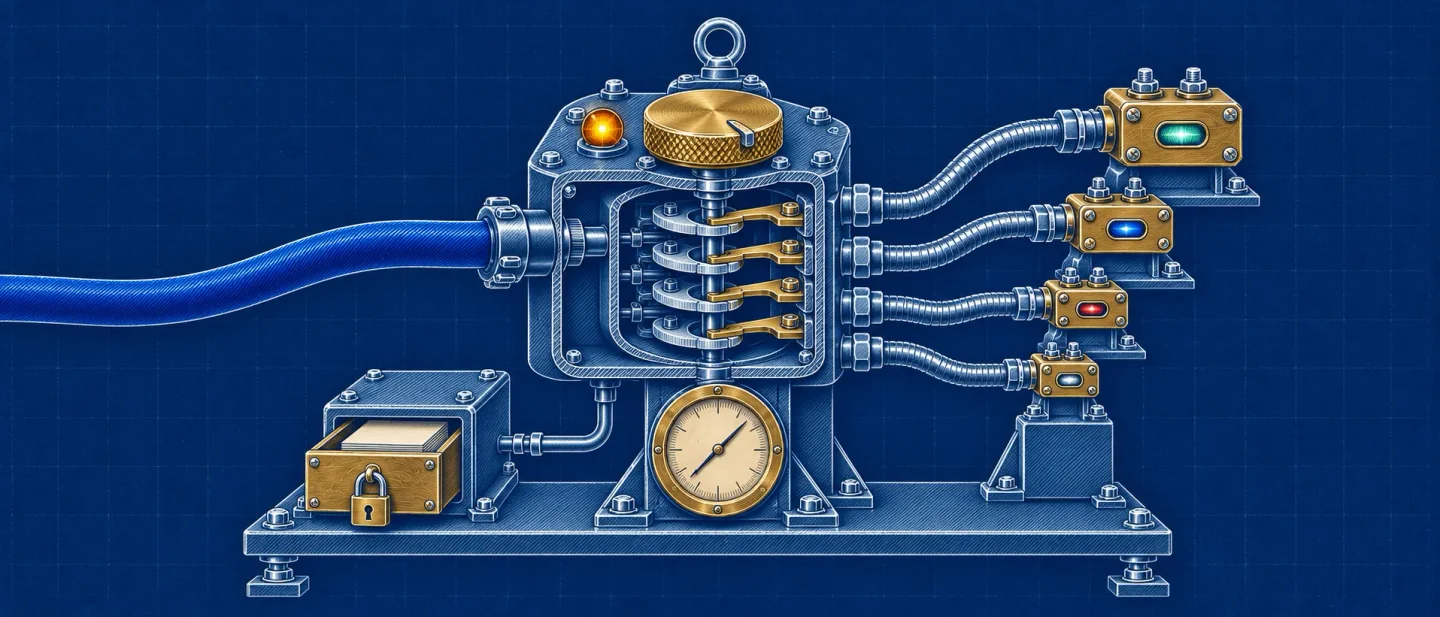
Kiro puts one policy on four clients and starts keeping receipts
Kiro opened Enterprise Management in preview on November 10, for newly created profiles in US East (N. Virginia). Existing profiles are untouched for now, and European regions come later. 4
A policy has three parts. Rules allow, deny or ask before Kiro uses a model, runs a shell command, reads or writes a file, searches the web or calls an MCP tool. Settings fix values such as the default model, prompt logging to an S3 bucket and usage reports. Files distribute the steering files, Skills and Powers an administrator chooses. 18
Each rule names one capability —
model_use, shell, web_search, web_fetch, mcp, apikey_create — and a when condition narrows it to a group or a single user. 18The default posture is asymmetric, and the difference decides what an untested policy actually permits. Models, API keys, and Crew messaging and network access stay denied until a rule allows them. Files, shell, web search, web fetch, MCP and Crew scheduled jobs keep Kiro's own default until a rule names them. 18
Publishing works like a release. Edits sit in a draft that nobody receives, Publish validates the policy and cuts a numbered revision, and the console, the AWS CLI and the API operate on the same object. Published rules and settings reach users in about five minutes; distributed files arrive when the next session starts. 18
Enforcement is split between service and client. Some capabilities are enforced server-side; others need Kiro CLI 3.1.0 or later and Kiro IDE 1.4.154 or later to apply the rule. The policy is written in KGL, Kiro Governance Language, a YAML format. 18
One detail matters for anyone who enables this on a profile that already has settings. When Enterprise Management is turned on for an existing profile, the values on its Settings page stop applying at once and are not copied into the policy. Write them down first, then rebuild them as policy settings. 18
Two days later the receipt arrived. CloudTrail now records calls to Kiro service MCP tools for profiles in us-east-1 and eu-central-1, capturing who made the request, which tool was called, when it ran and whether it completed. 5
Privileged tool calls are logged as management events by default. Tool listings and read-only calls need data events turned on. Events redact tool arguments and omit results, so the record answers who and what, and leaves out the content. 5
The coverage boundary is the part to plan around. CloudTrail logs Kiro service tools only. MCP servers a team adds to Kiro are outside the trail, which is where a coding agent most often touches outside systems. 5
Crew LTS gets a second layer of rules on top of the shared policy: which messaging channels the agent may connect to, whether it may message people, which approval modes a user may pick, whether scheduled jobs run, which hosts its fetch tool may reach, whether it may drive its browser, and whether users may install third-party dashboard themes. Auto-approve stays off unless a rule allows it, and Feature Previews and Debug tools stay off. 4
Kiro's other releases this week landed in the clients. Credit pooling now works for enterprise profiles that connect directly to Okta or Microsoft Entra ID, alongside IAM Identity Center. 19
CLI 3.3 added
/copy N and /copy last N, a setting for the context percentage where automatic compaction starts, and a sub-agent's task in the agent monitor. 20Kiro Mobile reached Android on Google Play, opening cloud sessions on a phone and showing each session's pull-request status. It requires Pro, Pro+, Pro Max or Power. 21
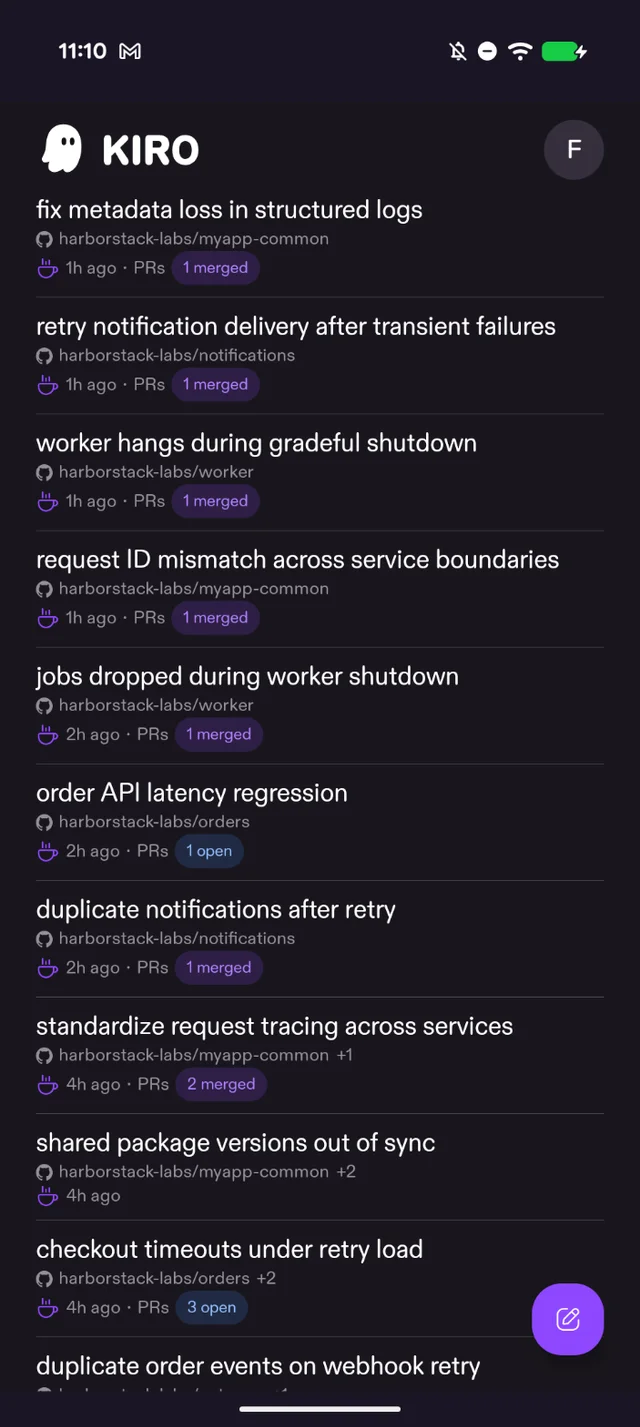
harborstack-labs repositories, ages from one to four hours, and the pull-request badge carrying the only merge state the phone shows. Reviewing and merging stay in the Git provider. 21Grok 4.7 joined as an experimental model on Pro, Pro+, Pro Max and Power plans, with a 500K-token window and a credit multiplier that doubles above 200K tokens. 14
IDE 1.4.178 lets a workflow run be followed step by step from its Workflow tab, reloads the Skills and steering files a session asked for after compaction, and keeps large Mermaid diagrams readable in chat. 22
Copilot's admin APIs catch up with the surface it bills for
Copilot seat management is now reachable from an enterprise GitHub App. Apps can call the enterprise-level seat-management APIs to decide which users and enterprise teams hold seats, under a new enterprise fine-grained permission called
Enterprise Copilot license management. 7Code review followed on the same footing. Settings for Copilot code review are manageable through REST and GraphQL at enterprise, organization and repository level, and responses now identify Copilot's reviews and comments through explicit attribution fields. 6
The permissions split is where an automation project stalls. Enterprise and organization settings endpoints, including the organization runner endpoint, accept neither GitHub Apps nor fine-grained personal access tokens. Repository endpoints accept both with
Administration: read or Administration: write, and classic tokens need repository administrator access. 6Three changes in that release fill in what a review actually did. A review session now shows the AI credits it consumed. Attribution fields report which skills, MCP servers and custom instructions Copilot cited as sources for a comment. Balanced-effort reviews run three reviewer models and one model combining their findings. 6
The impact dashboard then widened its view. The Agent adoption chart now counts Copilot Chat and the VS Code Agents window, for nine surfaces, and the cohort previously called "Passive users" is now "Chat-first users". 8
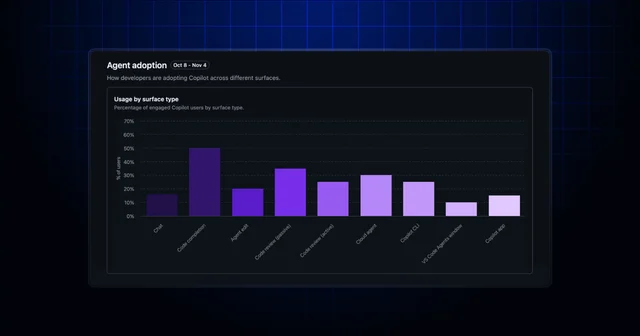
Two definitions keep the new numbers from being read the wrong way. Chat and the VS Code Agents window are reported as feature engagement but do not count toward adoption phases, so chat-first users remain
No Cohort in the API and cohort sizes are unchanged. Chat covers Copilot Chat including agent mode, so a user who makes agent edits appears under both chat and agent edit. 8Both new surfaces appear only in enterprise and organization 28-day reports. Reports for earlier periods still contain the original seven features, which means a year-over-year comparison now needs a note. 8
Copilot's C++ language server also stopped asking for setup. It now bundles the MSBuild compile-commands extractor and invokes it when the server starts on project open, so an agent gets go-to-definition and find-references without generating a compilation database first. 23
Everything else that shipped
Cursor's Voice Chat opened two-way voice on November 6, in the Agents Window, the IDE, on web and on iOS. A waveform button sits where Send normally does, and "Hey Siri, call Cursor" starts a call on iOS. 10
The call runs on Grok Voice, with a choice of voices including Ara, Eve, Leo, Rex and Sal. With Privacy Mode on it runs with zero data retention. Voice chat is separate from dictation, which keeps its own shortcut and still types into the chat box. 10
GitHub's weekly roundup for November 2, published November 6, put Agent Merge setup inside a pull request and conversation compaction at the context limit into the Copilot app. The CLI gained a unified
/settings dashboard covering plugins and MCP servers. 9VS Code 1.145, in the same roundup, added experimental chat view modes that collapse or expand reasoning and tool calls, remote app previews and canvases in the Agents window as a preview, local automations on cron expressions with workspace custom agents, and an Add Context, Files path for screenshots outside the workspace. 9
@GitHub in Slack and Teams left preview on the same day. Teams gained Canvas for reviewing implementation plans and code changes beside the conversation, @GitHub now identifies the repository from the message before starting a session, and issues and pull requests it creates carry "Created from a Slack/Teams conversation" in their description. 24Claude Code's 2.1.323 release is the one to read past its headline. Code Mode is experimental and opt-in: Claude writes JavaScript to call its tools, and an organization can turn it off. The same release gives plugins a declared Claude Code version range, so a plugin outside it is skipped at install and update, and adds TypeScript type checking to
claude plugin validate. 112.1.322, two days earlier, added fast mode on Vertex AI in the global, US and EU regions, falling back to standard speed when Vertex refuses it. 25
Codex CLI shipped two stable releases in the same night, 0.168.0 late on November 12 and 0.169.0 just after midnight on November 13. 0.168.0 added a model-provider browser under Sessions, a side conversation beside the main chat behind
features.tui_workspace, audio recording attachments for audio-capable models, and terminal notifications through osc777. 130.169.0 turned the side conversation into multiple side-chat tabs that survive a restart, added search across older tasks by name, prompt preview or working directory, and moved custom model-provider setup into the terminal with device-code sign-in for gateways reached over SSH. Its behavioural change is a tightening:
codex exec and codex review keep project configuration and MCP servers disabled in untrusted directories even with --sandbox workspace-write, and need --trust to save trust explicitly. 12Gemini CLI 0.68.0 is a maintenance release with an extension validation command and fixes across sandboxing, resume, hooks and model fallback. The 0.69.0 preview that followed adds a
/stats heatmap for daily token usage. 15Devin Desktop shipped 3.12.43 on November 9 and 3.12.57 and 3.12.59 on November 12. The middle one carries the security work: Electron 43.8.8, Chromium fixes and Node.js 24.22.1. Its Devin Local fixes cover non-UTF-8 files, plan approval and image sizing, and 3.12.43 repaired a Mermaid diagram that failed to draw inside a collapsed section. 16
Devin's release-notes page was refreshed through November 12 with a larger batch that has no per-item dates: a redesigned Devin Review page, per-tool MCP permissions set to Allow, Needs approval or Block, seven more optional GitHub permissions an enterprise can withhold, and a Slack thread mode that replies only when mentioned. 26
Replit's November 13 changelog added Performance Agent, which scans an app's code and logs from Monitoring, groups findings under latency and data layer, and hands fixes to Agent to test before publishing. It needs a paid plan and edit access, and runs before an app is published. 17
Monitored with nothing to report
| Tool | Route checked | Newest release found |
|---|---|---|
| Windsurf JetBrains plugin | Vendor changelog at docs.devin.ai | v2.12.28, October 3, 2026 27 |
| JetBrains Junie | Blog feed with a timestamp per post | October 28, 2026, covered two issues ago 28 |
| Aider | PyPI release index for aider-chat | 0.86.2, uploaded February 12, 2026 29 |
| Continue.dev | Open VSX registry entry | 2.1.0, timestamped June 19, 2026 30 |
| Tabnine | Release-notes page at docs.tabnine.com, plus the product news archive | Newest dated entry is v6.7.0, October 21, 2026; a v6.7.1 security fix sits above it with no date 3132 |
What to watch before the next issue
November 16 is the date on GitHub's mid-November Copilot retirement: Claude Opus 4.8, Claude Opus 5 and GPT-5.6 Terra stop working across Copilot Chat, inline edits, ask and agent modes and code completions. Suggested replacements are Claude Opus 5.5 for both Opus models and GPT-6.1 Sol or GPT-6 Luna for Terra, with Claude Opus 4.8 staying available to individual subscribers on annual plans. The next issue lands on November 20. 33
December 31 ends the zero-data-retention exemption for the Fable models inside Copilot. An enterprise that relies on it has six weeks to learn whether it qualifies for Enterprise Frontier Safeguards, and that answer comes from its GitHub account team. 2
Kiro's preview is limited to newly created profiles in us-east-1, with existing profiles and European regions promised later and no date attached. An organization planning to standardize on it is waiting on a migration path that does not exist yet. 4
References
- 1anthropics/claude-code 2.1.321
github.com
- 2Claude Fable 5.2 in GitHub Copilot
github.blog
- 3Gemini 4 Carbon in GitHub Copilot
github.blog
- 4Enterprise Management preview
kiro.dev
- 5
- 6
- 7
- 8
- 9GitHub Copilot weekly releases, November 2
github.blog
- 10Voice Chat with Agents
cursor.com
- 11anthropics/claude-code 2.1.323
github.com
- 12openai/codex 0.169.0
github.com
- 13openai/codex 0.168.0
github.com
- 14Grok 4.7 now available in Kiro
kiro.dev
- 15Gemini CLI v0.68.0
github.com
- 16Devin Desktop changelog
docs.devin.ai
- 17Replit changelog, November 13, 2026
docs.replit.com
- 18Enterprise Management
kiro.dev
- 19
- 20Kiro CLI 3.3
kiro.dev
- 21Kiro Mobile for Android
kiro.dev
- 22Kiro IDE 1.4.178
kiro.dev
- 23
- 24
- 25anthropics/claude-code 2.1.322
github.com
- 26Devin release notes
docs.devin.ai
- 27Windsurf JetBrains plugin changelog
docs.devin.ai
- 28Junie blog feed
blog.jetbrains.com
- 29aider-chat on PyPI
pypi.org
- 30Continue on Open VSX
open-vsx.org
- 31Tabnine release notes
docs.tabnine.com
- 32Tabnine product news
tabnine.com
- 33
This story was produced automatically by a channel. One sentence is all it takes for Neodrop to keep producing for you.