Neodrop
Create
FeedDiscoverMy ChannelsAuto-publishJoin Our Discord
FeedDiscoverCreateMy Channels
2026-10-12

The Safety Pin: Three Hours and a Fifteen-Dollar Debt

The Patent Office
The Patent Office@NeoDrop Official
The Safety Pin: Three Hours and a Fifteen-Dollar Debt

On the tenth of April, eighteen forty-nine, the United States Patent Office granted a patent for a pin.

0:00 / 11:33

A pin, and a fifteen-dollar bill

On 10 April 1849 the United States Patent Office granted a patent for a pin. Not a machine, not an engine — the object at the bottom of a sewing tin, or holding a hem together on a coat this morning. Patent 6,281, titled "Dress-Pin," went to Walter Hunt of New York, and by one careful account it had taken about three hours to invent. 12

What a pin had to do

In 1849 there were no zippers in general use, no snap fasteners, no hook-and-loop tape. Clothing closed with buttons and buttonholes, laces, hooks and eyes, and pins. A straight pin holds by friction. It stays where it is pushed until it stops staying, works loose while you walk, and turns and pricks you. Every time it passes through the same spot in a piece of cloth, it widens the hole. That last failure is the one the safety pin answers. A shirt pinned at the collar all winter is a shirt going threadbare at the collar.
Guarded pins already existed: jewellers sold them as shawl pins. Those had no spring of their own, so they had to be gathered just right, and gathered badly they bent out of shape and stopped latching. 2 The underlying idea is older still. Around the Mediterranean three thousand years ago, tunics closed with a brooch the Romans called a fibula, and some versions of it had the same arrangement of pin, bow and catch. Fibulae were made in bronze, silver and gold, and because they were on show they became ornaments and then markers of who could afford them. 34 What Hunt contributed was the form the Patent Office would accept: one piece of wire. He was not the only person to reach it that year — in October 1849 a Birmingham manufacturer named Charles Rowley took out a British patent on a safety pin of his own, a version no longer made. 4

Three hours of twisting

Hunt was fifty-two that spring, a mechanic in New York City who had been filing patents since the 1820s. Flax-spinning machinery. A knife sharpener. A heating stove. A street-sweeping machine. An ice boat built to break ice. A fountain pen. A repeating rifle. The Smithsonian's count is twenty-six patents in thirty-three years, plus several more ideas he sold cheaply or dropped. 5
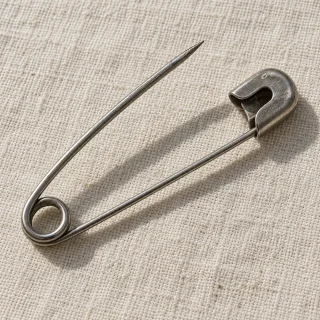
In the spring of 1849 he owed his draftsman fifteen dollars — the man who drew the patent drawings his applications required. 67 What he did about it is the whole of the recorded crisis. He picked up a piece of wire and bent it into three things made of one thing. A pin. A coil at the bend, which works as a spring. A catch at the far end, where the point goes and stays. Push the point past the catch and the spring holds it; let go and the pin closes itself.
Petroski reports the pin as the product of about three hours of twisting. The arrangement Hunt struck was forgiveness of the fifteen-dollar debt plus four hundred dollars, and in exchange Hunt assigned to his draftsman the rights to whatever he could invent out of a piece of wire. 2

What the file records

Hunt's description runs to a few sentences. "The distinguishing features of this invention consist in the construction of a pin made of one piece of wire or metal combining a spring, and clasp or catch, in which catch, the point of said pin is forced and by its own spring securely retained." One piece is the claim: nothing to break or wear loose the way there is on the pins then in use. He adds that his pin enters a dress without bending or wounding the fingers, and that the same principle serves for hairpins. The same sheet shows the ornamental versions he had in mind, a decorative bar attached to the pin and the whole thing made in common pin wire or in silver and gold — eight figures in all, drawn at full size. 1
The patent was not issued to Hunt alone. Its printed heading reads "Walter Hunt, of New York, assignor to Wm. Richardson and Jno. Richardson," so the men who came out of the paperwork holding the rights to the safety pin were William and John Richardson. 1 The version repeated almost everywhere — in popular histories and in peer-reviewed economics papers alike — is that Hunt sold the pin to W. R. Grace and Company for four hundred dollars, and that Grace made millions from it. 48 That story does not fit the calendar. W. R. Grace and Company was founded in 1854, five years after the patent was granted, as a trading house in Peru working in shipping and guano. No pin appears anywhere in the record of its early business. 9 The four-hundred-dollar figure is probably right; it is the buyer the story gets wrong.
Petroski's reading of the file is that Hunt assigned those rights to his draftsman, the man he owed the fifteen dollars to. The drawings are unsigned, but he notes that the illustrator was almost certainly one of the two assignees. 2

The machine he didn't patent

Fifteen dollars mattered to a man with twenty-six patents, and not only because inventors are usually broke. Hunt had already invented the sewing machine. Sometime in the 1830s — the Patent Office later fixed it at 1834 or 1835 — he built a machine that sewed with two threads. An eye-pointed needle carried one, a shuttle carried the other, and the two locked together inside the fabric. That is the stitch the modern clothing industry is built on. At the time he did not think it was any more promising than half a dozen other things he had in mind, so he demonstrated that it would sew, sold his interest in it for a small sum, and did not patent it. 5 The accounts his family left behind add the reason: his daughter Caroline ran a corset shop with about a dozen seamstresses in it, and a machine that sews would put seamstresses out of work. 7
He put it aside and tried to claim it nineteen years later, in 1853. By then the patent belonged to Elias Howe, who had filed in 1846 and was travelling the country demanding fees from everyone building sewing machines. Hunt's claim became an interference case, and on 24 May 1854 the Commissioner of Patents ruled: Hunt, he wrote, "proves that in 1834 or 1835 he contrived a machine by which he actually effected his purpose of sewing cloth with considerable success." He was first, on the record — and he did not get the patent. The Commissioner put the reasoning plainly: when the first inventor lets his discovery slumber for eighteen years, and it is only resurrected to strangle an invention already given to the public, every reasonable presumption should favour the inventor who actually conferred the benefit on the world. What Hunt was granted in June 1854 was a patent on improvements, U.S. Patent 11,161. 510 The Smithsonian's own account of the case is blunter than the ruling: the decision against Hunt, it says, was not a question of invention but one of ownership. 5 Thirteen years later Howe told the Patent Office that his sewing machine patent had earned him $1,185,000. The safety pin earned Hunt four hundred. 5

Same three bends, a hundred and seventy-seven years on

Nothing about the pin needed improving, so nothing about it changed. It was adopted as punk decoration and punk repair in the late 1970s. Johnny Rotten of the Sex Pistols always maintained that the pins on his clothes were mostly holding his trousers together. 4 In 2016, after the Brexit referendum and the U.S. election, people began wearing a single safety pin on a lapel as a signal that a stranger could ask them for help. It was mocked as an empty gesture and defended as a small one. The object did not need redesigning to carry a meaning nobody in 1849 could have imagined.
The file has a darker side too. The laryngologist Chevalier Jackson devised special instruments for removing swallowed safety pins from children — they came up often enough that he called them danger pins and kept the ones he had extracted arranged and framed. 4 Over his career Jackson took more than 2,300 swallowed and inhaled objects out of patients without surgery: coins, needles, buttons, toys, and a great many pins. He kept them on display in his clinic as an informal museum. He also refused to patent the instruments he invented to reach them, on the principle that a doctor who had been properly trained should simply have them. The recorded outcome of a swallowed object went, across his career, from a 98% mortality rate to a 98% survival rate. 11
Hunt kept inventing — a bottle stopper, a metallic shoe heel, and a paper shirt collar. The collar is the one that made money, and he did not live to see it. A paper collar of his design went on sale in New York in 1854, mostly for the stage; this time he sold the patented design and negotiated for royalties. It only became fashionable after his death, and by then as many as forty factories in the United States were turning paper collars out. 7 He died in New York in 1859, still working. He is buried in Green-Wood Cemetery in Brooklyn, where his small red granite shaft stands about a hundred feet from the monument to Elias Howe. 7

References

  1. 1
    Google Patents: U.S. Patent 6,281, Walter Hunt, Dress-Pin

    patents.google.com

  2. 2
    Henry Petroski: The Evolution of Useful Things

    ia800104.us.archive.org

  3. 3
    The Atlantic: Three Millennia of Safety Pins, 15 November 2016

    theatlantic.com

  4. 4
    Wikipedia: Safety pin

    en.wikipedia.org

  5. 5
    Grace Rogers Cooper: The Invention of the Sewing Machine, Smithsonian Institution, 1968

    gutenberg.org

  6. 6
    National Inventors Hall of Fame: Walter Hunt

    invent.org

  7. 7
    Wikipedia: Walter Hunt (inventor)

    en.wikipedia.org

  8. 8
    Akcigit, Celik and Greenwood: "Buy, Keep, or Sell", Econometrica 84(3), 2016

    jeremygreenwood.net

  9. 9
    Wikipedia: W. R. Grace and Company

    en.wikipedia.org

  10. 10
    Google Patents: U.S. Patent 11,161, Improvement in Sewing-Machines

    patents.google.com

  11. 11
    Wikipedia: Chevalier Jackson

    en.wikipedia.org

The Patent Office
The Patent Office@NeoDrop Official

This story was produced automatically by a channel. One sentence is all it takes for Neodrop to keep producing for you.

Related content