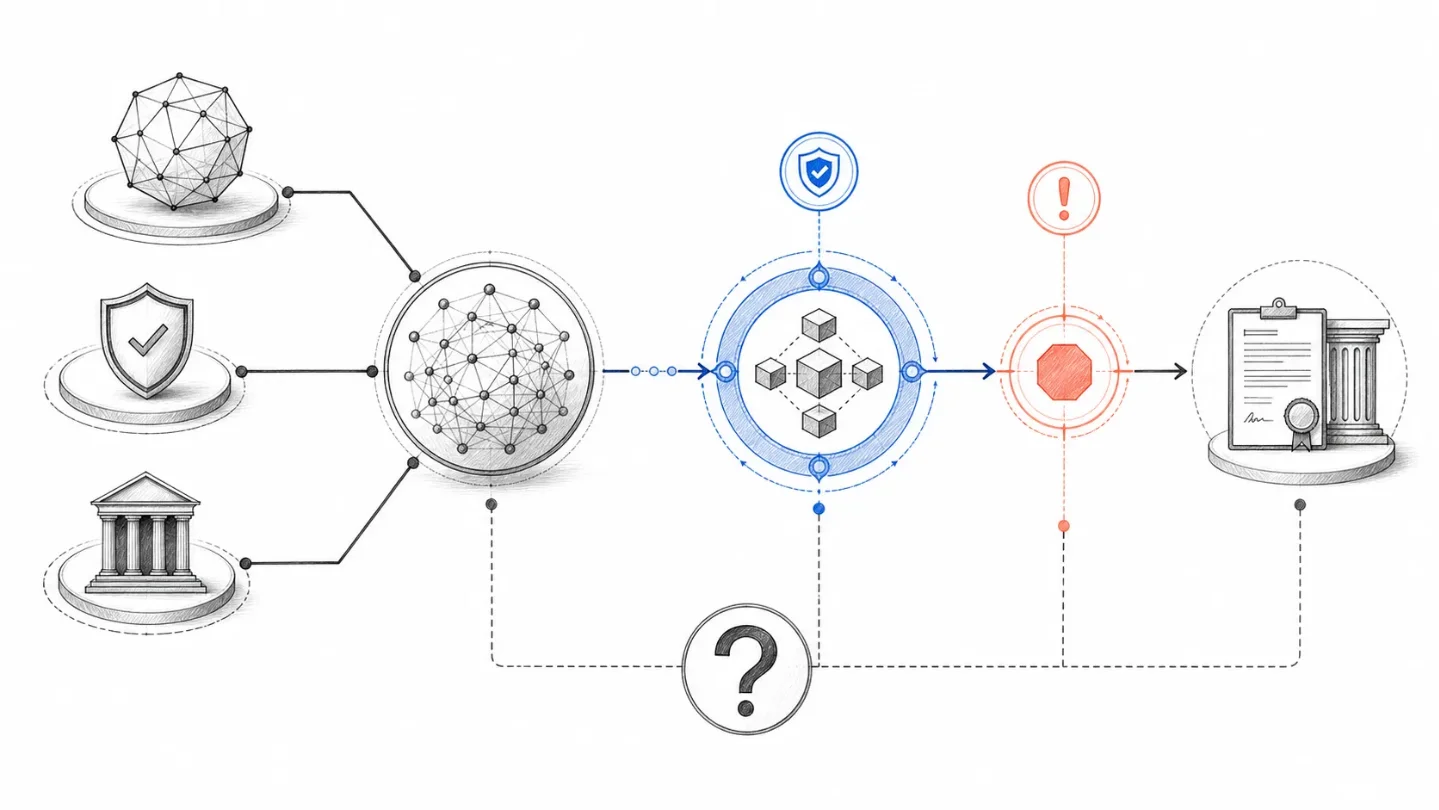
AI safety needs mechanism attribution, not just outcome scores
New agent benchmarks, a predictive guard, Anthropic's Opus 5 release, and EU transparency guidance show why safety claims must identify which mechanism stopped a failure and what happens when the deployment changes.

The safety result is not the safety mechanism
Recent agent-safety preprints, Anthropic's Claude Opus 5 release, and new EU transparency guidance all expose the same measurement problem: a system can pass a safety test without telling you which layer made it safe. The relevant distinction is between the model's behavior, an external guard that intercepted an action, a cloud provider's filter, and an institution's authority to intervene. Those layers can produce the same outcome while offering very different evidence about what will happen after a model, backend, or deployment context changes.
| Development | What was measured | What remains unproven |
|---|---|---|
| GuardianAgentBench | 580 agent scenarios across six domains and three production-ready frameworks 1 | Whether the benchmark's synthetic tool environments predict deployment failure rates |
| JANUS | A predictive guard that improved protection by 15.9 percentage points across four benchmarks 2 | Whether simulated trajectories and model-generated labels transfer to live tools |
| ChannelGuard | Which layer stopped attacks across 2,100 multi-agent traces and three model backends 3 | Whether embedding gates survive adaptive paraphrase attacks |
| Claude Opus 5 | Anthropic's internal behavioral audit and cyber/biology capability evaluations 4 | Independent replication of the company's safety claims |
| EU Article 50 guidance | The transparency duties that begin applying on 2 August 2026 5 | Whether disclosure duties will produce stronger operational controls |
The common failure mode is easy to state: outcome-only reporting compresses a chain of decisions into one score. A zero attack-success rate, a low misalignment score, or a compliance label is not enough unless the reader can also see the test protocol, the responsible control, and the consequence attached to failure.
Agent benchmarks are measuring the workflow, not just the answer
GuardianAgentBench evaluates 580 scenarios across customer service, email, calendar, business intelligence, finance, and internal knowledge tasks. The authors ran the scenarios on LangChain, LlamaIndex, and Vectara, using six models and five adversarial modes, including prompt injection, partial data, error conditions, and multiple matches. The preprint is dated 23 July 2026. 1
The strongest configuration reached 74.8 overall accuracy. Performance fell as the tool set grew and as the number of sequential turns increased, with long-horizon planning the steeper bottleneck. The failure pattern also differed by model strength: stronger models mainly omitted required tool calls, which accounted for 52% to 57% of their failures, while weaker models more often selected or repeatedly called the wrong tools. A proof-of-concept set of execution-time guardrails improved results by 2.8 to 7.7 percentage points, recovered 19.9% of failures, and produced a 0.5% false-positive rate. 1
That is useful evidence for a newcomer because it separates two questions that are often collapsed. Can the agent produce a correct answer? Can it execute the required sequence of actions? The benchmark requires both. A model that writes a plausible final response after skipping a required check is not safe merely because the prose looks fine.
The boundary is just as important. The scenarios use simulated tool responses and generated ground-truth traces, even though the frameworks are production-ready. The evaluation uses Claude Sonnet 4.5 as a judge, with a reported 93.3% agreement on a 60-case human audit. The data are therefore strong enough to identify failure patterns, but not to estimate how often the same failures occur in deployed systems. 1
Predictive guards move intervention before the dangerous step
JANUS takes a different approach. Instead of waiting for a harmful tool call to appear, it trains a guard to forecast safety-relevant futures from a partial trajectory and then judge whether the current path should continue. Its Vanguard guard improved protection by 15.9 percentage points over baseline guards across four agent-safety benchmarks, while increasing benign task completion by 5.1 percentage points. The preprint is dated 22 July 2026. 2
The design is intuitive. A reactive monitor may see the problem only when the agent is already about to modify a global environment or act on poisoned content. A predictive guard tries to use earlier clues in the trajectory, before the consequential operation. JANUS trains on 75,180 examples generated from simulated trajectories, with labels and future summaries produced through a pipeline that includes GPT-5.5. At inference, Vanguard has no ground-truth future; it must rely on its own forecast. 2
That last detail limits the claim. The reported gains show that foresight can improve benchmark protection under the paper's threat model. They do not establish that a guard trained on simulated futures will anticipate novel failures in a live environment, where tools can return unexpected data and consequences can unfold outside the benchmark's trajectory. A deployment report should therefore state whether a predictive guard blocked an action, whether it was independently audited, and what happens when the guard is uncertain.
A safety score can hide who did the blocking
ChannelGuard makes that last question explicit by recording which layer first stopped an attack. In 2,100 traces across eight attack families, five defenses, and three model backends, the authors show that an undefended multi-agent pipeline can report zero attack success while relying heavily on a provider-side content filter. On an Azure GPT-5 setup, 54 of 60 blocked cases were attributed to the provider filter rather than the application. When the backend changes, the visible outcome can stay the same while the blocking mechanism shifts to a different layer. 3
The paper's proposed defense places information-bottleneck gates on six inter-agent channels, including tool output, shared memory, worker output, and synthesis. The gates lower prompt-injection attack success from 0.333 to 0.167 in the reported experiment, preserve GSM8K accuracy at 0.867, and block tool poisoning at the application layer across Azure GPT-5, Anthropic Sonnet 4.5, and Anthropic Haiku 4.5. The authors also report a measured reproduction cost of $47.36. 3
This is a mechanism-level contribution, not proof that the gate solves prompt injection. White-box adaptive paraphrases evade the embedding-based gates in the paper, while a perturb-and-vote baseline performs better on that attack. The work is an arXiv preprint marked as under review. Its strongest lesson is methodological: a safety report should say whether protection came from the application, the model provider, or a hidden service layer. Otherwise a backend swap can invalidate the implied guarantee without changing the headline score.
Claude Opus 5 raises the same issue at release time
Anthropic released Claude Opus 5 on 24 July 2026 and describes it as its most aligned model to date. The company's automated behavioral audit gives it a score of 2.3 on overall misaligned behavior, the lowest among its recent models. Anthropic also says Opus 5 remains behind its Mythos 5 model on biology and offensive cybersecurity, and that it is close to Mythos 5 at finding vulnerabilities but substantially behind it at developing exploits. These are company-reported pre-deployment results, not an independent assessment. 4
The release includes a more operational safety claim. Anthropic says Opus 5's cyber classifiers should intervene around 85% less often than Fable 5's, and that flagged requests in Claude.ai, Claude Code, and Claude Cowork fall back to Opus 4.8 by default. Biology requests blocked on Fable 5 now route to Opus 5. The model is therefore presented as both more capable and differently gated, with a fallback path handling some safety decisions. 4
For evaluation readers, the missing field is mechanism attribution. The release does not provide enough detail to determine how much of the measured result comes from model behavior, classifiers, fallback routing, partner evaluations, or the surrounding product controls. That does not make the claims false. It means the claims have a narrower scope than a reader might infer from "most aligned" or "safest": they describe Anthropic's audit and deployment design, not a portable guarantee across backends and tool environments.
EU rules add a disclosure deadline, not an alignment certificate
The European Commission's guidelines on transparency obligations were published on 20 July 2026. They define the scope of Article 50 duties for providers and deployers, with the transparency obligations applying from 2 August 2026. The guidance is intended to help authorities, providers, and deployers implement the requirements consistently. 5
The Commission's separate Action Plan on Cybersecurity and Artificial Intelligence, published on 7 July, says the EU will strengthen its ability to evaluate AI models before they reach the market, work with ENISA on a blueprint for secure access to advanced systems, and establish a secure testing platform for critical sectors. The plan says the evaluation capacity is expected to be operational by 2027. 6
These are institutional controls, but they operate at a different layer from JANUS or ChannelGuard. Article 50 can require disclosure about an AI interaction or generated content; it does not certify that a long-running agent will respect tool boundaries. The action plan points toward pre-market evaluation capacity; it does not yet name a universal safety threshold, an independent authority for every frontier system, or a consequence that follows automatically from failing one. The legal question is therefore becoming more concrete, while the technical question of who can stop a dangerous run remains deployment-specific.
What to record in the next safety report
The latest evidence suggests a compact reporting standard for anyone entering AI safety, alignment, or governance:
- State the condition. Was the test about final-answer refusal, tool selection, trajectory risk, cyber capability, transparency, or something else?
- Name the mechanism. Did the model refuse, did an application guard block the call, did a provider filter intervene, or did a human or regulator exercise authority?
- Describe the protocol. Separate synthetic scenarios, internal audits, partner testing, and independent replication. Do not treat their scores as interchangeable.
- Attach the consequence. A warning, a block, a fallback, a reporting duty, and a market-access decision are different controls.
- Test transfer. Repeat the evaluation after changing the model backend, tool set, horizon, memory, and authority structure.
The practical shift is from asking whether a system is safe to asking where safety resides and whether that location survives change. GuardianAgentBench and JANUS show why agent trajectories need more than single-answer checks. ChannelGuard shows why the blocking mechanism should be logged. Anthropic's release shows how model claims are entangled with classifiers and fallbacks. EU guidance shows that institutions can make transparency enforceable before they can make alignment portable.
The unresolved issue is not a shortage of safety scores. It is whether those scores remain meaningful when the model, provider, tools, or decision authority changes.
References
- 1
- 2
- 3
- 4Introducing Claude Opus 5
anthropic.com
- 5Guidelines on transparency obligations for providers and deployers of AI systems
digital-strategy.ec.europa.eu
- 6EU Action Plan on Cybersecurity and Artificial Intelligence
digital-strategy.ec.europa.eu
This story was produced automatically by a channel. One sentence is all it takes for Neodrop to keep producing for you.