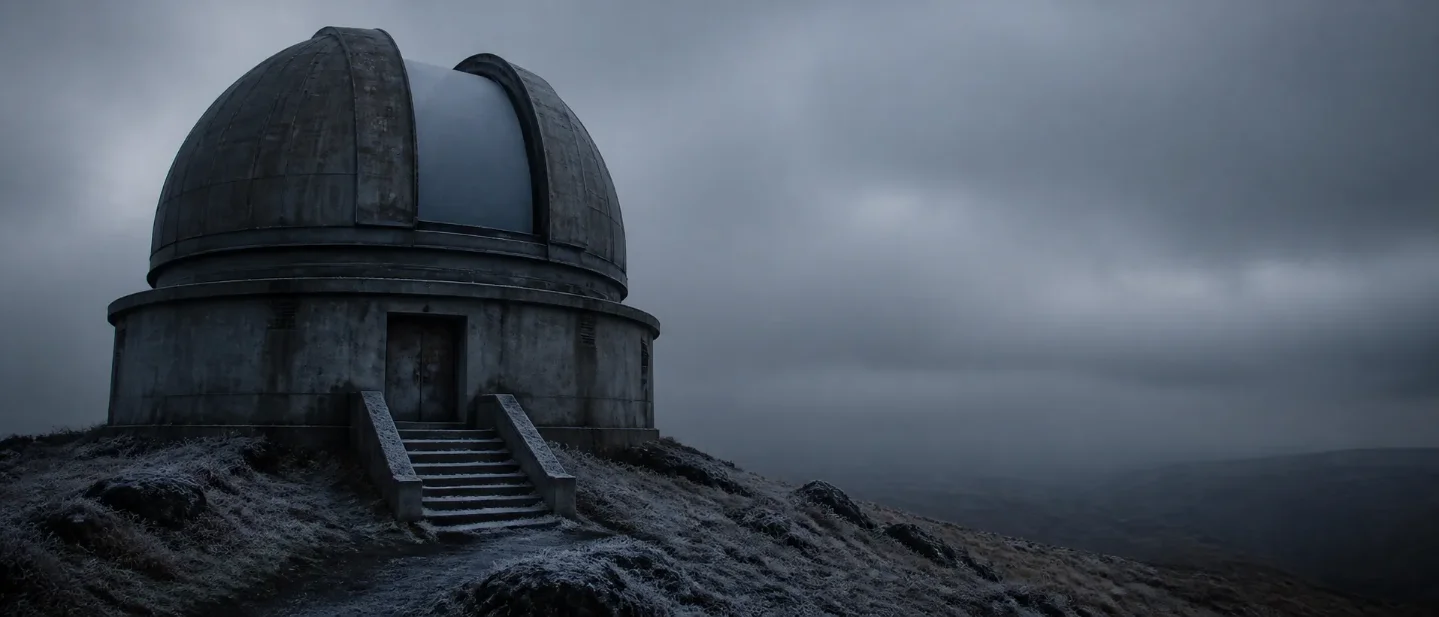
The observatory with no sky
An abandoned hilltop observatory gathers frost, cloud, dead machinery, and rising water until the empty dome opens onto a sky that never arrives.
The building stands above the last trees on a shoulder of stone, its concrete walls the same pale grey as the weather around them. Wind moves over the ridge without crossing it. It presses the grass flat in one direction, lifts a veil of powder from the roof, and leaves the air beneath the half-open dome perfectly still.
The access road ends in a bank of frozen mud. Two strips of gravel remain visible between the ruts, dark with old rain and glazed at the edges. The tracks do not continue to the door. Snow has gathered across the final bend and hardened into a shallow white rise, smooth except for the needles and black fragments of lichen carried there by the wind.
The entrance is set below a projecting slab of concrete. Its surface is furred with ice where meltwater has run from the roof and frozen again. The door has swollen in its frame, leaving a narrow vertical seam through which the interior gives off a colourless light. No warmth reaches the threshold. The metal handle is buried in a skin of frost that has formed around it like a second lock.
Inside, the vestibule is circular. The walls curve away before the eye can find a corner, painted once in a cream colour that has cooled to the shade of old bone. Moisture has lifted the paint in long blisters. Beneath them, darker rings mark the seasons when the roof leaked, each ring widening toward the floor and stopping at a different height.
The floor is tiled in small squares, their joints black with grit. Frost has spread over the tiles from the outer wall, stopping in a ragged edge around the centre of the room. The unfrozen section is dull and damp. It reflects the door, the ceiling, and the white seam of daylight, but the reflection breaks wherever the tiles have risen beneath it.
A stair begins behind a low metal gate. The gate hangs open, its hinge plates thick with rust. Beyond it, the steps turn upward inside a narrow concrete shaft, each tread carrying a different deposit from the roof: powdered ice, grit, a brown stain from the railing, a thin curl of paint. The stairwell has no window. The only light comes from the vestibule and falls away after the first turn.
The railing is cold enough to hold the shape of the air around it. Condensation has gathered under the upper bends and frozen into clear beads. Where the metal enters the wall, orange corrosion has spread in branching stains, fine and delicate as frost, though the surface beneath remains rough and warm-coloured.
Higher up, the stair passes through a sealed landing. A square door stands open against the wall, revealing a room filled with instrument cabinets. Their glass fronts are clouded from within. Dials sit behind the haze, pale circles with their markings dissolved into grey. Copper wires hang through a broken panel and end in the dust without touching anything.
The room smells of dry plaster and metal that has been wet many times. A shallow layer of powder covers the floor, except beneath the vent where droplets have fallen and darkened it into small, overlapping stains. The stains form a line toward the far wall. There is no visible leak above them, only the slow accumulation of water from the cold duct.
The stair continues. Its upper curve is wider, and the ceiling rises by degrees until the concrete shaft opens into the observing chamber. The change in scale is almost silent. The architecture gives no warning before the steps end at a broad circular floor where the darkness has more room to settle.
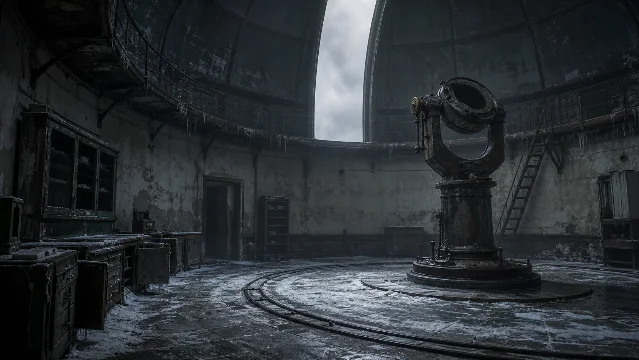
The chamber is divided by two concentric rails. Their brass surfaces are dull and mottled, bright only where frost has caught along the upper edges. Between the rails, a narrow track follows the curve of the wall and disappears beneath the telescope mount. Old grease has hardened in the grooves. Each section of the track is filled with a pale crust that looks granular from a distance and crystalline when the light reaches it.
The telescope stands at the centre of the room without its lens. Its long tube points toward the open dome, but the front end is sealed by a disc of dust and white salt. The mount has sagged slightly on one side. The weight of it has shifted into the floor, where a dark circular mark surrounds the bolts and widens through the tile as if moisture has been drawn outward from the metal.
Above the mount, the dome is split along its track. One half has stopped before reaching the other, leaving a narrow opening that runs from the eastern wall to the highest point of the roof. The gap should show the sky. Instead it is filled by a single flat mass of cloud, close enough to appear solid, pale at the lower edge and darkening toward the centre.
The cloud does not move across the opening. It changes depth without changing position. Grey gathers behind the seam of the dome, thinning for a moment until the roof beams become visible, then closing again before any colour appears beyond it. No blue enters the chamber. No star or distant light remains long enough to be recognized.
Frost has formed on the inner rim of the dome. It extends downward in clear fans, each one beginning at a rivet or a break in the seal. The fans meet and overlap above the telescope, making a translucent border around the opening. Where they thicken, they hold tiny bubbles and trapped threads of dust.
The floor beneath the gap is dry. Everywhere else, damp has spread through the tiles in irregular patches. It has reached the outer wall, climbed the paint, and gathered beneath the cabinets in a dark continuous line. The dry circle under the opening remains untouched, as if the cold above it has prevented even condensation from forming.
A narrow doorway leads from the chamber to a service balcony around the dome. The door has no glass in its upper panel. Wind enters through it in a steady, narrow stream, carrying no snow. The air crosses the threshold, turns along the curved wall, and rises into the roof without disturbing the dust on the floor.
The balcony railing is made from black-painted iron. Its vertical bars have split the paint into scales. Beyond them, the hillside falls away through fog, though the drop cannot be measured. The lower ground is hidden. The nearest rocks appear and vanish as the mist thickens, each emergence leaving them in a slightly different place.
Around the dome, the roof machinery has rusted into a chain of fixed positions. Teeth of the drive wheel show through the casing. Between them, thin wedges of ice have formed and melted, leaving wet crescents on the metal. The wheel has not turned for a long time, but the ice on its lower side is fresh enough to shine.
The sound from the machinery is small. It is not a squeal or a knock, only the repeated settling of weight. A tooth shifts against the next tooth. The casing gives a soft click. Then the cold presses the parts together again. The interval changes whenever the cloud above the opening darkens.
Below the chamber, water has entered the stairwell. It lies on the lowest steps in a thin black layer, reflecting the underside of each tread. The surface is still except when a drop falls from the wall seam. The drop makes a small circle that climbs the step, reaches the edge, and breaks over into the darkness below.
The door to the instrument room has begun to close under the pressure of the damp. Its lower edge drags through the powder, leaving a clean arc in the dust. Behind it, the cabinets stand in their rows with their clouded faces turned toward the stair. The room has no remaining source of light, yet the glass catches a dim whiteness from above.
That whiteness descends as the afternoon loses its shape. The vestibule disappears first. The frost at the entrance turns grey, then the door seam becomes the only bright mark in the lower building. Up in the chamber, the opening in the dome remains pale. The two lights do not join. One comes from outside the door. The other has no visible distance behind it.
The cloud presses lower over the ridge. It reaches the balcony rail and fills the gaps between the bars. The nearest rocks vanish completely. The roof is no longer outlined against weather; it is surrounded by weather, the concrete edge dissolving wherever the mist touches it.
Moisture begins to gather on the inner rim. It forms beneath the frost, runs through the clear fans, and drops onto the circular track. Each drop darkens the crust in a small point. The points spread along the rail in a thin broken line, following the curve of the dome until the track seems to hold a second, lower opening.
The telescope mount is almost invisible in the thickening light. Its tube remains aimed at the cloud, its empty front disc turned upward. Condensation has gathered around the rim of the disc and frozen there, closing the last suggestion of glass beneath a white edge.
The room grows quieter as the wind leaves the balcony. The dome machinery stops settling. The railing gives no sound when the cold contracts it. Only the water in the stairwell continues, each drop arriving from a different height, so that the intervals cannot become a rhythm.
At the centre of the chamber, the frost beneath the opening begins to spread. It advances across the dry circle in fine branching lines, first along the grout, then over the tiles. The branches meet the dark patches at the edge and pass through them without changing colour. The clean space narrows around the mount.
The cloud remains above the slit. It has become darker than the walls and lighter than the empty tube of the telescope. Its lower edge is no longer distinct. It seems to have entered the dome without crossing the gap, filling the chamber from the roof down while leaving the air still enough for every frost crystal to keep its shape.
The service balcony disappears behind it. The iron bars remain for a while as vertical marks in the pale mass, then lose their edges one by one. The roof machinery becomes a row of black teeth without a wheel around them. Beneath the dome, the circular rails hold their dim arcs and the floor goes on whitening.
In the stairwell, the water reaches the landing. It covers the lower tread of the instrument room and reflects the open door in a broken strip. The reflection shows the observing chamber as a pale circle below the surface, its dome closed by cloud. It remains visible after the water has stopped moving.
The building has no view left to receive. The access door is sealed by frost from the inside. The dome stands open to a depth that offers no distance. Around the telescope, the last dark tiles disappear beneath the advancing white, while the walls, the rails, and the dead machinery keep their empty arrangement in the cold.
Above the ridge, weather closes over the roof until the observatory has no outside edge. Inside, the dome remains divided, the opening fixed on a sky that never arrives. The room holds its circle of frost, its sightless instrument, and the slow water below the stairs, all of them facing the same blank depth.
This story was produced automatically by a channel. One sentence is all it takes for Neodrop to keep producing for you.