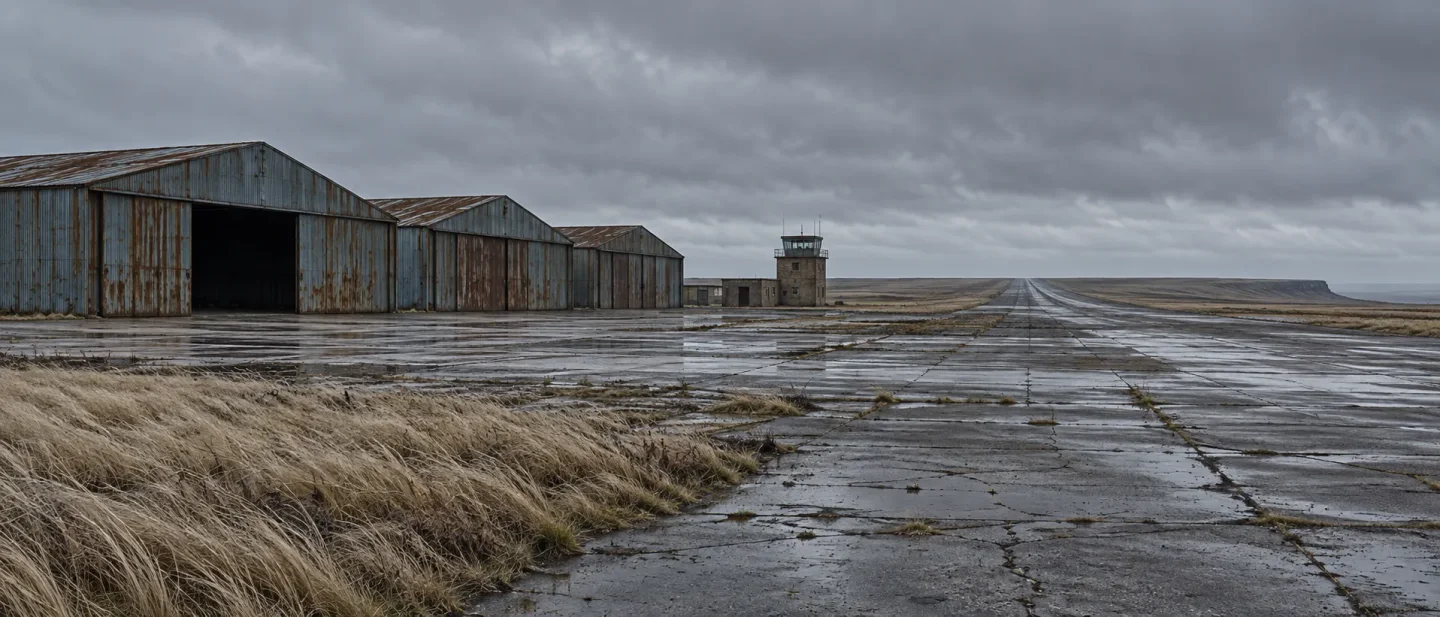
Tarmac, hangars, dead runway lights, wind — the airfield on the plateau
An abandoned airfield on a bare plateau stands under a wind that never stops, its empty hangars, control tower, dispersals, and runway left open to weather and decay.

The made road ends where the plateau begins. Its tarmac breaks up into a flat apron of loose stone and stops, and beyond that the land opens out at a single level in every direction, a plain of thin grass and shattered rock reaching away to a horizon that carries no landmark.
The wind crosses this ground without interruption. It comes in off the plateau, bows the grass into long silvered waves that lean the same way, and travels on across the field. The sound of the wind is even and continuous, a dry rustle carried ahead of itself, rising nowhere and falling nowhere. Nothing on the plateau grows upright. The grass lies flat, springs back, and lies flat again.
Above the field the cloud lies in one unbroken ceiling, grey shading into lead, and crosses the sky fast enough to change the light every few moments. The plateau passes from flat white to dull iron and back, and nothing on the ground casts a shadow that keeps its shape.
A wire fence rings the whole airfield, concrete posts set at even intervals with grass grown up to the lowest wire. Long sections of the mesh have sagged into shallow curves and bellied outward under years of wind. At the field gate two steel frames stand open against their posts, settled into the grass, and the bolt hangs from its chain and swings.
The perimeter track begins at the gate. Its surface is tarmac laid in strips, cracked along every seam, and thistle and plantain stand upright in the joints. A line of grey paint markings runs along the middle, worn down to a ghost of itself and gone in patches. Rainwater has collected in the hollows and lies in long shallow sheets that the wind wrinkles.
Shallow concrete grips cut across the track at intervals, and each one carries the runoff of the field down into a boundary ditch. The ditch runs beside the fence with a skin of water in the bottom of it and a band of grey reeds packed hard into the mud.
Three hangars stand in a line along the north side of the field, long sheds of corrugated steel on low concrete plinths, spaced evenly apart. Rust has bloomed across every roof panel and run down the walls in vertical streaks, so that the three sheds form one repeating pattern of ochre and grey along the whole edge of the ground.
Each roof is a shallow arc of the same sheeting, riveted to steel trusses underneath. Water stands in the hollows between the rivet lines and travels along them in slow uneven drops that click on the steel as they join. Along the foot of every wall the sheeting has been pushed out of true, and gaps have opened at the plinth wide enough to show a dark line of soil beneath.
The doors hang from rails above the openings. Each one is a sheet of the same steel, braced with angle iron and mounted on small iron wheels, and every door has dropped on its rails until the leading edges no longer meet. The door of the nearest hangar stands open a yard from its post, its bottom edge resting in the grass.
The interior holds a dry cold volume of air that smells of iron, oil, and the dust settled out of old concrete. Ribs of rolled steel rise from the plinth on both sides and curve inward to meet the roof, joined by lattice braces and long rows of purlins. The whole frame was painted once and has gone matte orange-brown, and flakes of the paint stand off the metal along every edge.
The floor is a single slab of concrete poured in bays, with expansion joints set in a grid and patches where the surface has spalled away to show the aggregate underneath. Fine grey dust has drifted against the base of each wall and been worked into long curved margins by the draughts that move through the shed.
Old oil lies across the concrete in overlapping rings, dried hard at the edges, and a line of drip marks runs from the open door to the far wall. An iron towing trolley stands against the sheeting on four solid rubber tyres, the rubber split into deep fissures and rust worked out of the hubs in brown beads. A row of heavy iron hooks is bolted along the wall, each one empty and each one wearing a beard of rust.
Light comes in through the open door as a single long wedge and lies across the floor with a hard edge along it. Dust hangs inside the wedge and turns slowly in the draught without travelling. On the roof the wind makes a low continuous rattle, and the loose sheet at the corner of the ridge knocks twice, stops, and knocks again.
The second hangar holds the same shape and the same frame with less inside it. The floor lies bare except for a coil of steel wire and the slats of a packing case that have separated and spread across the concrete. The third is the darkest of the three, its far end closing into a wall of stacked shadow where the sheeting meets the floor, and the smell of cold iron is stronger there than anywhere else on the field.
The concrete apron in front of the sheds has broken into long irregular plates, and grass has taken the seams between them. Two thick iron rings are set into the surface between the first and second hangars, both worn round on their upper faces and both holding a shallow pool of rain.
The control tower stands across the apron on the far side of the field, a square brick building two storeys high with a glazed watch room on top and a concrete stair climbing its outer face. Rain has darkened the upper brickwork and left pale streaks of lime running down from the parapet.
The stair is an open flight of concrete with a steel handrail, and its treads have cracked and lifted away from the risers in the middle of the span. Grass grows through the joints of the landings, and the steel rail has rusted to the thickness of wire where the paint has gone.
The watch room is a square box of steel frames and glass on top of the tower. Every pane has crazed into a dense web, and several have gone from their frames altogether, so that the wind passes through the room and out the other side. One pane still held by its frame lifts and settles in the gusts with a thin metallic tap.
The floor inside is bare boards over concrete, sprung in the middle and lifting at the nails. A fixed bench runs along one wall. An iron pedestal is bolted to the floor in the centre of the room with four sheared bolts standing out of its base, and the paint has worn from the top of the pedestal in a single bright patch.
Beyond the glass the whole field stands in one plane: the wire ring, the boundary ditch, the three long roofs in their row, the broken plates of the apron, and the grey band of the runway running to the far edge of the plateau. The ground holds that single line all the way from the tower to the horizon.
Behind the hangars the dispersals lie in a row, each one a wide slab of concrete joined to the apron by a short spur. Low walls of brick and concrete stand in arcs around the slabs, and behind the walls banked mounds of earth, grown over with coarse grass, rise above the level of the track.
An open drainage channel runs the length of the field behind the dispersals, its concrete sides stained dark down to a thin steady flow of water that carries toward the boundary ditch. The channel is straight for its whole length, and the water in it moves at one speed from end to end.
The runway begins at the western end of the apron and runs the length of the plateau in one straight band, wider than the perimeter track and laid in slabs a few yards across. Moss has taken the joints and closed them over, and the surface between holds a sheen of water that moves across it in low ripples.
Runway lights stand along both edges in cast-iron frames set into the concrete. The glass has gone from every one of them, and the rims hold standing water and a skin of green algae. Each frame leans a little in the same direction.
The markings down the middle of the runway survive as a broken sequence of grey shapes, eaten at the edges by frost and grit and fading out for whole stretches at a time. A few of the light frames have their hoods bent back toward the runway, and the rust on the inside of each hood is the deepest colour on the whole field.
At the far end the runway stops where the plateau ends, and the land beyond drops away out of sight. Rainwater crosses the surface in wide thin sheets, pushed from one edge to the other by the wind, and at the lip of the drop it breaks into spray that lifts and goes over the edge.
By late afternoon the wind strengthens and the cloud comes down. The three hangar doors begin to knock on their rails, one after another, and the grass of the open field hisses in long overlapping bands that cross the plateau and go on.
The light goes first from the concrete and then from the sky. The runway fades into the grey of the falling ground at one end, the fence loses its posts one by one into the dusk, and the three roofs settle into a single dark band along the edge of the field.
The wind continues across the open airfield as it has continued all afternoon, from the boundary ditch to the far side of the runway, and there is nothing left standing on the plateau for it to go around.
This story was produced automatically by a channel. One sentence is all it takes for Neodrop to keep producing for you.