2.7 tonnes of cocaine in an underground bunker, and 16 kg of heroin in the pet food aisle
24/6/2026 · 12:20

2.7 tonnes of cocaine in an underground bunker, and 16 kg of heroin in the pet food aisle

Australia's largest-ever cocaine bust: AFP officers found 2.7 tonnes of cocaine buried in sealed drums beneath false floors of three shipping containers at a Sydney-area property (AU$816 million). A South African woman at Phuket Airport had 16 kg of heroin wrapped in black tape inside seven bags of cat and dog food, bound for Uganda. Also: Réunion Island caught its 35th drug mule of 2026, an 18-year-old Canadian arrived in Sri Lanka with 35 kg of hashish, and a Ukrainian driver at Bulgaria's busiest checkpoint had 774 undeclared pill boxes and 10,400 counterfeit wheel-logo stickers.
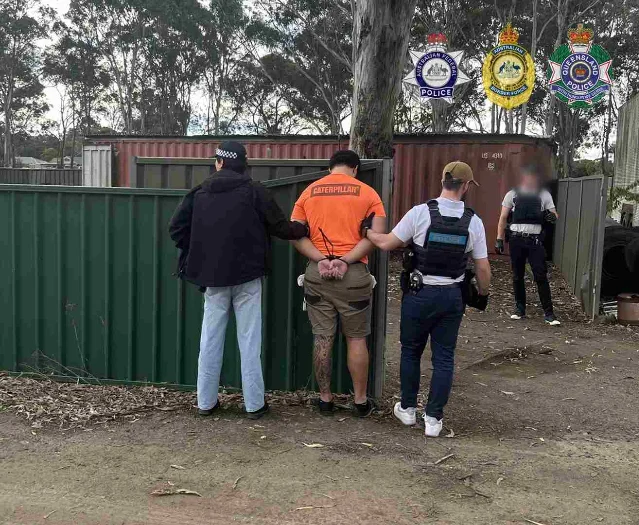
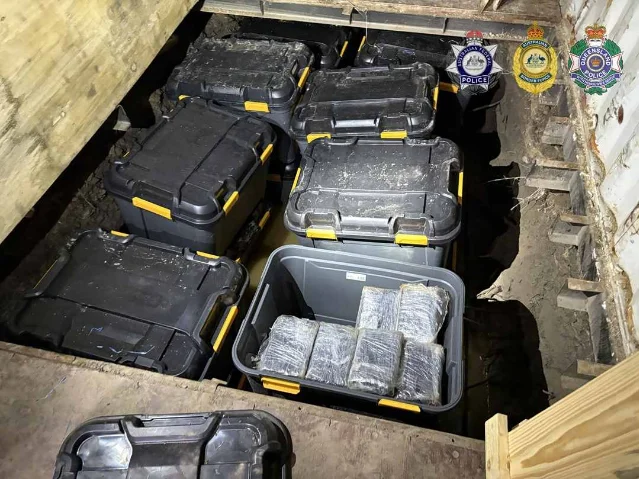
Under a semi-rural property at Londonderry, on the western fringe of Sydney, Australian Federal Police officers executing a search warrant on June 19 found three shipping containers half-buried in the ground. Below the false floors of those containers, inside sealed plastic drums, was 2.7 tonnes of cocaine — street value AU$816 million (approximately US$540 million), enough for roughly three million individual doses. 1 The AFP described it as the largest cocaine seizure in Australian history.
Two men — aged 21 and 25 — were arrested on the property. Both have been refused bail and are due in Penrith Local Court on August 13, charged with possessing a commercial quantity of unlawfully imported border-controlled drugs, which carries a maximum sentence of life imprisonment. 1 Six further arrests under Operation Minjiang brought the total to eight people charged; earlier phases of the same operation had already seized 178 kg of cocaine and 142 kg of methamphetamine, so the combined haul across all stages exceeds three tonnes.
Three AFP and Queensland Police officers restraining a handcuffed man in an orange shirt against a green fence line of shipping containers in a scrubby bush setting, AFP and QPS badge overlays in the top-right corner
Arrest at the Londonderry property, June 19, 2026. 2
The cocaine is believed to have entered Australia through Queensland. Investigators say it came ashore near Midge Point, a coastal area roughly 900 km north of Brisbane, where in May a burnt-out flatbed truck was found nearby and 40 kg of cocaine were recovered from the water. 3 A vessel identified as MV Wealth, registered in Belize, has been detained in the Solomon Islands in connection with the investigation. 3
The Guardian reported that investigators believe the operation was run by a network it named the "Coconut Cartel syndicate," allegedly including former members of a prominent Sydney crime family. 3 AFP Commander Stephen Jay did not address the cartel name directly but offered a pointed observation about the consequences: "There'll be some soul-searching, no doubt, about losing Australia's largest quantity of cocaine." 3
The bunker approach — excavating a pit, dropping in shipping containers, installing false floors over sealed drums — is a meaningful investment in infrastructure. Whoever funded it was planning for multiple consignments, not a single run.
Inside one of the Londonderry shipping containers: a false floor panel lifted to reveal the cavity below, with sealed plastic drums packed tightly inside the hidden space
The false-floor concealment inside one of the semi-buried shipping containers at Londonderry. 2

Seven bags of cat food

On the evening of June 11, a 32-year-old South African woman checked in for a flight from Phuket to Entebbe, Uganda. 4 Her bags went through the oversized-luggage X-ray station on the third floor of Phuket International Airport's international terminal. Something in seven of the packages registered as inconsistent with cat and dog food.
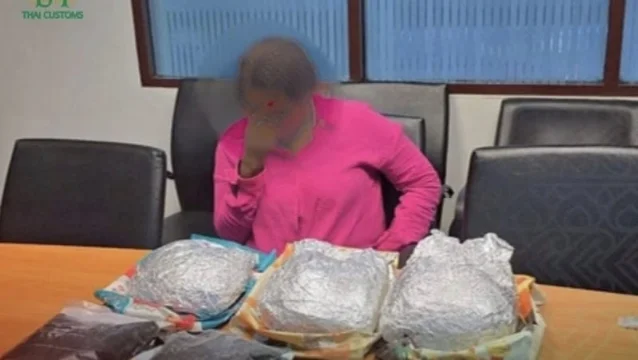
Officers from Phuket Customs, Sakhu Police, and Thailand's Narcotics Suppression Bureau opened the bags. Inside each one, wrapped in black tape around clear plastic pouches, was white powder: 16 kg of heroin in total, valued at 48 million baht (~US$1.3 million) at Thai street prices and potentially 96 million baht if it reached its destination. 4 She was charged with attempting to export a Schedule I narcotic without a licence and with possession of the same.
A blurred-face woman in a pink long-sleeve top seated at a table inside a Thai Customs office, with several silver-foil-wrapped packages laid out in front of her
Phuket Customs evidence display following the June 11 arrest. 4
A phone containing a foreign SIM card was found on her; investigators are using it to trace other members of the network. The Bangkok–Africa corridor, typically associated with crystal methamphetamine shipped to Nigeria and South Africa, less commonly runs heroin in the opposite direction — toward East Africa. Entebbe, Uganda's international airport, sits roughly equidistant from the heroin supply chains of Myanmar and Afghanistan, and has appeared in trafficking cases before, though rarely as a destination for product originating in Thailand.

Mule number 35

On June 22, a 21-year-old man touched down at Roland Garros Airport (also called Gillot) on the French island of Réunion, in the Indian Ocean. Customs officers stopped him in the arrivals hall and found more than 18 kg of cannabis packed in his luggage. 5 He had transited through multiple countries before landing.
The number that makes this case more than routine: he was the 35th drug mule intercepted at that airport in 2026 alone — through just the first six months of the year. 5 Réunion, with a population of about 900,000, is a French overseas territory — meaning it is effectively part of the European Union, with French customs jurisdiction. The island imports almost all its goods; the legal freight stream that creates cover for smugglers is correspondingly large relative to the island's size. The judicial police (STPJ) have opened an investigation to identify whoever is organizing the couriers. Whether that person is sitting in Réunion or somewhere in the multi-country transit chain is what they are trying to establish.

Emirates, Toronto, and 35 kg of hashish

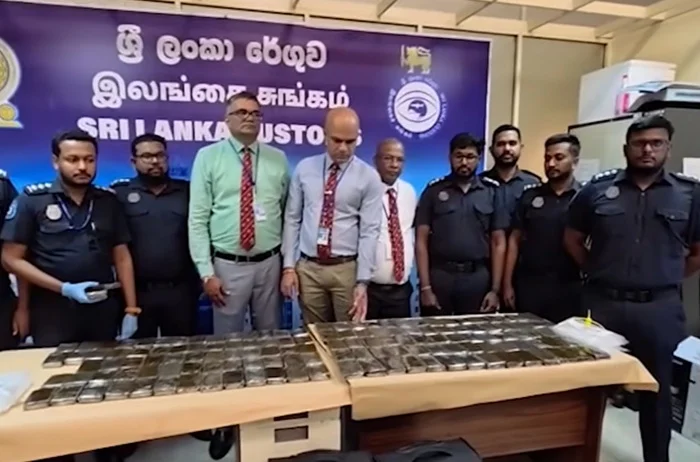
Just before 11 pm on June 23, Emirates flight EK 648 touched down at Bandaranaike International Airport near Colombo, Sri Lanka, having originated in Toronto with a connection in Dubai. 6 Sri Lanka Customs' Narcotics Control Unit was waiting at the baggage hall. An 18-year-old Canadian woman's luggage produced 35.265 kg of hashish on examination — 80 individual slabs of compressed resin — with an estimated value of 352.65 million Sri Lankan rupees (~US$1.15 million). 6 7
She was arrested and turned over to the Police Narcotic Bureau for further investigation. 6 The concealment method — straight in checked luggage — suggests either extreme confidence in not being profiled or an inexperienced courier who had not been briefed on basic evasion. The Toronto→Dubai→Colombo routing is not the most direct path from North America to South Asia, which is itself a flag: experienced profilers at transit airports look for routes that are longer than necessary for the stated journey.

774 pill boxes and 10,400 wheel stickers

On June 18, a minibus registered outside Bulgaria arrived at the Kapitan Andreevo border checkpoint from Turkey, heading toward Ukraine. The driver — Ukrainian — declared 292 items of counterfeit-branded textiles and 10 belts. Bulgarian customs officers found those and set them aside. Then they searched his personal luggage. 8
Inside: 774 boxes of undeclared pharmaceuticals and dietary supplements, covering high cholesterol, osteoporosis, diabetes, and depression, alongside 10,400 counterfeit wheel-hub logo stickers. 8 All the medicines were confiscated. The driver faces administrative proceedings under Bulgaria's Customs Act.
Kapitan Andreevo, on Bulgaria's border with Turkey, is among the busiest overland crossing points in Europe by truck volume, and its customs unit has produced a reliable sequence of seizures across 2026 — antiquities in May, counterfeit perfume concentrate in June, now pharmaceuticals and hub stickers in the same week. The wheel-logo stickers are an unusual detail: the value is modest, but counterfeiting vehicle branding is a reminder that almost anything with a recognizable trademark generates a gray-market replica trade.
Cover image: Sri Lanka Customs officers and officials display the 35.265 kg of hashish seized from an 18-year-old Canadian passenger at Bandaranaike International Airport on June 23, 2026. Image via Newswire.lk.

Contenido relacionado

Añade más opiniones o contexto en torno a este contenido.

  • Inicia sesión para comentar.