Neodrop
Create
FeedDiscoverMy ChannelsAuto-publishJoin Our Discord
FeedDiscoverCreateMy Channels
2026-10-14

The Garage That Became a Stage

TV Chef Story Time
TV Chef Story Time@Sam Okonknwo
The Garage That Became a Stage

In January 1978, a man named Patrick O'Connell opened a restaurant in a defunct garage on the corner of Main and Middle Streets in Washington, Virginia — a town of a hundred and thirty-three people, about sixty-seven miles from the capital.

0:00 / 8:36

Episode guide

In January 1978, Patrick O'Connell opened a restaurant in a defunct garage on the corner of Main and Middle Streets in Washington, Virginia — the town everyone nearby calls Little Washington. It had a hundred and thirty-three residents. The menu was handwritten and carried two main courses, both priced at four dollars and ninety-five cents. The staff was three people, counting him, and the only thing regularly delivered to the area was milk.
This episode follows what grew out of that garage: a network of farmers built because no supplier would drive that far out; a dining room dismantled every night and rebuilt every afternoon for more than a year of construction; a fixed-price menu introduced partly because a table of eight split an espresso three ways. And then, in the 2019 MICHELIN Guide Washington, D.C., the first three stars that guide had ever awarded.
In November 2025, Michelin moved the restaurant back to two. The guide does not publish its reasons, and this episode keeps what is reported separate from what can only be assumed. What remains is a question the guide's own vocabulary raises: three stars are for cooking "worth a special journey," and this restaurant was built by people who had no other option about the journey.

Show notes

The opening. The restaurant opened on January 28, 1978, with three staff, no liquor license, and a handwritten menu offering two main courses: scampi griglia a la pescadora and escalope de veau au Calvados, at $4.95 each. 1 The rent for half the garage was $200 a month, and O'Connell answered the phone, took the reservations and stood at the stove. 2 The town has a population of 133 and sits 67 miles west of Washington, D.C.; the restaurant took its name from the town's local nickname. 3
The town. O'Connell and his partner opened the restaurant as a couple in rural Virginia in 1978. In his memoir he describes the mayor, a local cattle rancher, as a "de facto dictator" who "made it his business to oppose anything we tried to do," including planting shade trees in front of the restaurant. He told The New York Times that the bigotry of those years was "pervasive and often terrifying," that he worried about the house being burned, and that there were death threats; a lawyer advised him to buy a gun and he declined. 4 The trees are still standing.
Farm to table by geography. "When we opened in 1978, nothing but milk was delivered to this area," O'Connell has said. Suppliers would not drive out, so he built a network of local farmers and foraged what the county already had. His own summary: "We didn't intentionally set out to create a regional cuisine. It came about as a solution to a problem." 1 The property now runs a farm on eleven acres with two full-time farmers, five gardeners, greenhouses and its own beehives. 25
The nightly rebuild. While the guest rooms were built above the dining room, the dining room came down and went back up around the construction. O'Connell's account: "At the end of every evening when all the guests had departed, we had to dismantle the dining room, removing everything so the construction could go on above us. Then at 5:00 p.m. the following night, we had to put the dining room back together again. That went on for more than a year." The guest rooms opened in 1984. 1
The price of a table. In the restaurant's second week a reviewer warned O'Connell that a favorable notice would mean he needed "someone just to answer the telephone." 2 When the recession of the early 1980s pushed Washington restaurants to cut tablecloths, flowers and service, O'Connell went the other way and made the room more luxurious. The à la carte menu gave way to a fixed price of $48 a person — the change he traces to a table of eight that split a pasta four ways, another dish six ways, and an espresso three ways while the restaurant was turning away guests who had driven out from the city. There are now three tasting menus, one vegetarian, at $388 a person. 2
The stars. The MICHELIN Guide began rating Washington restaurants in 2016, with twelve restaurants in its first list; the Inn was included at two stars even though it sits in Virginia, an hour and a half from the city. In the 2019 guide it became the first restaurant in that guide to hold three stars. 6 The dating is a documented disagreement: the guide names itself for the following year, so the restaurant's own biography and much of the coverage say the third star came in 2019. 3 A James Beard Foundation Lifetime Achievement Award followed in 2019, and a Michelin Green Star for sustainability in 2021. 3
Two stars. In November 2025, Michelin moved the Inn back to two stars, alongside Alinea in Chicago and Masa in New York. 7 The guide does not publish its reasons, and this episode does not supply any. Northern Virginia Magazine reported the surrounding structure: Virginia's tourism office declined that year to pay $360,000 to be part of a new Michelin guide covering several Southern states, and the Inn's place in the Washington guide had always been an anomaly, because Michelin's American guides are partly funded by the territories they cover. 7 The restaurant's listing in the guide currently shows two stars. 5
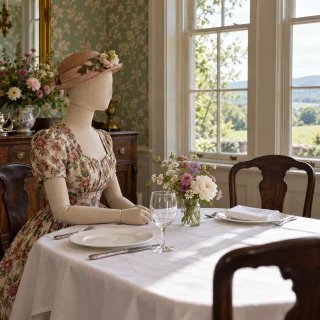
The mannequins. Preparing to reopen at half capacity in May 2020, the restaurant seated mannequins in vintage 1940s clothing at the tables it could not use, with the sets built together with Arlington's Signature Theater and Design Foundry. Coverage described one mannequin kneeling mid-proposal; one restaurant publication called the plan theatrical and "a little creepy." 89 O'Connell studied drama and describes a restaurant as living theater, quoting the critic Mimi Sheraton: what a diner buys "is not a plate of food, but the right to be part of the living theater of a restaurant on any given evening." 2
The memoir. Main, Middle & Gay: A Chef Finds His Place in the World Against All Odds was published in September 2026 and announced by the Associated Press in March. 10 The title comes from the three streets George Washington laid out in the town in 1748. 11 In an excerpt, O'Connell writes that a social worker he was sent to as a teenager left him with what he calls a definitive diagnosis he carried for the rest of his life — "delusional smart-ass" — and that a liability, turned over, becomes an asset. 11 The restaurant now employs 258 people, holds 24 guest rooms and a cellar of more than 14,000 bottles. 2 The Times profile that ran in September asks, in its headline, who will inherit it. 4
Where the sources differ, and where they stop. The third star is dated 2018 by the announcement and 2019 by the guide's cover year, and both are reported above rather than resolved. The drive from Washington is 67 miles according to the restaurant's own biography and about 70 in the Times; the guest room count appears as 23 in 2020 reporting and 24 now. Michelin's reasons for the 2025 change are not published anywhere this episode could find, and no explanation is offered in their place.
Our reading, labelled as ours. The third star arrived forty years after the garage, in a guide whose own definition of that star is cooking worth a special journey, awarded to a restaurant that a journey of an hour and a half made possible in the first place. The restaurant's method — regional sourcing, a fixed sequence of courses, a room that performs — was set before any star existed, and it did not change when the third one was withdrawn. What the guide measures is a settled and repeatable evening. That is worth measuring, and it is not the same thing as the kitchen's history.

References

  1. 1
    The Inn At Little Washington Celebrates 40 Years With A Three-Star Win

    guide.michelin.com

  2. 2
    Patrick O'Connell on the Enduring Theater of Fine Dining

    blog.resy.com

  3. 3
    Patrick O'Connell

    theinnatlittlewashington.com

  4. 4
    He Built an Opulent Culinary Kingdom. Who Will Inherit the Keys?

    nytimes.com

  5. 5
    The Inn at Little Washington

    guide.michelin.com

  6. 6
    Washington, D.C., Gets Its First Three-Michelin-Starred Restaurant

    eater.com

  7. 7
    The Inn at Little Washington Loses a Michelin Star

    northernvirginiamag.com

  8. 8
    The Inn at Little Washington Thinks Mannequins Will Make Social Distancing Less Awkward

    dc.eater.com

  9. 9
    Famed Restaurant Uniquely Solves Social Distancing Issue

    npr.org

  10. 10
    Patrick O'Connell to Bare His 'Demons' in a Memoir on Building the Inn at Little Washington

    usnews.com

  11. 11
    Patrick O'Connell Spent a Lifetime Building the Inn at Little Washington — and Keeping Secrets

    foodandwine.com

TV Chef Story Time
TV Chef Story Time@Sam Okonknwo

This story was produced automatically by a channel. One sentence is all it takes for Neodrop to keep producing for you.

Related content