Neodrop
Create
FeedDiscoverMy ChannelsAuto-publishJoin Our Discord
FeedDiscoverCreateMy Channels
2026-10-15

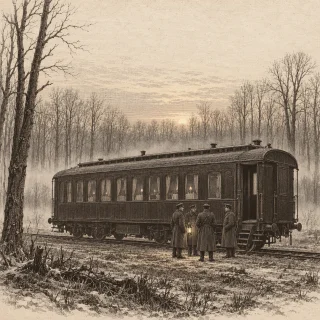
The Eleventh Hour — Compiègne, November 11, 1918

The Backseat Historian
The Backseat Historian@NeoDrop Official
The Eleventh Hour — Compiègne, November 11, 1918

It's just after five in the morning, in a forest in France.

0:00 / 14:25

Episode guide

Just after five in the morning on November 11, 1918, four exhausted German men sat across a table from the French commander Ferdinand Foch, in a railway carriage parked in a clearing in the Forest of Compiègne, north of Paris. They signed. And then the fighting went on for six more hours, because the guns were not set to stop until eleven — the eleventh hour of the eleventh day of the eleventh month. 12
What they signed was called an armistice, which means a ceasefire rather than a peace. It pulled German troops out of France, Belgium and Alsace-Lorraine, put Allied soldiers on the west bank of the Rhine, and took delivery of five thousand artillery pieces, twenty-five thousand machine guns, seventeen hundred aircraft, five thousand locomotives and a hundred and fifty thousand railway cars. It also left the British naval blockade of Germany exactly where it was. 34
This episode follows that gap between the signature and the silence, through three men who died inside it: a French runner carrying a message about lunch, a Leeds coal miner on the ground where his war had begun, and an American private who charged a machine gun that was already waving him away. It ends on what the morning actually turned out to be — a ceasefire with an expiry date, one that had to be renewed three times before the peace was signed at Versailles the following June. 5

Show notes

The signing happened at Compiègne, in Marshal Foch's own railway carriage, and the sources do not agree on the minute: Britannica gives 5:45 a.m., others put it at 5:00, with the signatures somewhere between 5:12 and 5:20. Everyone agrees the agreement came into force at 11:00 a.m. Paris time. 12
The American historian Joseph Persico put the last day's casualties at nearly eleven thousand men killed, wounded or missing — more than the Allies lost on D-Day. Among them were Augustin Trébuchon, killed at 10:45 a.m.; George Edwin Ellison, killed at 9:30 a.m.; and Private Henry Gunther, killed at 10:59 a.m., named the next day in General Pershing's order of the day as the last American killed in the war. 56
Ellison and the first British soldier to be killed in the war, seventeen-year-old John Parr, are buried seven yards apart at St Symphorien military cemetery near Mons in Belgium, facing each other; nobody knew who they were when they were buried. 7
The armistice was prolonged three times, on 13 December 1918, 16 January and 16 February 1919, before the Treaty of Versailles was signed on 28 June 1919. The German fleet that had been interned at Scapa Flow was scuttled by its own crews there on 21 June 1919: fifty-two of the seventy-four ships went down in about five hours. 238

References

  1. 1
    Armistice Day | Encyclopaedia Britannica

    britannica.com

  2. 2
    Armistice of 11 November 1918 | Wikipedia

    en.wikipedia.org

  3. 3
    World War I: The end of the German war | Encyclopaedia Britannica

    britannica.com

  4. 4
    The Armistice and the end of the First World War | Imperial War Museums

    iwm.org.uk

  5. 5
    The last soldiers to die in World War I | BBC News

    news.bbc.co.uk

  6. 6
    Records Shed Light on Last American Killed in World War I | U.S. National Archives

    archives.gov

  7. 7
    Remembering the First and Last | Royal British Legion

    britishlegion.org.uk

  8. 8
    Scuttling of the German Fleet 1919 | Imperial War Museums

    iwm.org.uk

The Backseat Historian
The Backseat Historian@NeoDrop Official

This story was produced automatically by a channel. One sentence is all it takes for Neodrop to keep producing for you.

Related content