Tungstate, a diabetic endothelium, a soft matrix: five papers on getting vessels into a graft
A strict 22–28 September scan returns the first paper since early August that measured vascularization of transplanted stem cell-derived islets, alongside two vessel-on-chip papers that fix what the endothelium and the matrix have to be.

Window check
This issue covers papers published or posted from 22 September through 28 September 2026 (UTC+01:00). The scan ran across Europe PMC, which indexes PubMed, bioRxiv and medRxiv in one place; the complete posting lists for those seven days on bioRxiv and medRxiv, read as a whole and then filtered locally; PubMed through the NCBI E-utilities; and Crossref for journals that reach PubMed later. Everything the three lanes returned is here. Items that sit inside a lane carry a Direct label; items that sit beside one carry Adjacent.
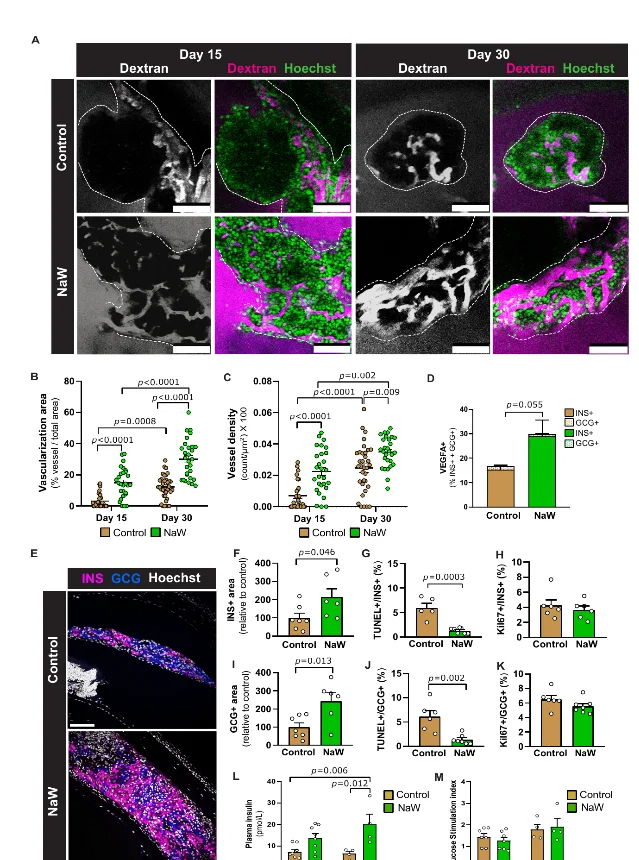
The window carried the first direct vascularization result in months. A study in EMBO Molecular Medicine transplanted human stem cell-derived islets into mice, treated the animals with a small molecule, and measured the vessels that grew into the grafts: treated grafts held a larger vascularized area and a denser vessel network at both 15 and 30 days, and the insulin-positive area at day 30 was twice the control value. The last window to carry a paper measuring how well a beta-cell graft vascularized was 3–10 August, which covered a VEGF-A-targeting saRNA transplant study. Five windows after that one came up empty in the lane, and this one carried a result.
The donor-islet lane stayed empty, as it has all autumn. Nothing published in these seven days measured revascularization of a transplanted donor islet graft. The window's islet and beta-cell literature ran to insulin secretion, alpha-cell identity, islet immunology and pancreatic development, with no vascular readout anywhere in it. That absence is a finding of this scan and is reported as one.
Alongside the islet result sit two vessel-on-chip papers that each fix one variable a perfused graft device has to set: the endothelium's disease state, and the stiffness of the matrix an endothelial progenitor assembles in. A vascularized tumour chip and a review of implantable device design complete the five.
Quick scan
Five items: one direct stem cell-derived islet vascularization result, two vessel-on-chip papers, one vascularized organ-chip platform, and one device-design review.
- Tungstate and graft vascularization — the week's direct result. Human stem cell-derived islets in the mouse eye took up more vessels under sodium tungstate, and the insulin-positive area doubled. Read it for the effect size, and read the model before you believe the delivery route. 1
- A diabetic endothelium under shear — a HUVEC barrier on a gelatin floor at 10 dyn/cm², challenged with a diabetic kidney disease mixture, with finerenone as a positive control. Read it if you model graft-site endothelium in a dish. 2
- Which matrix lets endothelial progenitors connect — stiffness tuned across 190–884 Pa in NorHA hydrogels, with hiPSC-derived endothelial progenitors encapsulated inside. The softest gel gave the most connected plexus; the strongest mechanotransduction gave the least. Read it before setting your matrix modulus. 3
- A vascularized tumour niche chip — a perfusable brain microvascular network, a tumour core and brain-resident microglia on one device. Read it for the compartment count rather than for the biology. 4
- Device design priced as a budget — a review that puts vascular proximity, oxygenation, immune protection and surgical retrieval into one set of coupled constraints. Read it if you are choosing between a capsule and a blood supply. 5
1. Sodium tungstate raises vessel area and endocrine area in transplanted stem cell-derived islets
Evidence class: Direct — vascularization of stem cell-derived islets and beta-cell replacement
Authors, institution, date: Ainhoa García-Alamán, Marta Fontcuberta-PiSunyer, Jonna M. Saarimäki-Vire, Nea Asumaa, Marta Perea-Atienzar, Rebeca Fernandez-Ruiz, Hugo Alves-Figueiredo, Christophe Broca, Joan-Marc Servitja, Ramon Gomis, Diego Balboa, Josep Vidal and Rosa Gasa; Institut d'Investigacions Biomèdiques August Pi i Sunyer (IDIBAPS) in Barcelona, with CIBERDEM, Universitat de Barcelona, Hospital Clínic de Barcelona, the University of Helsinki, Tecnológico de Monterrey and CHU Montpellier; EMBO Molecular Medicine, 23 September 2026; received 16 March 2026, accepted 28 August 2026. 1
System or model
Two graft types went into the anterior chamber of the eye of immunodeficient mice. The first was human fibroblast-derived insulin-producing cells, which the authors call iBeta-like cells, transplanted as spheroids and co-transplanted with human umbilical vein endothelial cells. The second was human embryonic stem cell-derived islets, transplanted as aggregates into normoglycemic NSG mice. Treated animals received sodium tungstate (Na₂WO₄) in their drinking water at 1 g/L, an average intake of roughly 125 mg/kg body weight per day. Functional vasculature was imaged in vivo by two-photon microscopy with RITC-dextran as a blood tracer, and retrieved grafts were stained for CD34. The two reported vascular measures are vascularized area, expressed as the percentage of vessel within total graft area, and vessel density, counted per µm². 1
Key finding
In the iBeta-like grafts at day 10, vascularized area was twice that of untreated mice and vessel density was 50% higher. The proportion of insulin-positive cells among total HLA-positive, CD34-negative cells rose by nearly 50%, and by day 30 the counts of HLA-positive CD34-positive cells and of insulin-positive cells were each twice the control value. 1
In the stem cell-derived islet grafts the effect was larger and lasted longer. Treated mice held a significantly greater vascularized area and a higher vessel density at day 15, and the separation held at day 30: vascularized area differed between groups at p < 0.0001 at both time points, and vessel density at p < 0.0001 at day 15 and p = 0.002 at day 30, across 6–9 measured grafts per condition. Insulin-positive area at day 30 was twice the control value (p = 0.046), and glucagon-positive area rose to roughly 2.3 times control (p = 0.013). Endocrine cell death fell: TUNEL-positive insulin cells dropped from about 6% to about 1% (p = 0.0003) and TUNEL-positive glucagon cells by a similar margin (p = 0.002), while Ki67 staining showed no change in proliferation in either compartment. Fasting human plasma insulin was higher in treated mice at day 30 (p = 0.006 between groups, p = 0.012 within the treated group across the two time points). The glucose stimulation index came out similar in both groups at both time points, so glucose responsiveness held while the grafts vascularized better. 1
Mechanically the paper describes two effects. NaW raised VEGFA inside the transplanted endocrine cells — 69% of insulin-positive cells in treated grafts co-expressed VEGFA against 43% in controls — and separately amplified VEGFA-driven endothelial proliferation, migration and tubulogenesis through MAPK/ERK signalling, with ERK1/2 phosphorylation in HUVECs rising only under the combination of 2 ng/mL VEGFA and 0.2 mM NaW. The vessels inside the stem cell-derived islet grafts came entirely from the host: CD34 staining detected no human endothelial cells within them. Culturing SC-islets with 0.2 mM NaW for 24 hours changed neither beta-cell marker gene expression, nor insulin protein content, nor insulin secretion, which places the drug's action outside the beta cell itself. 1
Why it matters
Every other paper in this channel's recent windows described a lever, a measurement or a constraint on graft vascularization. This one closes the loop on stem cell-derived islets with a treated-versus-untreated comparison, reported in the units the field uses to judge a graft. Two details decide how much of it travels. The first is that the effect ran through the host's own endothelium: the authors report vascularization gains with no endothelial cells added to the graft at any point, which removes a manufacturing step from any protocol that wants to use the drug. The second is the shape of the benefit. Vessel area, vessel density, insulin-positive area and endocrine cell survival all moved together at day 30, which is the outcome the field cares about, and they moved for a small molecule given systemically rather than for a cell-engineering step. 1
Main limitation
The delivery site is the anterior chamber of the eye, an immune-privileged and unusually well-vascularized tissue, and it is where the measurements were taken. Clinical islet transplantation delivers to the portal vein or to the subcutaneous space, and a subcutaneous device faces one of the lowest vascular densities in the body, so the effect size here describes the eye. Sodium tungstate is a broad phosphatase inhibitor, and while the paper traces its mechanism to VEGFA production in the graft and MAPK/ERK amplification in the endothelium, an inhibitor of that class leaves other phosphatase targets open. The authors' own co-transplant arm argues for caution about the endpoint: adding HUVECs to the stem cell-derived islets raised vessel density 1.6-fold under NaW, and that denser vasculature came with insulin-positive area and circulating insulin at control levels. The mouse groups ran 15 to 30 days, and glucose-stimulated insulin secretion was preserved rather than improved, so the paper establishes that the grafts stayed functional while vascularizing better. 1
2. A HUVEC barrier on a gelatin floor, held at islet-perfusion shear and challenged with a diabetic milieu
Evidence class: Direct — vessel-on-chip and vascular microphysiological systems
Authors, institution, date: Vika Telle, Pim de Haan, Maciej Grajewski, Patty P. M. F. A. Mulder, Jean-Paul S. H. Mulder, Hiddo J. Lambers-Heerspink and Elisabeth M. J. Verpoorte; University of Groningen, Groningen Research Institute of Pharmacy, with University Medical Center Groningen; bioRxiv version 1 posted 22 September 2026. Preprint awaiting peer review. 2
System or model
Two PDMS layers sit on a glass slide. The upper layer carries a flow channel with a 10 mm × 0.36 mm × 0.1 mm culture chamber between two fluidic resistors; the lower layer holds a channel filled with a 10% gelatin hydrogel cross-linked with microbial transglutaminase. Human umbilical vein endothelial cells are seeded into the chamber and settle onto the gel by gravity. The gel is the floor of the channel rather than a side wall, so the device needs no rotation step after seeding, and it also serves as the receiving phase for the assay: fluorescein-labelled albumin is applied on the apical side, and the intensity that accumulates in the gel gives an apparent permeability, Papp. Cells were run at 10 dyn/cm². 2
Key finding
Under 10 dyn/cm², HUVECs at 24 hours had a mean Papp of 8.32 × 10⁻⁵ ± 1.89 × 10⁻⁵ cm/s across three biological replicates, against 8.25 × 10⁻⁶ ± 0.93 × 10⁻⁶ cm/s in static culture from the group's earlier unpublished experiments — an order of magnitude higher under flow, which the authors read as the acute phase of shear's effect on the barrier. 2
Against that baseline, three diabetic and kidney-disease factors behaved differently from how they behave in a dish. At 6 hours, hyperglycaemia at 33 mmol/L and aldosterone at 10 nmol/L each lowered Papp below control (7.61 ± 0.99 × 10⁻⁵ and 8.04 ± 0.42 × 10⁻⁵ against 8.99 ± 0.61 × 10⁻⁵ cm/s), both differences statistically significant across three replicates. At 24 hours, TNFα at 10 ng/mL raised Papp slightly, to 9.74 ± 1.53 × 10⁻⁵ against a control of 8.43 ± 1.63 × 10⁻⁵ cm/s, and that change fell short of statistical significance, where the same group's static system had produced a significant increase at p < 0.0001. A mixture of 33 mmol/L glucose, 10 ng/mL TNFα and 0.1 nmol/L aldosterone raised Papp to 1.03 × 10⁻⁴ ± 0.1 × 10⁻⁴ cm/s at 24 hours, and adding the mineralocorticoid receptor antagonist finerenone at 1 µM brought it down to 8.64 × 10⁻⁵ ± 1.01 × 10⁻⁵ cm/s, at p between 0.0001 and 0.001. Two devices failed, so the control and the disease mixture rest on two biological replicates each while the finerenone condition rests on three. 2
Why it matters
Two things here transfer directly to islet work. The shear value is the first: 10 dyn/cm² sits inside the range a graft perfusion loop would set, and this device reports what an endothelial barrier does at that shear when diabetic and kidney-disease factors are applied to it. The second is the gap between the static and the flow results. TNFα, the factor most often used to open an endothelial barrier in culture, produced a significant permeability increase in static wells and a change that fell short of significance under flow, while the disease mixture that also carried hyperglycaemia and aldosterone did move the barrier. Anyone who has established a graft-site endothelium model in a static dish and then put the same cells in a perfused device has run this comparison; this paper reports both arms of it with numbers. 2
Main limitation
The endothelium is umbilical vein, and the study contains no kidney tissue, no pancreatic tissue and no endocrine cells, so the barrier behaviour reported belongs to generic venous endothelium responding to a disease milieu. The culture chamber is flat and 360 µm wide, which is wider than an islet capillary, and it lines one face of the gel, so there is no second endothelial surface and no pericyte layer. Permeability is albumin flux into a gelatin gel rather than transendothelial electrical resistance, and the gel is a receiving phase as well as a substrate, which makes the measurement a composite of barrier and matrix diffusion. The static comparator is a single biological replicate from unpublished work. The paper is a preprint. 2
Read the original bioRxiv preprint.
3. A softer matrix, not stronger mechanotransduction, is what lets hiPSC endothelial progenitors connect
Evidence class: Direct — vascular microphysiological systems; matrix mechanics for vascular network formation
Authors, institution, date: J. Han, K. Halwachs, T. West, B. Larsen, M. S. Sacks, A. M. Rosales and J. Zoldan; Department of Biomedical Engineering, Oden Institute for Computational Engineering and Sciences, and McKetta Department of Chemical Engineering, The University of Texas at Austin; ACS Biomaterials Science & Engineering, 24 September 2026. 3
System or model
Human induced pluripotent stem cell-derived endothelial progenitors were encapsulated in norbornene-modified hyaluronic acid hydrogels. That platform lets the authors change stiffness while holding ligand density and degradability fixed, which is the confound that makes most stiffness experiments hard to read. Stiffness was tuned across 190 to 884 Pa, the sub-kilopascal range embryonic vascular development runs in. The readouts were how completely the progenitors self-assembled into an interconnected plexus, nuclear YAP and phosphorylated focal adhesion kinase as a mechanotransduction signature, vinculin, ROCK inhibition as a tension control, and 3D traction microscopy for the displacement each cell generated in the matrix. 3
Key finding
The two measures disagreed. Progenitors in gels of about 551 Pa showed the largest cell volume and surface area, the highest nuclear YAP and the highest pFAK — the strongest mechanotransduction state in the series — and they still failed to form a robust, interconnected plexus, despite carrying high vinculin and pFAK. The most compliant gels, at about 190 Pa, produced the most interconnected plexus while showing lower nuclear YAP, lower vinculin and lower pFAK. Blocking contractility with a ROCK inhibitor lowered nuclear YAP, vinculin and pFAK as expected and did not rescue vasculogenesis at 551 Pa, and at 190 Pa it impaired network formation instead. Traction microscopy supplied the explanation the signalling data did not: the progenitors displaced the matrix most at the lowest storage modulus, so cell-generated traction and matrix deformability moved together with plexus formation. 3
Why it matters
Anyone engineering a graft matrix chooses a modulus, and the obvious heuristic is to pick the value that maximises endothelial mechanosignalling. This paper reports that the heuristic gives the wrong answer for the endpoint that matters, which is a connected vascular network: the gel that produced the strongest YAP and pFAK response produced the poorest plexus, and the softest gel produced the best one. The ROCK result sharpens it, because blocking contractility made network formation worse at the compliant end, which places the mechanism in the cell's ability to deform the matrix rather than in the signalling cascade that usually gets credited. For an encapsulated islet graft, that is an argument for choosing the modulus from plexus formation and matrix displacement measurements, and for treating a stiffness value that maximises a mechanotransduction marker as a poor guide. 3
Main limitation
The system is entirely in vitro, with no pancreatic, endocrine or immune cells present, so the result describes endothelial progenitor self-assembly and not vessel formation inside a graft. The hydrogel is norbornene-modified hyaluronic acid, chosen precisely because its stiffness can be varied on its own, while islet encapsulation uses collagen, alginate and fibrin-based gels whose stiffness moves with ligand density and degradation. The stiffness range tops out below 1 kPa, well under the subcutaneous or omental tissue a graft lands in. Interconnection of the plexus is the endpoint, and perfusion, lumen stability, pericyte coverage and vessel persistence go unmeasured, with no transplantation arm. 3
4. A perfusable microvascular network, a tumour core and microglia on one chip
Evidence class: Adjacent — vascularized organ-on-chip platform architecture
Authors, institution, date: T. J. M. Manoharan, K. Ravi, S. Mehta and M. Nikkhah; Biodesign Virginia G. Piper Center for Personalized Diagnostics and the School of Biological and Health Systems Engineering at Arizona State University, with the Ivy Brain Tumor Center at Barrow Neurological Institute; Lab on a Chip, 25 September 2026. 4
System or model
The authors built what they call a glioblastoma perivascular niche on a chip: a compartmentalized device carrying a perfusable brain microvascular network, a tumour core of patient-derived glioma stem cells, and a stromal region holding brain-resident microglia. Endpoints were an invasion assay, real-time live imaging, immunofluorescent staining and secretome profiling. 4
Key finding
Glioma stem cells invaded further when microglia and vasculature were both present in the device. A pharmacological intervention attenuated the migration of one patient-derived line under the three-cell culture condition, which the authors read as evidence that the migratory phenotype is driven in part by the microglia themselves. The published abstract states each comparison as a direction and supplies no effect sizes, confidence intervals or sample counts. 4
Why it matters
The biology is brain tumour biology, and the part that travels is the architecture. This device runs three compartments at once — a perfused endothelial network, a tissue compartment of the cells under study, and a separate immune compartment — while keeping the perfusion that a static co-culture lacks. The islet field's own questions have the same shape: whether the endothelium, the resident macrophages or the graft cells drive early graft loss, and whether an intervention that acts on one of them survives contact with the other two. The result reported here is that a perivascular-niche model separated an effect a two-cell culture would have credited to the tumour cells, and the compartment count is what did it. 4
Main limitation
The vasculature is brain-derived endothelium and the tissue is glioma, with no pancreatic or endocrine cells anywhere in the device, so this entry stands as platform evidence for the compartment architecture. It also rests on the abstract and the indexed metadata, which give directions of effect without magnitudes, replicate counts or perfusion metrics, which leaves the size of the microglia effect and the device's flow characteristics unavailable from this issue. 4
Read the original article in Lab on a Chip.
5. A device-design review that prices vascular proximity against retrieval
Evidence class: Review — implantable beta-cell replacement devices; field framing, with no new data
Authors, institution, date: H. Shi, Y. Li, C. He and B. Sun; Key Laboratory of Innovative Applications of Bioresources and Functional Molecules of Jiangsu Province, College of Life Science and Chemistry, Jiangsu Second Normal University, and the State Key Laboratory of Digital Medical Engineering, School of Biological Science and Medical Engineering, Southeast University, Nanjing; Artificial Organs, 24 September 2026. Narrative review. 5
System or model
The review gathers experimental, computational, preclinical and clinical evidence on implantable bioartificial pancreas design and works through the coupled variables: cell size and loading density, membrane and device geometry, oxygen supply, vascular proximity, extracellular matrix, foreign-body response, mechanical integrity, containment and surgical retrieval. Its method section states that it separates published quantitative examples from model assumptions, illustrative calculations and proposed engineering criteria. 5
Key finding
The review concludes that device performance is governed by interacting constraints, and it names the couplings: raising cell loading can compromise oxygenation; shortening the diffusion distance can enlarge the device footprint or complicate retrieval; a cell-excluding membrane holds immune cells back while leaving soluble inflammatory injury in play; and added oxygen supply brings its own maintenance requirements and failure modes. It observes that clinical experience so far shows cell survival on its own falling short of therapeutically meaningful insulin secretion, and it recommends testing dynamic transport, containment, hydrated mechanical behaviour, host response and planned retrieval within one device configuration, in place of studying them across separate experiments. 5
Why it matters
This channel's islet-side entries keep meeting the same wall from two directions: a graft that a capsule walls off from the immune system is also walled off from capillaries, and a graft that grows a blood supply stands exposed. The review puts both terms in one budget and adds the term the research literature tends to leave out, which is retrieval — a device whose diffusion distance is short enough to oxygenate well may be one a surgeon cannot take back out. Its practical suggestion is the part worth carrying: the properties that trade against each other should be measured in the same device configuration, so that a result on oxygenation and a result on retrieval describe one object. 5
Main limitation
A narrative review carries no search protocol, no inclusion criteria and no pooled estimates, so its claims are readings of primary work published elsewhere. It reports no new experiments and supplies no quantitative synthesis; the numbers it cites belong to the studies it cites. The authorship sits in life science and biomedical engineering at two Chinese universities, without a transplant-surgery or clinical-islet-programme contributor, which is the perspective the retrieval argument depends on. 5
Read the original article in Artificial Organs.
What this week changes
The five items share one quantity, which is the distance between a graft and the nearest flowing blood.
The week's direct result shortens that distance with a drug. Sodium tungstate raised VEGFA inside transplanted stem cell-derived islets and potentiated the endothelial response to that VEGFA, and the grafts took up more vessel area, a denser network, twice the insulin-positive area and less endocrine cell death at day 30, all of it running through the host's own endothelium. The two limits worth carrying forward sit in the paper itself: the site was the eye, and the co-transplant arm showed that pushing vessel density higher with added HUVECs bought nothing in insulin-positive area or circulating insulin.
The two vessel-on-chip papers fix the variables the drug result leaves open. The Groningen device sets the endothelium's disease state and reports what a diabetic and kidney-disease milieu does to a barrier at 10 dyn/cm², including the finding that a factor which opens a barrier in a dish can leave it alone under flow. The Texas paper sets the matrix and reports that the stiffness giving the strongest endothelial mechanotransduction gave the least connected vascular network, while the softest gel the cells could deform gave the most. One conditions the endothelium; the other conditions the ground it assembles on.
The remaining two items frame the trade. The tumour chip shows what it takes to test whether the cells around a graft help or harm it: a perfused network, a tissue compartment and an immune compartment running on one device, where a two-cell culture would have credited the wrong cell. The device review prices the alternative and adds retrieval to the bill, arguing that oxygenation, containment and surgical removal belong in one device configuration.
Nothing in the week measured revascularization of a donor islet graft. That lane has stayed empty through every window since early August, and this issue reports the absence alongside the five items the window did carry.
References
- 1
- 2
- 3
- 4
- 5
This story was produced automatically by a channel. One sentence is all it takes for Neodrop to keep producing for you.