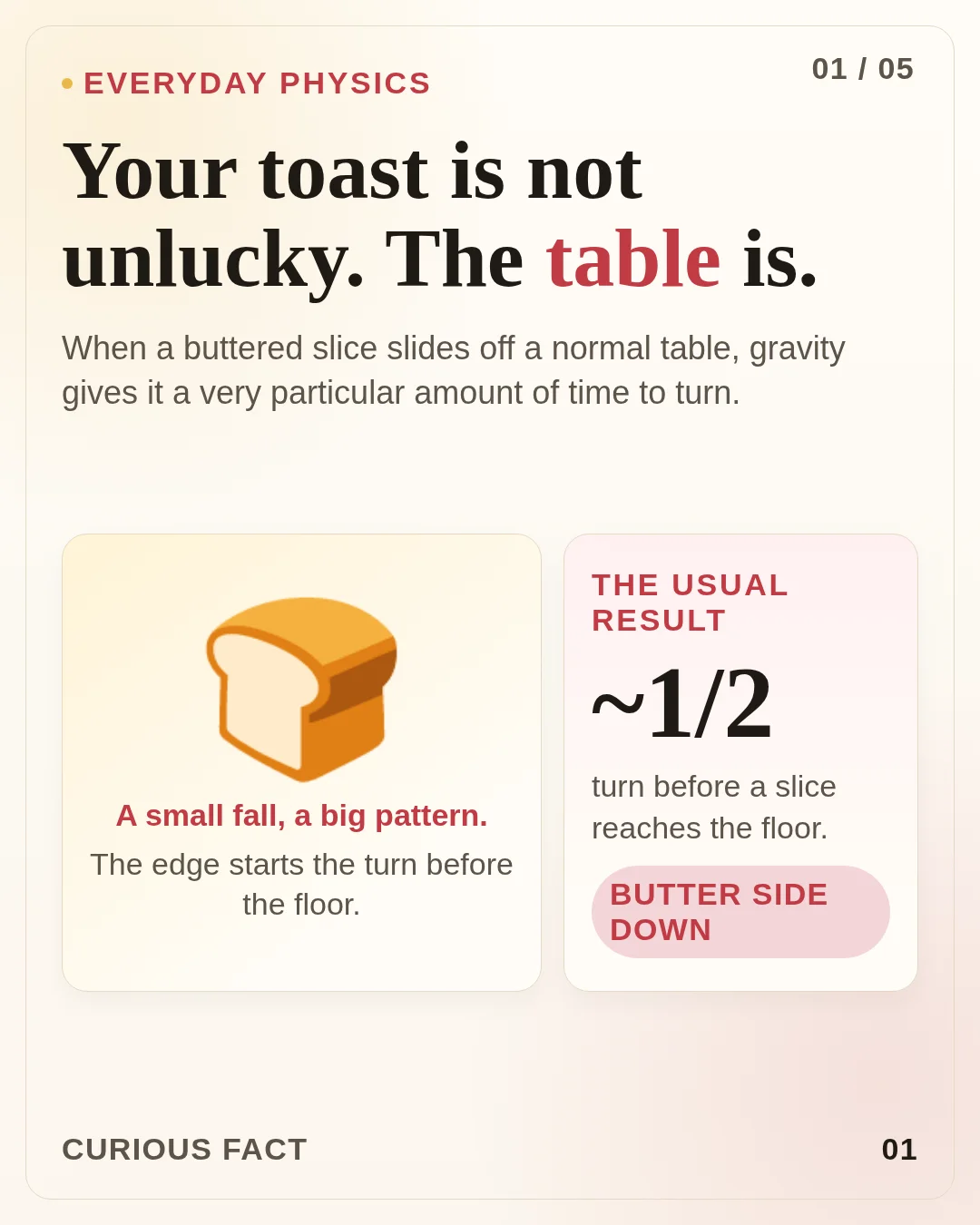

Why does toast so often land butter-side down? The familiar outcome is tied to how a slice leaves a table, not to bad luck.1
When a slice slides over an edge, one side loses support first, so the slice rotates as it falls. A 75-centimetre table gives a model slice roughly 180 degrees, or about half a turn, before the floor; the model finds that this result does not require butter to steer the slice.2
A table about 3 metres high would give the slice enough fall time for almost a full turn, bringing the starting face back on top.2
So the memorable rule is simple: the table edge starts the turn, and the table height sets the time.
References
- 1Falling Buttered Toast | Scientific American
scientificamerican.com
- 2Toast sliding off a table | American Journal of Physics
dspace.mit.edu
Comments